Fitter and Turner Visa Pathway to Australia: Complete 2026 Guide
Updated: 16 August 2026
Australia classifies Fitter and Turner under ANZSCO 323212. Trades Recognition Australia handles the skills assessment, with most offshore applicants required to complete the Job Ready Program. The occupation sits on both the MLTSSL and the Core Skills Occupation List, unlocking subclasses 189, 190, 491, 482, and 186. Typical 2026 salaries range AUD $75,000-$132,000, with Sydney and Canberra at the top end and resources-sector turners reaching well beyond.
Quick Facts: Fitter and Turner Migration Pathway
| Detail | Information |
|---|---|
| ANZSCO Code | 323212 (Fitter and Turner) |
| Skill Level | 3 (AQF Certificate III or IV) |
| Skills Assessment | TRA (Trades Recognition Australia) via Job Ready Program |
| Occupation List | CSOL and MLTSSL |
| Visa Options | 189, 190, 491, 482, 186 |
| Demand Level | High — listed on the 2025 Occupation Shortage List; metal trades fill rates below 55% |
| Salary Range | AUD $75,000-$132,000 (SEEK Salary Hub, 2026) |
| Typical 189 Score | 65-75 points |
| Key Challenge | Demonstrating genuine turning experience separate from general fitting |
What a Fitter and Turner Does in Australia
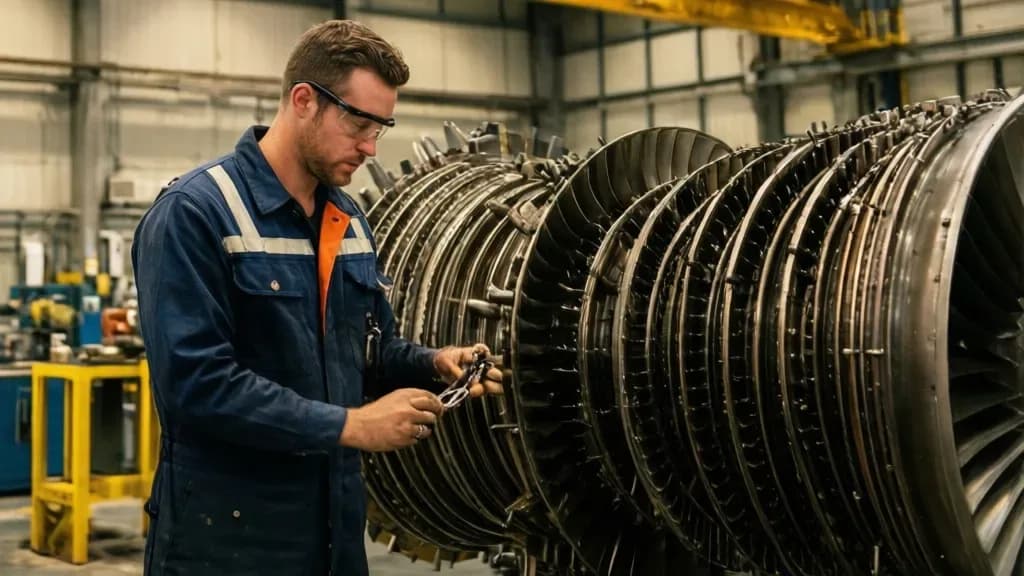
Fitter and turners produce precision-machined metal components, fit and assemble them into mechanical systems, and maintain the equipment that keeps Australian manufacturing, mining, and infrastructure running. The hallmark of the trade is the centre lathe — turners produce shafts, bushings, pulleys, threaded components, and bespoke parts to engineering tolerances that off-the-shelf suppliers cannot meet.
Work concentrates in toolrooms, machine shops, mine maintenance workshops, defence sustainment sites, and the engineering departments of large manufacturers. Real employers include the Adelaide-based ASC submarine sustainment program, BAE Systems in Williamtown and Osborne, Visy in Tumut and Coolaroo, BlueScope in Port Kembla, and hundreds of mid-sized engineering shops servicing mining contractors in Mackay, Karratha, and Kalgoorlie.
Jobs and Skills Australia flagged metal trades on the Priority List in 2025, citing 54.3% fill rates for Skill Level 3 trades nationally. The shortage is structural — Australian apprenticeship intakes have not kept pace with retirement attrition since the early 2010s. Regional employers carry the worst undersupply and are most likely to sponsor offshore.
ANZSCO Code 323212 — Fitter and Turner
The 323212 code applies to fitters whose work routinely combines mechanical fitting and assembly with centre-lathe turning and related machining operations. TRA expects employment references to describe both activities — fitters who only assemble and do not turn should look at 323211 Fitter (General), and those whose work is dominated by precision machining without fitting should consider 323214 Metal Machinist (First Class).
Core duties for 323212 include:
- Studying engineering drawings and specifications
- Operating centre lathes to produce machined components
- Marking off and cutting metal stock
- Fitting and assembling parts into mechanical equipment
- Setting up production machines and tooling
- Dismantling, repairing, and reassembling faulty plant
If your work also involves significant welding, the better code is 323213 Fitter-Welder. Code mismatches are the leading cause of TRA rejection — pick the one your employment references can substantiate.
Skills Assessment — Trades Recognition Australia
TRA assesses 323212 through three possible programs.
Job Ready Program (JRP) — the standard offshore pathway
Almost all offshore-trained fitter and turners must complete the JRP. The program has four sequential steps:
- Provisional Skills Assessment (PSA) — verifies qualification and recent employment (12 months in the previous three years)
- Job Ready Employment (JRE) — registration to commence 1,725 paid hours of Australian employment
- Job Ready Workplace Assessment (JRWA) — onsite practical assessment by a TRA assessor
- Job Ready Final Assessment (JRFA) — the outcome document for visa lodgement
Combined cost across all four steps: AUD $3,000-$3,500 Total duration: 12-18 months minimum (the 1,725 hours alone take roughly 12 months at 38 hours per week) Required qualification: AQF Certificate III in Engineering — Mechanical Trade or comparable overseas equivalent, plus current skills evidenced through 12 months recent employment
The JRWA is where most failures occur. Assessors observe the candidate at work and check that duties match 323212. If the Australian sponsoring employer has placed the candidate in a role dominated by welding or assembly only, the assessment fails. Pick an Australian role that includes routine lathe work before signing the employment contract.
Migration Skills Assessment (MSA) — Australian-qualified only
The MSA is faster and document-only, but is available only to applicants who completed their qualification in Australia (typically an Australian apprenticeship) or hold qualifications recognised under a bilateral arrangement. Most offshore-trained turners do not qualify for MSA.
Offshore Skills Assessment Program (OSAP) — limited
OSAP provides paper-based recognition for applicants from select countries with mutual recognition arrangements. It functions as a preliminary check rather than a full migration assessment. Confirm OSAP eligibility for your qualification before relying on it.
Visa Pathways for Fitter and Turners
Subclass 482 — Skills in Demand
For most offshore turners, the 482 is the practical first move because it pairs with the JRP work-hours requirement. A sponsoring employer engages you, you complete the 1,725 hours, sit the JRWA, and the JRFA outcome supports a subsequent permanent visa.
- Visa fee: AUD $4,015 (primary applicant)
- Core Skills Income Threshold (CSIT): AUD $76,515 (FY2025-26), increasing to AUD $79,423 from 1 July 2026
- Duration: Up to 4 years
- Stream: Core Skills (323212 is on the Core Skills Occupation List)
Subclass 186 — Employer Nomination Scheme
The PR destination for sponsored turners. The Direct Entry stream is available with a positive TRA outcome; the Temporary Residence Transition (TRT) stream requires two years with the sponsoring employer on a 482.
- Visa fee: AUD $6,140 (primary applicant)
- Streams: Direct Entry or TRT
- Reality: TRT is the path most 482-holders use to reach PR
Subclass 491 — Skilled Work Regional
A 5-year provisional regional visa carrying a 15-point boost. The most realistic points-based pathway for trades in 2026 given that 189 invitation rounds remain ICT- and healthcare-heavy.
- Visa fee: AUD $6,140 (primary applicant)
- Living obligation: 3 years in a regional area before applying for 191 PR
- Quirk: Many turning roles in Queensland, WA, and South Australia are already regional, making the obligation a non-issue
Subclass 190 — Skilled Nominated
State-sponsored permanent residency. NSW, Victoria, Queensland, and South Australia all nominate 323212 in their 2025-26 programs.
- Visa fee: AUD $6,140 (primary applicant)
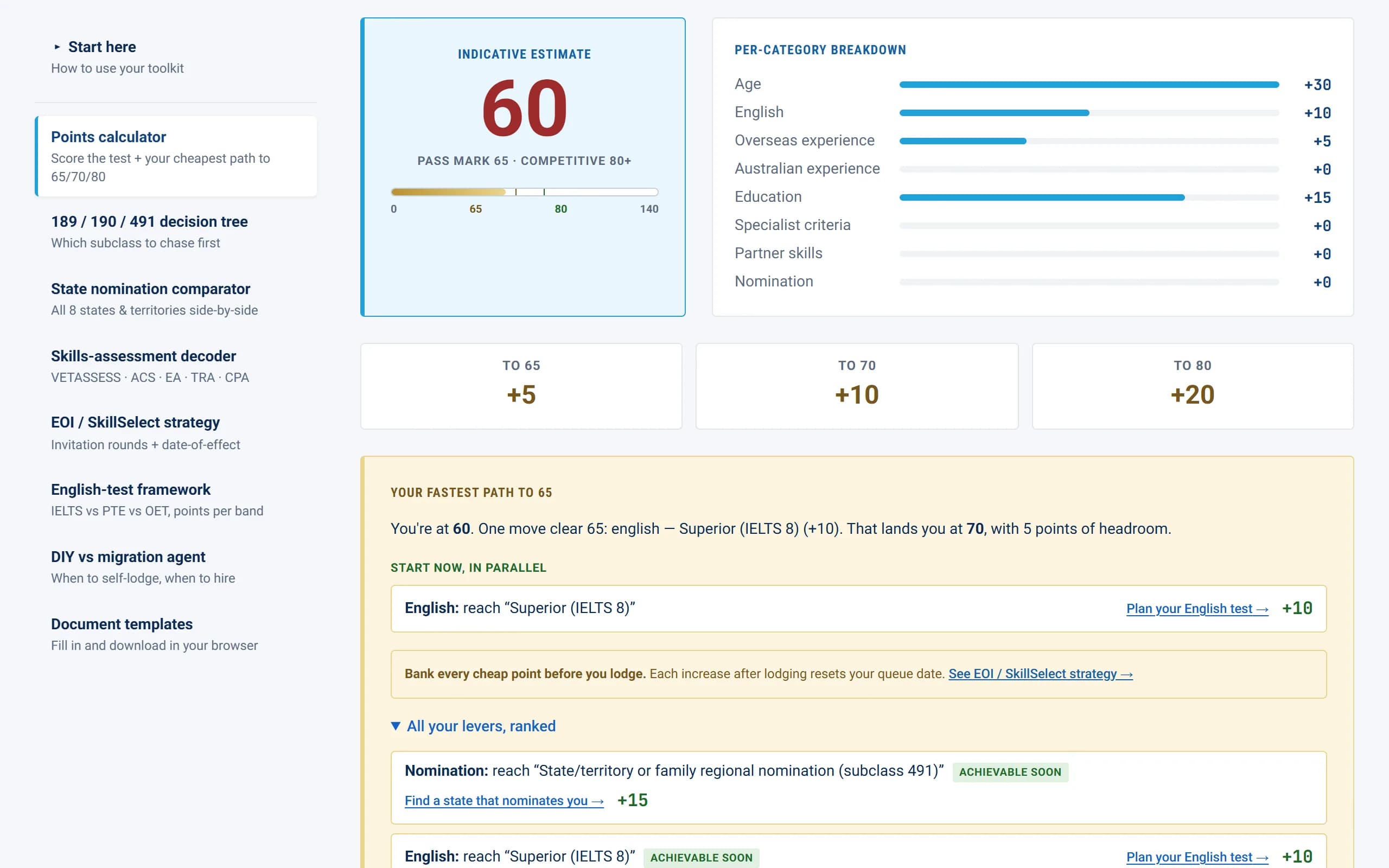
- Points boost: +5 from state nomination
- Live-in obligation: 2 years in the nominating state
Subclass 189 — Skilled Independent
Trade occupations face fewer competitors than ICT in 189 ballots, but invitation rounds since late 2024 have been heavily skewed toward healthcare. Lodge an EOI for 189 in parallel with 491/190, but plan on the sponsored or regional pathway as the realistic route.
- Visa fee: AUD $6,135 (primary applicant)
- Minimum points: 65 (realistic invitations 75+)
Points Test Strategy
| Points Factor | Points | Notes |
|---|---|---|
| Age (25-32) | 30 | Maximum |
| Age (33-39) | 25 | Strong |
| English (Proficient — IELTS 7) | 10 | Standard target |
| English (Superior — IELTS 8) | 20 | High-impact boost |
| Skilled Employment (5-7 yrs overseas) | 10 | Typical for experienced turners |
| Skilled Employment (8+ yrs overseas) | 15 | Common in this trade |
| Australian Skilled Employment (1-2 yrs) | 5 | Relevant once on 482 |
| Qualification (AQF Cert III/IV equivalent) | 10 | Standard for TRA-eligible applicants |
| State Nomination (190) | 5 | All four major states nominate 323212 |
| Regional Nomination (491) | 15 | Dominant trade booster |
| Partner Skills | 5-10 | If partner holds a CSOL occupation |
Realistic Scenarios
Scenario 1 — Offshore turner, 28 years old, IELTS 6, 9 years experience
Age 30 + English 0 + Experience 15 + Qualification 10 = 55 points. Either improve English to Proficient (+10) for 65 total, or pursue 491 regional nomination (+15) for 70.
Scenario 2 — Onshore turner on 482 in regional Queensland, 31 years old, IELTS 7, 7 years overseas plus 2 years Australian
Age 30 + English 10 + Overseas 10 + Australian 5 + Qualification 10 + 491 Regional 15 = 80 points. Strongly competitive.
State Nomination
New South Wales
NSW nominates 323212 for both 190 and 491. Demand concentrates in Western Sydney precision-engineering firms and the Hunter Valley mining-services sector. NSW typically requires three years of skilled employment in the nominated occupation and prefers candidates with a current NSW job offer or strong genuine intent to settle.
Victoria
Victoria's 2025-26 program nominates fitters, turners, and fitter-welders. The state has 2,700 places allocated to 190 and 700 to 491. Manufacturing demand sits across Melbourne's western and northern industrial corridors and around Geelong's defence-adjacent sector. Victoria prefers three years of recent post-qualification experience and either current Victorian employment or evidence of genuine intent.
Queensland
Migration Queensland flags trades as a priority for 2025-26. Demand for turners is heaviest in resources-sector workshops in Mackay, Gladstone, and Townsville, and in Brisbane's southern industrial belt. Queensland generally requires a current Queensland job offer for 190 nomination; the 491 pathway is more accessible from offshore.
South Australia
South Australia allocates 3,000 places to 190 and 800 to 491 in 2025-26, with trades flagged as priority and reduced English thresholds for occupations in shortage. ASC and BAE submarine and frigate programs drive significant demand for precision turners in Adelaide. SA requires three years of skilled employment in the previous five years.
Salary and Employment Outlook
What Fitter and Turners Earn
| Role / Location | Typical Salary Range (AUD) |
|---|---|
| Entry-level Turner (Cert III, 0-2 yrs) | $65,000-$80,000 |
| Experienced Fitter and Turner (5+ yrs) | $85,000-$105,000 |
| Toolroom Turner (precision) | $90,000-$120,000 |
| Mining-sector Turner (FIFO) | $120,000-$170,000 |
| Defence/Shipbuilding Turner (Adelaide) | $95,000-$130,000 |
| Senior Maintenance Turner | $110,000-$140,000 |
Source: SEEK Salary Hub 2026, Hays Salary Guide 2026. Sydney averages AUD $132,500, with Canberra and Hobart following at AUD $125,143 and AUD $125,000 respectively. National average sits around AUD $82,303 per year (Jooble 2026 aggregate). PayScale data shows an average hourly rate of AUD $39.93 in 2026.
Total packages typically include superannuation at 11.5%, overtime (penalty rates of 1.5x-2.5x), site allowances for remote work, and FIFO travel benefits where applicable.
Highest-Paying Sectors
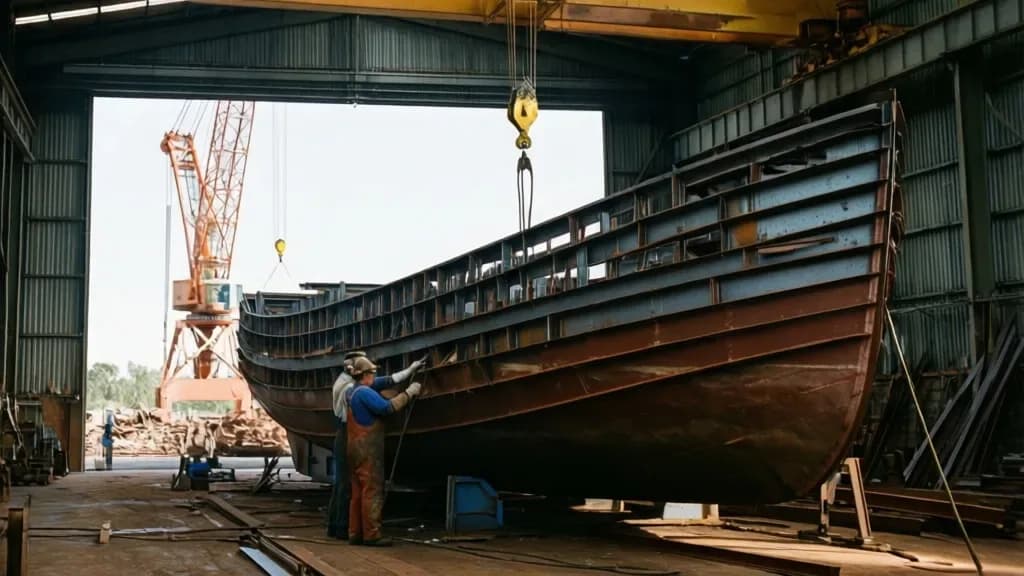
- Defence and shipbuilding — submarines, frigates, naval sustainment in Adelaide and Henderson WA
- Mining and resources — fixed-plant maintenance in the Pilbara, Bowen Basin, Hunter Valley
- Aerospace — defence aviation maintenance, civil airline engineering
- Heavy manufacturing — steel processing, automotive components, agricultural equipment
- Toolmaking and precision engineering — high-tolerance contract machining
Tips for a Successful Application
1. Make sure your employment references describe turning work explicitly
The single biggest difference between 323212 and 323211 is the lathe. References that only mention "fitting and mechanical assembly" steer TRA toward the general code. References that describe "operated centre lathes, produced machined shafts and bushings to engineering tolerances, set up tooling for turning operations" support 323212 cleanly.
2. Negotiate JRP-suitable duties at your Australian workplace
When agreeing the position description on a 482, ensure routine lathe work is in writing. JRWA failures most often come from Australian roles that drifted into all-assembly or all-welding because the workshop priorities changed. Confirm with the employer that you will be on the lathe regularly.
3. Allow 14-18 months for the full JRP timeline
The 1,725 paid hours alone take 11-12 months at standard hours. Add PSA (4-8 weeks), JRWA scheduling (1-3 months), and JRFA (4-8 weeks). Plan migration timing on 18 months between PSA submission and visa-ready outcome.
4. Target South Australian sponsorship if defence work suits your background
The Adelaide defence shipbuilding programs are running for decades and pay competitively. SA's nomination program is also among the more accessible in the country, and the state has reduced English thresholds for some occupations in shortage. ASC, BAE, Naval Group, and their tier-2 suppliers all sponsor offshore turners.
5. Sit IELTS or PTE before the skills assessment
A Proficient result (IELTS 7 / PTE 65) unlocks state nomination options that are closed at Competent level, and adds 10 points to the points test. Most state nomination programs also score English in their internal ranking.
Step-by-Step Migration Roadmap
- Confirm 323212 is the right code — review duties against the ANZSCO code finder
- Check the occupation list — confirm 323212 on the CSOL and SOL 2026
- Sit IELTS or PTE — Proficient (7.0) minimum
- Lodge the TRA Provisional Skills Assessment — AUD $300
- Secure a sponsoring Australian employer with genuine turning work — direct outreach to defence, mining-services, and toolroom employers
- Apply for a subclass 482 visa — AUD $4,015
- Register with TRA for Job Ready Employment — AUD $490
- Complete 1,725 paid hours of fitter-and-turner work — approximately 12 months
- Sit the JRWA — onsite assessment by a qualified TRA assessor
- Receive Job Ready Final Assessment — the positive outcome for visa purposes
- Apply for 186 (TRT) or 190 / 491 — AUD $6,140
- Receive PR grant — relocate or remain per state obligations
Frequently Asked Questions
What separates Fitter and Turner from Fitter (General) for migration?
323212 requires routine lathe and turning work as part of the daily role. 323211 covers fitting without a turning specialism. TRA assessors check that employment references explicitly describe machining on centre lathes. If your work has included turning for years but the references are written in general terms, get them rewritten before lodging — the difference is the difference between a positive and a negative assessment.
Can I claim work as a Fitter and Turner if my qualification is in mechanical engineering, not trades?
Engineering degrees do not substitute for a trade qualification in the TRA framework. The 323212 pathway requires either an AQF Certificate III in Engineering — Mechanical Trade, a comparable overseas trade qualification, or three years of full-time equivalent post-qualification experience plus current skills. A bachelor's degree in mechanical engineering is generally assessed differently and points toward the Engineers Australia pathway, not TRA.
How does the 482 visa work for fitter and turners under the 2026 rules?
323212 is on the Core Skills Occupation List, so the standard Core Skills stream applies. The Core Skills Income Threshold is AUD $79,423 from 1 July 2026 (AUD $76,515 in 2025-26). Most turner roles in mining, defence, and precision engineering clear that threshold comfortably. Roles in lower-paying sectors may struggle to meet CSIT and need to be lifted to threshold to qualify.
Is South Australia really the easiest state for fitter and turners?
It depends on definition. SA has the largest per-capita 190 and 491 allocation, accessible English settings for shortage occupations, and concentrated defence demand that genuinely needs turners. But SA's nomination programs still require evidence of intent to settle in SA, and competition for the publicised places is real. The honest answer is that SA is among the more accessible states for trades, but not a free pass.
What if I run out of time on my 482 before completing the Job Ready Program?
The 482 lasts up to 4 years, which is significantly longer than the JRP typically takes. If your JRP hours are not yet complete when the 482 expires, a 482 renewal with the same employer is usually straightforward. The bigger risk is the 1,725 hours being interrupted by job changes — switching employers during the JRP usually means restarting parts of the program.
Are turning roles really shrinking due to CNC machining?
Manual lathe work has declined, but CNC turning still falls within the 323212 scope. TRA recognises CNC operation and programming as part of modern turning practice. The shortage in Australia is across both manual and CNC turners. The strongest candidates are those who can demonstrate proficiency in both, since many Australian shops still run hybrid manual-and-CNC operations for prototype and low-volume work.