Land Economist Visa Pathway to Australia: Complete 2026 Guide
Updated: 16 August 2026
Australia classifies Land Economist under ANZSCO 224511. VETASSESS conducts the skills assessment. The occupation sits on both the Core Skills Occupation List (CSOL) and the Medium and Long-term Strategic Skills List (MLTSSL), unlocking subclasses 189, 190, 491, 482, and 186. Typical 2026 salaries range AUD $95,000-$170,000. Sydney and Melbourne dominate hiring through major property developers, REITs, and government land agencies.
Quick Facts: Land Economist Migration Pathway
| Detail | Information |
|---|---|
| ANZSCO Code | 224511 (Land Economist) |
| Skill Level | 1 (Bachelor degree or higher, AQF Level 7+) |
| Skills Assessment | VETASSESS (Vocational Education and Training Assessment Services) |
| Occupation List | CSOL and MLTSSL |
| Visa Options | 189, 190, 491, 482, 186 |
| Demand Level | Moderate — steady demand tied to property cycles and infrastructure investment |
| Salary Range | AUD $95,000-$170,000 (SEEK, Glassdoor 2026) |
| Typical 189 Score | 80-90 points (competitive but less crowded than ICT) |
| Key Challenge | Narrow ANZSCO definition — valuation, town planning, and property management work does not count |
What Land Economists Actually Do in Australia
Land economists advise on the commercial use, administration, and financial performance of land and property. In practice, that means feasibility studies for new developments, highest-and-best-use analysis for vacant sites, lease strategy for commercial portfolios, and policy work on land tax and zoning. The work sits between economics, finance, and property — closer to a property economist or development manager than a valuer or urban planner.
Demand concentrates in three places. First, the big four banks and non-bank lenders use land economists for development finance origination. Second, REITs (Goodman, Charter Hall, Dexus, GPT, Stockland) employ land economists across acquisition, leasing strategy, and portfolio analysis. Third, state and territory land agencies — Landcom in NSW, Development Victoria, Stockland's joint ventures with state governments — recruit for greenfield masterplanning and economic impact assessment.
Sydney holds the largest cluster of senior roles because it concentrates head offices of the major REITs and infrastructure investors. Melbourne ranks second, with strong demand around Fishermans Bend and Arden precincts. Brisbane and the Gold Coast have grown sharply since 2024 on the back of Olympic infrastructure investment.
ANZSCO 224511: How the Code Works
Land Economist sits inside ANZSCO Unit Group 2245 — Land Economists and Valuers — alongside Valuer (224512). The two codes are routinely confused, and choosing wrongly is the most common reason VETASSESS refuses an assessment in this group.
The 224511 code covers professionals who:
- Provide advice on land and property financing and valuation matters
- Research and advise on the administration and use of land and property
- Develop and implement sales and leasing proposals for commercial land and property
- Provide asset management services for the administration and use of land and property
- Conduct feasibility studies and market analysis on commercial land
What does not count under 224511: primary focus on valuations (that is 224512 Valuer), urban and regional planning and design (232611 Urban and Regional Planner), or pure property management (612112 Real Estate Agent). VETASSESS reviews your employment references against the dot points above. If your day-to-day work is 70% valuation reports, you will be assessed under Valuer, not Land Economist.
Skills Assessment: VETASSESS
VETASSESS is the assessing authority for Land Economist. The assessment runs to two tests — qualifications and employment — and both must pass for a positive outcome.
Qualification requirement: A qualification assessed as comparable to an Australian Qualifications Framework (AQF) Bachelor degree or higher in a field highly relevant to the nominated occupation. Acceptable fields include property economics, land economy, real estate finance, economics with a property major, or business with a property/real estate major. A general business or commerce degree without a property specialisation typically fails the relevance test.
Employment requirement: At least one year of post-qualification, highly relevant, paid employment in the last five years, working 20 hours or more per week. For applicants with a less-than-highly-relevant qualification, VETASSESS may require three years of relevant employment plus additional qualifications.
Assessment cost: AUD $1,096 (offshore, professional occupation standard fee from 22 October 2025). Onshore applicants pay $1,205.60 including GST.
Priority processing: Additional $825 (excl. GST). Drops outcome to roughly 10 business days from the standard 8-12 weeks.
Standard processing time: 8-10 weeks from submission.
Common rejection reasons: Duties on employment references describe valuation or property management work rather than economic analysis; qualification is in general business rather than property economics; or evidence of paid employment is missing (volunteer or self-employed work without clear paper trail).
For full assessing body context see the skills assessment bodies complete list.
Visa Pathways for Land Economists
Subclass 189 — Skilled Independent Visa
Permanent residency through the points test. Open to Land Economist because it sits on the MLTSSL.
- Visa fee: AUD $6,135 (primary applicant)
- Processing time: 6-12 months
- Realistic points: 80-90 for an invitation in 2026
- Quirk: Lower volume than ICT means slightly less crowded cut-offs at 85 points
Subclass 190 — Skilled Nominated Visa
State or territory nomination plus permanent residency. Adds 5 points to your EOI score.
- Visa fee: AUD $6,140
- Processing time: 6-9 months once nominated
- Best states: NSW and Victoria — both consistently nominate property and economics roles tied to the major commercial property markets
Subclass 491 — Skilled Work Regional (Provisional)
Five-year provisional visa with pathway to permanent residency through subclass 191. Adds 15 points.
- Visa fee: AUD $6,140
- Processing time: 6-12 months
- Best regions: Greater Newcastle, Wollongong, Geelong, Sunshine Coast — regional councils and land development corporations recruit for economic and feasibility analysis
Subclass 482 — Skills in Demand (SID)
Employer-sponsored temporary visa. Renamed from Temporary Skill Shortage in late 2024 and now the dominant route for offshore land economists into Australian REITs and banks.
- Visa fee: AUD $4,015 (primary applicant)
- Core Skills Income Threshold (CSIT): AUD $79,423 from 1 July 2026 (AUD $76,515 until 30 June 2026)
- Specialist Skills threshold: AUD $146,576 — most senior land economist roles clear this comfortably
- Duration: Up to 4 years
Subclass 186 — Employer Nomination Scheme
Permanent residency through employer sponsorship. Direct Entry stream needs 3 years post-qualification experience. Temporary Residence Transition stream available after 2 years on a 482.
- Visa fee: AUD $6,140
- Processing time: 6-15 months
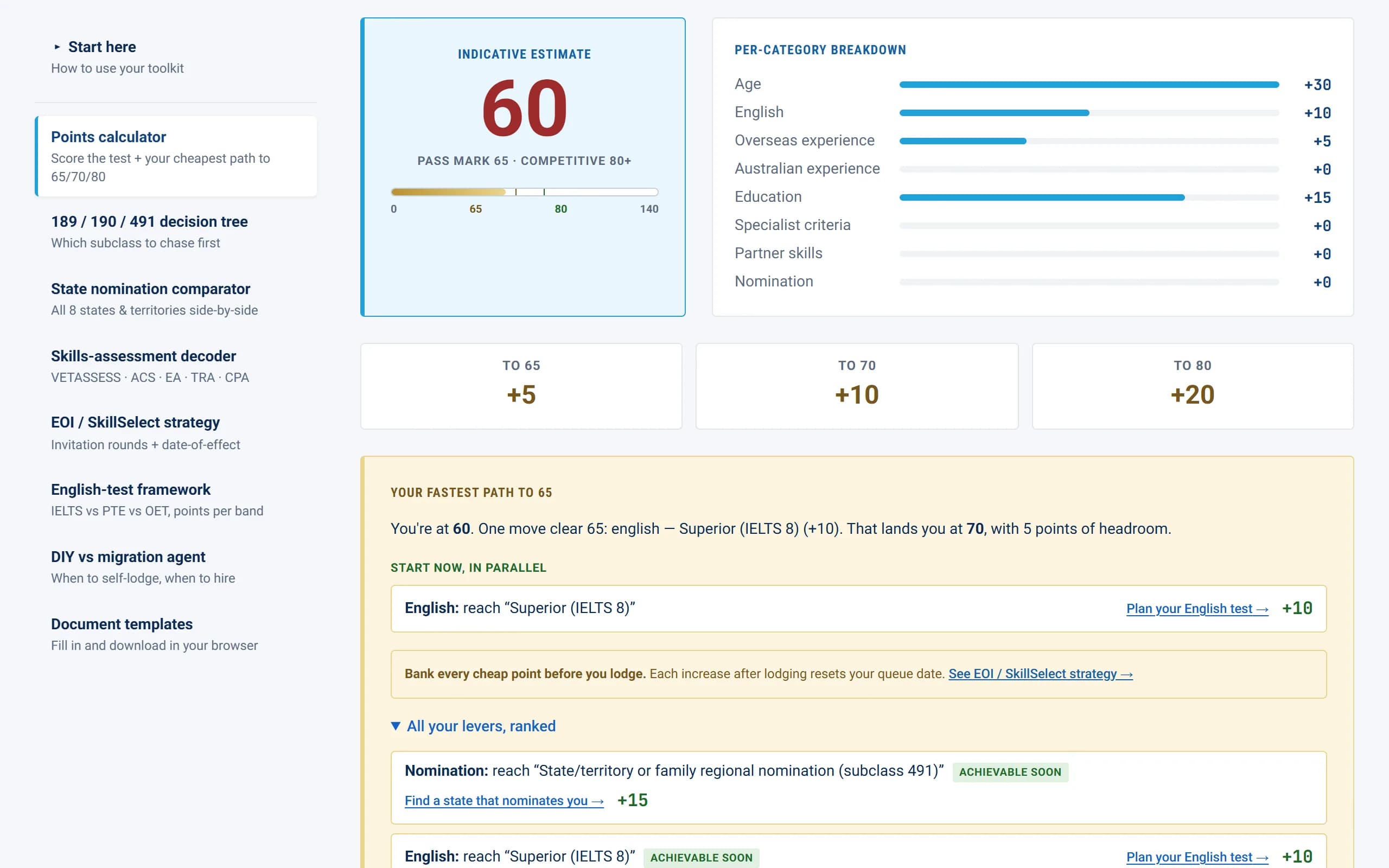
Points Test Strategy
| Points Factor | Points | Notes |
|---|---|---|
| Age 25-32 | 30 | Maximum bracket |
| Age 33-39 | 25 | Still strong |
| Bachelor degree | 15 | Property economics or related |
| Master's degree | 15 | No additional bonus over Bachelor |
| PhD | 20 | Rare in this occupation |
| English — Superior (8.0 IELTS) | 20 | Material advantage |
| English — Proficient (7.0 IELTS) | 10 | Common floor |
| Overseas experience (5-8 years) | 10 | After VETASSESS deduction |
| Australian experience (3-4 years) | 10 | Strong lever if available |
| State nomination 190 | 5 | |
| Regional nomination 491 | 15 | |
| Partner skills | 5-10 | If partner is assessable in a skilled occupation |
Scenario A — Mid-career REIT analyst, offshore: Age 30 (30) + Bachelor (15) + Proficient English (10) + 5 years offshore experience (10) + 190 nomination (5) = 70 points. Competitive for NSW or Victoria.
Scenario B — Senior property economist, in Australia on 482: Age 35 (25) + Master's (15) + Superior English (20) + 3 years Australian experience (10) + 5 years overseas (10) = 80 points before nomination. Strong 189 candidate.
State Nomination for Land Economists
New South Wales
Sydney runs the largest commercial property market in Australia by deal value. NSW nominates Land Economist on its CSOL-aligned skilled visa list. The state prioritises applicants with current NSW employment, an offer of employment with a NSW-based business, or close ties to the state. Investment in build-to-rent and the Western Sydney Aerotropolis continues to drive demand.
Victoria
Melbourne has a deep development pipeline at Fishermans Bend, Arden, and Sunshine. Victoria allows all CSOL occupations to apply, but actively prioritises critical sectors. Land economists with experience in feasibility analysis or government land agencies are well placed. Victoria typically requires recent and ongoing employment in the nominated occupation.
Queensland
Brisbane's Olympic-driven infrastructure pipeline through 2032 has lifted demand for development economists across south-east Queensland. Queensland's Skilled Migration Program prioritises applicants already living and working in the state, particularly outside Greater Brisbane for regional 491 pathways.
Salary and Employment Outlook
Typical 2026 Salary Bands
| Role | Typical Salary Range |
|---|---|
| Graduate Land Economist / Analyst | AUD $75,000-$95,000 |
| Land Economist (3-5 years) | AUD $95,000-$120,000 |
| Senior Land Economist | AUD $120,000-$150,000 |
| Development Manager (economics-led) | AUD $140,000-$180,000 |
| Head of Research / Strategy (REIT) | AUD $200,000-$300,000+ |
| Government — Director-level | AUD $160,000-$220,000 |
Source: SEEK Australia Career Advice (April 2026), Glassdoor Australia (April 2026), and Hays Salary Guide FY25/26.
Superannuation adds 11.5% on top. REIT and investment bank roles often pay 15-30% bonuses; government roles do not. Sydney pays 8-12% above the national average; Brisbane and Adelaide pay 5-10% below.
Where the Highest-Paying Roles Sit
- REITs and listed property — Goodman, Dexus, Charter Hall, GPT, Mirvac, Stockland
- Investment banks and big four banks — origination and credit roles in property finance
- Property consultancies — JLL, CBRE, Knight Frank, Colliers (research and capital markets)
- State land agencies — Landcom, Development Victoria, Economic Development Queensland
- Infrastructure investors — Macquarie, IFM, Lendlease Investment Management
Tips for a Successful Application
- Choose 224511 only if your day-to-day work is economic analysis, not valuation. If you write valuation reports for a living, apply under Valuer (224512). VETASSESS does not allow you to switch codes mid-assessment without paying again.
- Get your employment references to use the right verbs. "Advised on commercial use of land", "conducted feasibility analysis", "developed leasing strategies", "researched land administration". Avoid "valued", "appraised", "managed properties", or "planned residential subdivisions".
- Lodge VETASSESS priority processing if your 491/190 EOI is competitive. The extra $825 buys you 6-8 weeks. In states with rolling invitation rounds, that can be the difference between an invitation this year and next.
- Calculate your effective points before you spend on English testing. Superior English (8.0 IELTS) costs months of preparation. If you can land 80+ points without it, focus on lodging quickly.
- Australian Property Institute (API) membership is not required for migration but signals credibility. It is mandatory for valuation work but optional for pure land economy roles. Membership through the Associate or Affiliate grade strengthens employer-sponsored applications.
Step-by-Step Migration Roadmap
- Confirm your duties fit ANZSCO 224511 — use the how to find your ANZSCO code guide
- Check the Skilled Occupation List confirms 224511 on CSOL and MLTSSL
- Compile employment references mapped to VETASSESS dot-point duties
- Sit your English test — aim for Proficient (7.0) minimum, Superior (8.0) for points
- Lodge VETASSESS application (AUD $1,096); add priority processing if needed
- Receive positive skills assessment in 8-12 weeks
- Submit Expression of Interest in SkillSelect for 189, 190, or 491
- Apply for state nomination if pursuing 190 or 491
- Alternatively, pursue employer sponsorship through a 482 SID visa
- Receive invitation to apply; lodge visa within 60 days
- Complete health and character checks (AFP plus country-of-residence police certificates)
- Visa grant and relocation
Frequently Asked Questions
Why is Land Economist on a separate ANZSCO code from Valuer?
ANZSCO 2245 separates the two because they involve different work even though they share an industry. Land Economist (224511) covers economic and commercial analysis of land and property. Valuer (224512) covers the formal valuation of specific properties for a defined purpose (mortgage, taxation, compensation). VETASSESS treats them as distinct occupations with distinct duty sets.
Can I switch from Land Economist to Valuer if my assessment fails?
Not in the same application. VETASSESS requires a fresh application and fresh fee. Plan carefully before lodging — review the Valuer pathway if formal valuation is your core work.
Is a property economics degree mandatory for VETASSESS?
No, but it materially helps. A general economics, finance, or commerce degree can succeed if you can prove the degree included property-relevant subjects and that your employment is strongly aligned. Pure business or accounting degrees rarely clear the relevance test.
Which states nominate Land Economists in 2026?
NSW and Victoria are the consistent nominators because both run major commercial property markets. Queensland nominates selectively, prioritising regional and Olympic-related infrastructure work. South Australia and Western Australia nominate only when there is a state-specific need.
Is the 482 SID visa a faster pathway than the points test?
Often, yes. With a job offer from an Australian REIT, bank, or consultancy paying above the Core Skills Income Threshold ($79,423 from 1 July 2026), 482 can be lodged within months. The points test typically takes 12-18 months from VETASSESS submission to visa grant. Senior land economists earning above the $146,576 Specialist Skills threshold qualify for a streamlined 482 pathway with shorter processing.