Life Scientists nec Visa Pathway to Australia: Complete 2026 Guide
Updated: 16 August 2026
Australia classifies Life Scientists nec under ANZSCO 234599. VETASSESS conducts the skills assessment. The occupation appears on both the MLTSSL and the Core Skills Occupation List (CSOL), unlocking subclasses 189, 190, 491, 482, and 186. Typical 2026 salaries range AUD $85,000-$160,000. The "nec" classification requires careful justification of which specialist title actually applies.
Quick Facts: Life Scientists nec Migration Pathway
| Detail | Information |
|---|---|
| ANZSCO Code | 234599 (Life Scientists nec — not elsewhere classified) |
| Skill Level | 1 (Bachelor degree or higher in a highly relevant life-science field) |
| Skills Assessment | VETASSESS (Vocational Education and Training Assessment Services) |
| Occupation List | MLTSSL and CSOL |
| Visa Options | 189, 190, 491, 482, 186 |
| Demand Level | Moderate — specialist life-science roles draw on a small but stable labour market across universities, medical research institutes, and pharmaceutical R&D |
| Salary Range | AUD $85,000-$160,000 (SEEK 2026, PayScale 2026) |
| Typical 189 Score | 85-95 points |
| Key Challenge | Justifying the "nec" code — applicants must demonstrate their specialty does not fit any of the named ANZSCO life-science codes (234511 Life Scientist (General), 234513 Biochemist, 234514 Biotechnologist, 234515 Botanist, 234516 Marine Biologist, 234517 Microbiologist, 234518 Zoologist) |
What a Life Scientist nec Does in Australia
The "nec" code captures life scientists whose specialty falls outside the eight named ANZSCO life-science occupations. In practice this means anatomists, animal behaviourists, neuroscientists, parasitologists, non-clinical pharmacologists, physiologists, and toxicologists. The work is concentrated in three sectors: university research, government and independent medical research institutes (such as the Walter and Eliza Hall Institute, QIMR Berghofer, and the Garvan Institute), and pharmaceutical or contract research organisations.
Geographically, Melbourne and Sydney host the highest density of roles thanks to the parkville biomedical precinct and the Sydney medical research corridor. Brisbane and Adelaide have growing biotech clusters. Government employers include the Therapeutic Goods Administration, CSIRO Health and Biosecurity, and state public health laboratories. Toxicologists working in environmental regulation and forensic science are based across all capitals.
Demand in 2026 is driven by Australia's medical research commercialisation push, the National Reconstruction Fund priorities in medical science and biotech manufacturing, and continued growth in neuroscience and ageing research. The labour market is small compared with general life sciences, and roles concentrate at PhD level.
ANZSCO Code 234599
ANZSCO 234599 covers life scientists not elsewhere classified — professionals studying living organisms, their behaviour, physiology, and interactions, where the specialty is not separately listed. Typical tasks include planning and conducting experiments, analysing samples and data, publishing research, supervising laboratory or field staff, and applying for grant funding.
Adjacent codes that should be ruled out before nominating 234599 include 234511 Life Scientist (General) for broad biological work, 234517 Microbiologist, 234513 Biochemist, and 234518 Zoologist. Applicants whose work spans several life-science disciplines often fit 234511 better than 234599. The nec code is appropriate only when the specialty has a recognised name — anatomist, neuroscientist, physiologist, toxicologist, parasitologist, non-clinical pharmacologist, animal behaviourist — and that name does not appear in any other ANZSCO code.
Skills Assessment — VETASSESS
VETASSESS is the sole assessing authority for ANZSCO 234599. The assessment falls into VETASSESS Group A, which is the most documentation-intensive category.
Qualification requirement. A qualification assessed as comparable to an AQF Bachelor degree or higher, in a field highly relevant to the nominated specialty. Most successful applicants hold a Master's or PhD because the underlying work is research-driven. A broad biology degree without specialisation rarely meets the "highly relevant" test.
Employment requirement. At least one year of post-qualification employment at the appropriate skill level, undertaken in the last five years, working 20 or more hours per week, performing duties directly aligned with the nominated specialist title.
Cost. AUD $1,205.60 for a standard professional assessment (online lodgement, includes GST for Australian residents; non-residents pay AUD $1,096). Priority processing adds AUD $825 and returns an outcome in 10 business days.
Processing time. 12-14 weeks for standard processing.
Common rejection reasons. Applicants frequently fail because their actual work matches a named ANZSCO life-science code rather than 234599 — for example a virologist whose duties are dominated by culture work fits 234517 Microbiologist. Applicants also struggle when their cover letter does not state plainly which specialty title (anatomist, toxicologist, etc.) applies and why none of the named codes fit. VETASSESS expects a written justification for the nec choice.
Visa Pathways for Life Scientists nec
Subclass 189 — Skilled Independent
Permanent residency through the points-based system, available because 234599 is on the MLTSSL.
- Visa fee: AUD $6,135 (primary applicant)
- Realistic points threshold: 85-95 in 2026 — life-science roles are not prioritised in invitation rounds, so the bar sits high
- Processing time: Home Affairs publishes 8-9 months for 189 grants in 2026
- Quirk: Invitation rounds in 2026 run quarterly. Low-volume occupations like 234599 may need to wait an entire round cycle before reaching the cut-off
Subclass 190 — Skilled Nominated
Permanent residency with state nomination. Adds 5 points and lowers the effective threshold.
- Visa fee: AUD $6,140
- Obligation: Live and work in the nominating state for at least two years
- Points boost: +5
Subclass 491 — Skilled Work Regional
Five-year provisional visa with a pathway to permanent residency via the 191 visa.
- Visa fee: AUD $6,140
- Points boost: +15 (the largest of any nomination type)
- Quirk: Regional research roles include positions at the University of Tasmania, James Cook University in Townsville, Charles Sturt University, and various regional CSIRO sites
Subclass 482 — Skills in Demand
Employer-sponsored temporary visa, often the most reliable route for early-career researchers with a confirmed postdoc or laboratory position.
- Visa fee: AUD $3,210 (Core Skills stream)
- Salary threshold: Core Skills stream AUD $76,515; Specialist Skills stream AUD $141,210 — most postdoc salaries clear Core Skills, but principal investigators often exceed Specialist Skills
- Processing time: Specialist Skills stream is processed in roughly 8 days at the median; Core Skills stream sits at a median of 51 days and stretches to 8 months at the 90th percentile in 2026
Subclass 186 — Employer Nomination Scheme
Permanent residency through employer sponsorship.
- Visa fee: AUD $6,140
- Streams: Direct Entry (assessment + three years of relevant experience) or Temporary Residence Transition (after at least two years on a 482)
Points Test Strategy
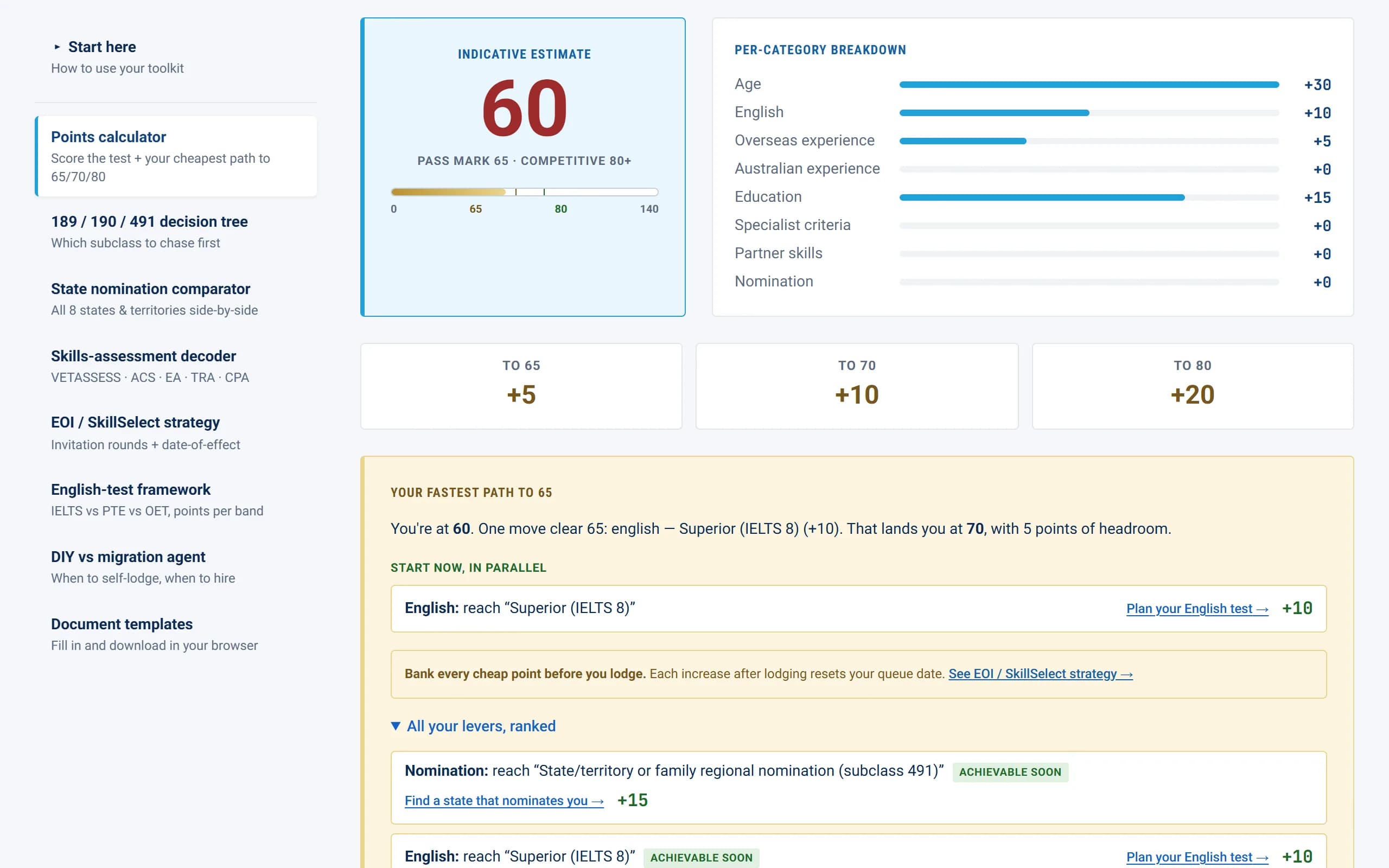
Life Scientists nec applicants typically score well on qualifications (most hold a PhD) but moderately on experience because research career paths often begin later than industry roles.
| Points Factor | Points | Notes |
|---|---|---|
| Age (25-32) | 30 | Maximum bracket |
| Age (33-39) | 25 | Common for PhD-holders |
| PhD | 20 | Standard for senior research staff |
| Master's degree | 15 | |
| Superior English (8.0+) | 20 | Achievable for research-active applicants |
| Proficient English (7.0) | 10 | |
| Overseas experience (8+ years) | 15 | |
| Australian study (2 years) | 5 | |
| State nomination (190) | 5 | |
| Regional nomination (491) | 15 | |
| Partner skills | 10 |
Scenario 1: postdoctoral researcher
A 32-year-old neuroscientist with a PhD, eight years of overseas postdoctoral experience, and IELTS 8.0 scores: Age 30 + PhD 20 + English 20 + Experience 15 = 85 points. State nomination would lift this to 90.
Scenario 2: industry toxicologist
A 35-year-old pharmaceutical toxicologist with a Master's degree, five years of relevant experience, and IELTS 7.0: Age 25 + Master's 15 + English 10 + Experience 10 = 60 points. Realistic only via 491 regional nomination (+15) plus employer sponsorship via 482 as a parallel track.
State Nomination for Life Scientists nec
State nomination for 234599 is selective. Programs typically prioritise applicants with confirmed job offers, postdoctoral appointments, or completed Australian study.
New South Wales
The NSW skilled visa nomination program includes ANZSCO 234599 in its broader skilled occupation list. The state's strongest demand sits in medical research institutes around Camperdown, Westmead, and Darlinghurst. Applicants with a NSW job offer or recent NSW study have stronger prospects than offshore-only applicants.
Victoria
Victoria's Skilled Migration program nominates life scientists where there is a clear contribution to the state's biotech and medical research strategy. The Parkville precinct, Monash and Deakin University networks, and the CSIRO Australian Animal Health Laboratory in Geelong are the main employer clusters.
South Australia
South Australia operates a streamlined pathway for research scientists working at SAHMRI, the University of Adelaide, and Flinders. The state has historically waived some English requirements for offshore healthcare and research candidates with PhD-level qualifications.
Tasmania
Tasmania's regional nomination (491) targets candidates with confirmed offers at the University of Tasmania, Menzies Institute for Medical Research, or the CSIRO Hobart marine and atmospheric campus.
Salary and Employment Outlook
Typical 2026 salaries
| Role | Typical Salary Range |
|---|---|
| Research Assistant (post-Bachelor) | AUD $70,000-$85,000 |
| PhD Stipend (research scholarship) | AUD $32,000-$45,000 (tax-free) |
| Postdoctoral Research Fellow | AUD $95,000-$120,000 |
| Senior Research Fellow | AUD $120,000-$150,000 |
| Principal Research Fellow / Group Leader | AUD $150,000-$220,000+ |
| Industry Toxicologist (pharma) | AUD $110,000-$170,000 |
| Neuroscientist (clinical research) | AUD $115,000-$180,000 |
| Pharmacologist (non-clinical, industry) | AUD $120,000-$180,000 |
SEEK Salary Hub 2026 data places general research scientists between AUD $110,000 and $125,000, and laboratory scientists between AUD $80,000 and $100,000. Compensation rises sharply with grant track record and supervisory responsibility.
Highest-paying sectors
- Pharmaceutical and contract research organisations — CSL, Cochlear, ResMed, Novotech
- Medical research institutes — WEHI, Garvan, Victor Chang, QIMR Berghofer, Telethon Kids
- University research with concurrent industry consulting
- Government regulatory science — TGA, APVMA
- Defence and biosecurity research — DSTG, Australian Centre for Disease Preparedness
Total packages at medical research institutes typically include 17% superannuation (the academic standard), salary packaging benefits, and access to PBI tax concessions that raise effective take-home pay by 5-10% for non-profit research employees.
Tips for a Successful Application
1. Write the nec justification before you start
VETASSESS expects a clearly written cover letter explaining which specialist title applies (anatomist, neuroscientist, toxicologist, physiologist, etc.) and why none of the named ANZSCO life-science codes fit. Draft this document first and use it to stress-test whether 234599 is genuinely the right code.
2. Match your references to your specialty, not to your job title
A "Research Fellow" job title means little to VETASSESS. References must describe the daily research methods — patch-clamp recordings, behavioural assays, pharmacokinetic modelling — that align with the nominated specialty.
3. Prioritise English testing for the 20-point band
Research-active applicants who routinely publish in English and have lived in English-speaking countries often score Superior English (8.0+) with modest preparation. The 10-point jump from Proficient to Superior frequently decides whether 189 is realistic.
4. Cross-check the named codes once more before lodgement
Microbiologist (234517), Biochemist (234513), and Life Scientist General (234511) capture a wider range of work than candidates assume. A wrongly chosen nec code wastes the AUD $1,205.60 fee and adds three months to the timeline.
5. Use the 482 visa as parallel insurance
If a post-doc role is on offer, lodge a 482 nomination in parallel with the points-based EOI. The Specialist Skills stream returns a decision in roughly 8 days for salaries above AUD $141,210, which suits group-leader appointments.
Step-by-Step Migration Roadmap
- Confirm the nominated specialty fits 234599 rather than a named life-science code — review the ANZSCO code finder.
- Confirm 234599 sits on the MLTSSL or CSOL for your target visa subclass.
- Draft the nec justification cover letter and gather research publications, supervisor letters, and grant records.
- Sit IELTS, PTE, or TOEFL — aim for the Superior band (IELTS 8.0+).
- Lodge the VETASSESS skills assessment (AUD $1,205.60) with full employment evidence.
- Calculate points once VETASSESS confirms post-qualification experience.
- Lodge an EOI in SkillSelect for 189, 190, or 491.
- Pursue state nomination if pursuing 190 or 491 — submit the state-specific application after EOI lodgement.
- In parallel, secure a postdoc or industry offer for a possible 482 nomination.
- Receive invitation and lodge the visa via ImmiAccount within 60 days.
- Complete health and police checks.
- Receive visa grant and relocate.
Frequently Asked Questions
Should I nominate 234599 or 234511 Life Scientist (General)?
Use 234599 only when your specialty has a recognised title — anatomist, neuroscientist, toxicologist, parasitologist, physiologist, non-clinical pharmacologist, animal behaviourist. If your work is broadly biological without a clear specialty, 234511 is the correct code. Both codes share VETASSESS assessment and the same MLTSSL placement, so there is no points advantage to the nec code, only a more demanding documentation burden.
Can I nominate 234599 with a PhD in another field?
VETASSESS assesses the qualification against the nominated specialty. A PhD in chemistry combined with extensive toxicology employment may succeed if the publication record and employment references demonstrate that the work fits the toxicology specialty rather than chemistry. Borderline cases benefit from a written submission summarising the cross-discipline pathway.
Is the post-PhD postdoc clock against me for points?
Postdoctoral years count as skilled employment provided the role is at AQF skill level 1 and the duties match 234599. Casual or unpaid research time, however, typically does not qualify. Document your postdoc contracts, FTE percentages, and weekly hours when assembling the VETASSESS submission.
Which states nominate Life Scientists nec for 491 in 2026?
State lists change each financial year. As of mid-2026, NSW, Victoria, South Australia, and Tasmania include 234599 in their broader nomination programs, though most require a state-based job offer, recent state study, or a regional postdoctoral appointment. Confirm directly against the state government website before lodging the EOI.
What's the demand outlook for Life Scientists nec?
Jobs and Skills Australia treats the broader life-science workforce as a stable specialist field rather than a national shortage occupation. Demand is concentrated at PhD level and skewed toward neuroscience, ageing research, drug development, and biosecurity. The labour market is small, so applicants without an Australian connection — job offer, completed Australian degree, or established collaboration — face longer timelines than equivalent applicants in shortage occupations. See the most in-demand occupations list for comparison.
What if my application sits in the named codes but I want the nec route for migration reasons?
VETASSESS does not permit code-shopping. Choosing a code that does not match the actual duties results in a negative assessment and a refused visa application. The named life-science codes (234511, 234513, 234514, 234515, 234516, 234517, 234518) share the same VETASSESS authority and the same MLTSSL and CSOL placement as 234599. Choose the code that matches your work, not the one that feels easier to assess.