Urban and Regional Planner Visa Pathway to Australia: Complete 2026 Guide
Updated: 16 August 2026
Australia classifies Urban and Regional Planner under ANZSCO 232611. VETASSESS conducts the skills assessment as a Group A professional occupation. The role sits on the Core Skills Occupation List (CSOL), unlocking subclasses 190, 491, 482, and 186. Typical 2026 SEEK salaries range AUD $75,000-$140,000, with senior Sydney planners reaching $112,000+.
Quick Facts: Urban and Regional Planner Migration Pathway
| Detail | Information |
|---|---|
| ANZSCO Code | 232611 (Urban and Regional Planner) |
| Skill Level | 1 (Bachelor degree or higher in a planning-relevant discipline) |
| Skills Assessment | VETASSESS (Vocational Education and Training Assessment Services) |
| Occupation List | CSOL (no 189 access — state nomination or employer sponsorship only) |
| Visa Options | 190, 491, 482, 186 |
| Demand Level | Moderate — concentrated in growth corridors, infrastructure-linked councils, and consultancies |
| Salary Range | AUD $75,000-$140,000 (SEEK Salary Hub, April 2026) |
| Typical 190/491 Score | 70-85 points with state nomination boost |
| Key Challenge | No 189 access — applicants depend on state nomination or sponsorship to migrate |
What Urban and Regional Planners Do in Australia
Urban and regional planners develop and recommend strategies for the use, conservation, and development of urban, regional, and rural land. The role spans statutory planning (assessing development applications, drafting planning instruments), strategic planning (long-term land use plans, structure plans, precinct strategies), and policy work for state and federal agencies. Most planners hold a bachelor's degree in urban planning, geography, or a related field, then build sector experience in council, consultancy, or government.
Demand is uneven. The east-coast capitals — Sydney, Melbourne, Brisbane — concentrate the bulk of senior planning roles, particularly around housing supply, transport corridors, and infrastructure delivery. Regional councils across NSW, Victoria, and Queensland struggle to attract experienced statutory planners, which is partly why the occupation sits on the CSOL and is nominated by several states under the 190 and 491 streams. Major consultancies such as Urbis, Ethos Urban, SJB, and the planning arms of WSP and GHD recruit at all levels. Federal infrastructure bodies and state planning departments hire for policy and assessment roles, especially around the Housing Accord and city deal programs.
The work is documentation-heavy and stakeholder-facing. Successful migrant planners typically arrive with a portfolio of statutory assessments, masterplans, or policy reports — not just a degree.
ANZSCO Code Mapping
The single code for this occupation is 232611 Urban and Regional Planner. The ABS ANZSCO description covers professionals who develop and recommend land use strategies, prepare and review planning schemes, and advise on planning matters. There is no separate ANZSCO code for "town planner", "strategic planner", or "land use planner" — all map to 232611.
Two related codes are sometimes confused with this one:
- 232612 — not used (the 6-digit slot is unallocated)
- 232613 Cartographer and 232614 Surveyor are distinct occupations with their own assessing bodies (Surveying and Spatial Sciences Institute for surveyors)
If your role is primarily GIS analysis, transport modelling, or environmental science with limited statutory or strategic planning content, VETASSESS may consider an alternative code such as 234911 Environmental Scientist (nec) or 232611 with reduced employment relevance. The duty match matters more than the job title on your business card.
Skills Assessment with VETASSESS
VETASSESS assesses 232611 as a Group A professional occupation. The body publishes its requirements at vetassess.com.au.
Qualification requirement: A qualification assessed as comparable to an Australian Qualifications Framework (AQF) bachelor degree or higher, in a field highly relevant to urban and regional planning (urban planning, regional planning, environmental planning, planning-major geography degrees).
Employment requirement: At least one year of post-qualification employment at an appropriate skill level within the last five years, working a minimum 20 hours per week, in duties closely matched to the ANZSCO description.
Assessment cost (2026): AUD $1,076 for the full skills assessment (VETASSESS fee schedule effective from October 2025).
Processing time: Standard 8-12 weeks; full process can extend to 12-20 weeks depending on documentation completeness. Priority processing is available at 2-4 weeks for an additional fee.
Common rejection reasons:
- Qualification field mismatch — degrees in pure geography, architecture, or environmental science without planning content frequently fail the qualification test. VETASSESS expects substantive planning coursework.
- Employment evidence too generic — references that describe "project management" or "GIS work" without specific statutory or strategic planning duties (DA assessment, scheme drafting, structure planning) are downgraded as not highly relevant.
VETASSESS may issue a positive assessment for a lower skill level or different occupation if the duties don't match 232611. Get an honest CV review before lodging.
Visa Pathways for Urban and Regional Planners
Because 232611 is on the CSOL but not on the MLTSSL, subclass 189 (Skilled Independent) is not available for this occupation. The realistic pathways are state-nominated and employer-sponsored.
Subclass 190 — Skilled Nominated Visa
- Visa fee: AUD $6,140 (primary applicant)
- Eligibility: Positive VETASSESS outcome + state nomination + 65+ points (realistically 75-85)
- Processing time: Roughly 6-12 months from invitation, though some applicants report 9-19 months end to end
- Quirk: NSW and VIC nominations require demonstrable connection to the state. Regional council experience in Australia is a strong signal.
Subclass 491 — Skilled Work Regional (Provisional)
- Visa fee: AUD $6,140
- Eligibility: State or family-sponsored nomination + 65+ points
- Processing time: 12-14 months for most applicants
- Quirk: Regional councils in NSW (Northern Rivers, Riverina), Victoria (Geelong, Ballarat, Bendigo), and Queensland (Cairns, Townsville, Toowoomba) actively recruit planners. The 491 leads to permanent residency via the 191 visa after three years of regional residence.
Subclass 482 — Skills in Demand (Core Skills stream)
- Visa fee: AUD $4,015 (primary applicant)
- Eligibility: Sponsoring employer + nomination + positive skills assessment + salary at or above the Core Skills Threshold
- Processing time: Median 21-47 days for Core Skills stream; Specialist Skills stream often resolves in around a week for 50% of applicants
- Quirk: Consultancies (Urbis, Ethos Urban, WSP) regularly sponsor mid-level planners. Local government sponsorship is rarer but does occur in regional councils with persistent vacancies.
Subclass 186 — Employer Nomination Scheme
- Visa fee: AUD $6,140
- Eligibility: Direct Entry (3 years skilled employment + skills assessment) or Temporary Residence Transition (2+ years on 482 with same employer)
- Processing time: Direct Entry currently 12-20+ months; TRT stream typically faster
- Quirk: The TRT route from 482 is the most common 186 pathway for planners in 2026, given Direct Entry backlogs.
For the full visa subclass detail, see /subclass/482 and our complete skills assessment bodies guide.
Points Test Strategy
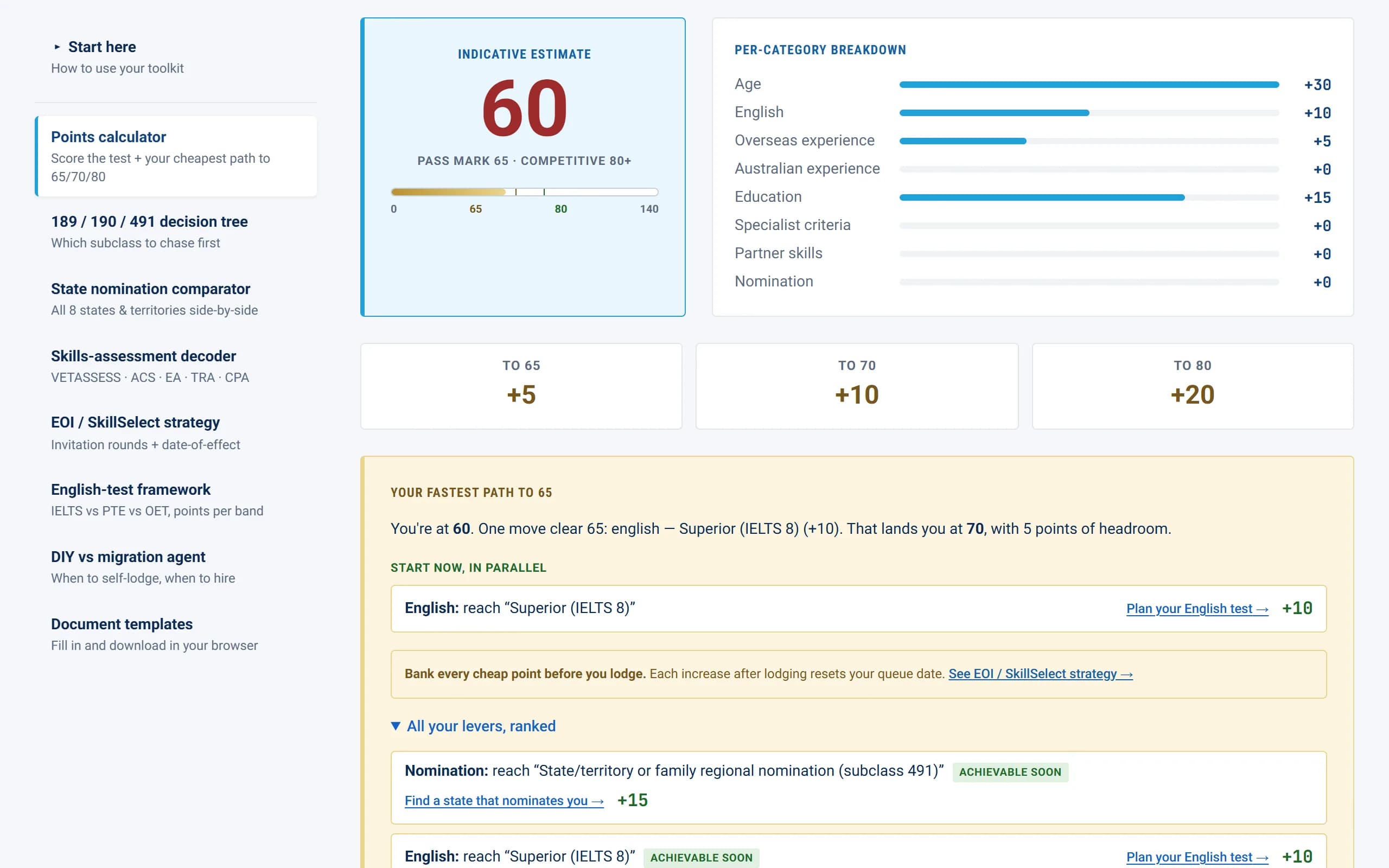
Although 189 is closed for 232611, the points test still drives 190 and 491 outcomes. Here is the standard scoring frame:
| Points Factor | Points | Notes |
|---|---|---|
| Age 25-32 | 30 | Maximum bracket |
| Age 33-39 | 25 | Still strong |
| Qualification (Master's or PhD) | 15-20 | Many planners hold a Master of Urban Planning |
| Qualification (Bachelor's) | 15 | Minimum for Skill Level 1 |
| English (Proficient — IELTS 7) | 10 | Realistic for most candidates |
| English (Superior — IELTS 8) | 20 | Strong differentiator |
| Overseas Skilled Experience (5-7 years) | 10 | Counted post-VETASSESS qualifying date |
| Australian Skilled Experience (3-4 years) | 10 | Significant if on a 482 already |
| State Nomination (190) | 5 | The unlock for permanent residency |
| Regional Nomination (491) | 15 | The strongest single boost |
| Partner Skills | 5-10 | If partner has a CSOL/MLTSSL occupation |
Realistic Scenarios
Scenario 1 — Offshore mid-career planner: Age 30 (30) + Master's (15) + Proficient English (10) + 5 years overseas experience (10) + 491 nomination (15) = 80 points. Competitive for regional 491 invitation in 2026.
Scenario 2 — Onshore planner on 482: Age 33 (25) + Bachelor's (15) + Proficient English (10) + 2 years Australian experience (5) + 3 years overseas experience (5) + 190 nomination (5) = 65 points. Borderline for 190 — would benefit from sitting PTE Academic again for Superior English (20 pts).
State Nomination for Urban and Regional Planners
State nomination is the dominant migration route for 232611. Always verify against the state's current published list before applying.
New South Wales
NSW periodically includes 232611 in its 190 stream when council and consultancy vacancies justify it. The state's housing pipeline (the NSW Housing Strategy and accelerated DA reform) sustains demand for statutory planners in the Sydney metropolitan councils and growth-corridor LGAs (Wollondilly, Hawkesbury, Camden). Living and working in NSW at the time of application strengthens an EOI.
Victoria
Victoria nominates planners under its 190 and 491 streams, with particular interest in statutory planners for regional councils across the Loddon Mallee, Hume, and Barwon regions. The Suburban Rail Loop and major precinct projects in Melbourne create senior strategic planning demand. Victoria's program traditionally favours candidates with current Victorian employment or recent graduation from a Victorian university.
Queensland
Queensland's 190 and 491 streams have included planners aligned with the state's growth strategy and Olympics-linked infrastructure planning around South East Queensland. Regional councils in Far North Queensland and Central Queensland have advertised the role consistently across 2025-26.
South Australia
South Australia's program nominates planners under the 491 stream for regional applicants and selective 190 for in-state candidates. The state's Housing Roadmap creates ongoing demand for statutory planners in Adelaide growth areas.
Western Australia
WA periodically includes 232611 on its 190 list, particularly for candidates with mining-sector or regional planning experience. The Perth and Peel @ 3.5 million strategy supports planner intake.
Tasmania and ACT
Tasmania's program nominates planners through the 491 stream when local council vacancies require it. The ACT periodically includes 232611 for candidates working in Canberra or with offers from federal infrastructure agencies.
Salary and Employment Outlook
2026 Salary Bands
| Role | Typical Salary Range |
|---|---|
| Graduate / Cadet Planner | AUD $70,000-$85,000 |
| Planner (2-4 years) | AUD $85,000-$110,000 |
| Senior Planner (5-8 years) | AUD $110,000-$140,000 |
| Principal / Manager Planner | AUD $140,000-$180,000 |
| Director of Planning (council or consultancy) | AUD $180,000-$240,000+ |
| Sydney mid-senior average (SEEK) | AUD $112,287 (Sydney average per ERI 2026) |
Sources: SEEK Salary Hub (April 2026, $75,000-$95,000 average for "Urban Planner"), ERI SalaryExpert (Sydney 2026 average AUD $112,287), Glassdoor Australia ($73,497-$99,500 typical range, May 2026).
Total package usually includes 11.5% superannuation. Larger consultancies add a discretionary bonus (5-10%); some councils provide a higher base in lieu of bonus.
Highest-paying sectors
- Tier-one consultancies — Urbis, Ethos Urban, WSP, GHD, SJB pay above council bands for senior planners with statutory and strategic experience
- State planning departments — NSW Department of Planning, Victorian DTP, Queensland State Development sit at the upper end of public-sector pay
- Mining and resources — BHP, Rio Tinto, and Fortescue retain planners for regional approvals work in WA and QLD
- Federal infrastructure agencies — Infrastructure Australia, the Department of Infrastructure, and the National Capital Authority pay APS 6 to EL 1 bands for senior planners
- Major property developers — Mirvac, Stockland, Lendlease retain in-house planning teams
Jobs and Skills Australia signal
Jobs and Skills Australia's occupation profile for 2326 Urban and Regional Planners records steady employment growth and identifies regional shortages, particularly for statutory planners in non-metropolitan councils. The occupation has not been classified as a national shortage but has consistently appeared in state-specific demand assessments.
Tips for a Successful Application
1. Frame your references against the ANZSCO description, not your job title
VETASSESS reads your duties against the published 232611 task list. If your employment reference reads "managed projects and produced reports", you will fail the highly-relevant test. Reframe in planning-specific language: "assessed development applications under the [local Act]", "drafted local planning policies", "prepared structure plans", "performed statutory referrals". Same work — language that matches the code.
2. Document your planning content, not just your degree title
If your degree is named "Geography and Environmental Studies" rather than "Urban Planning", attach a course transcript and unit descriptors that show the planning subjects (land use law, urban economics, statutory planning, GIS for planning). VETASSESS assessors look for substantive planning content, not just the program label.
3. Apply for state nomination as early as practical
Several states process planner EOIs in tranches and exhaust allocations mid-year. Lodge your EOI in SkillSelect immediately after VETASSESS returns a positive outcome, and submit state nomination expressions as soon as the state's program opens for the financial year. Waiting until April or May regularly costs candidates a year.
4. Target regional councils for 491
NSW Riverina, Victoria's Loddon Mallee, Queensland's Wide Bay, and northern WA councils carry persistent statutory planning vacancies. Direct outreach to council CEOs and planning directors with a tailored CV (and a sample DA assessment from your home jurisdiction) routinely secures 491-aligned offers.
5. Sit PTE Academic if your IELTS sits below 8
The points jump from Proficient (10 points) to Superior (20 points) is the single most economical points lever for 232611 candidates. PTE Academic's scoring profile rewards spoken planning vocabulary, which most planners already use daily.
Step-by-Step Migration Roadmap
- Confirm the ANZSCO match — review the ANZSCO code finder and cross-check your duties against 232611
- Verify CSOL status — confirm 232611 is current on the Core Skills Occupation List
- Prepare qualifications evidence — academic transcripts, syllabus details, course descriptors
- Prepare employment evidence — detailed references for each role, organisational charts, payslips, tax records
- Lodge VETASSESS skills assessment — AUD $1,076; allow 8-20 weeks
- Sit English — IELTS or PTE Academic, target Superior band
- Submit EOI in SkillSelect — claim 190 and 491 for relevant states
- Apply for state nomination — separate application per state, demonstrate connection
- Receive nomination and ITA — 60 days to lodge the visa
- Lodge the visa application — 190, 491, or 482 as appropriate
- Complete health and character checks — Bupa Medical Visa Services, federal police clearance
- Receive grant and relocate — meet the conditions of stay (regional residence for 491; 2 years in state for 190)
Frequently Asked Questions
Why isn't Urban and Regional Planner on the MLTSSL?
The MLTSSL has been progressively wound back since the introduction of the CSOL in late 2024. 232611 sits on the CSOL, which underpins employer-sponsored visas (482, 186) and state-nominated visas (190, 491). It does not appear on the residual MLTSSL list that feeds subclass 189. The practical implication is that planners migrate through state nomination or sponsorship — the points-only 189 route is closed for this code.
Can a planner with a non-planning degree still pass VETASSESS?
Sometimes. VETASSESS will assess a degree in geography, urban studies, architecture, or environmental science against the qualification standard. The decisive question is whether the degree contains substantive planning content (land use law, statutory planning, urban policy, regional development). Architecture-only degrees usually fail; planning-major geography degrees usually pass. A postgraduate Master of Urban Planning over a non-planning bachelor's typically resolves the question.
Is the 491 regional visa worth taking for a planner?
For most offshore candidates, yes. The 491 gives 15 points (versus 5 for 190), grants five years of provisional residence, and provides a permanent pathway via the 191 visa after three years of regional residence. Regional councils in NSW, Victoria, and Queensland have persistent statutory planner vacancies, and the cost of living in regional cities is materially lower than Sydney or Melbourne. The trade-off is geographic confinement during the provisional period.
What's the demand outlook for planners in 2026?
The federal Housing Accord (1.2 million homes over five years) and state housing strategies have lifted statutory planning demand across all east-coast metros. Jobs and Skills Australia's occupation profile records ongoing employment growth, and regional councils continue to advertise long-running vacancies. The role is not in critical national shortage, but the structural demand for assessment-capable planners is firm through 2026 and into 2027.
How does my overseas planning qualification compare to an Australian one?
VETASSESS benchmarks overseas qualifications against the Australian Qualifications Framework. Most accredited planning bachelor's degrees from the UK, Ireland, Canada, NZ, the US, South Africa, India, and Malaysia assess as AQF Bachelor or higher when supported by transcript evidence. Degrees from less commonly assessed jurisdictions take longer and may require additional course descriptors. The Planning Institute of Australia (PIA) accreditation status of your university — while not formally required for VETASSESS — strengthens the case.