Locksmith Visa Pathway to Australia: Complete 2026 Guide
Updated: 16 August 2026
Australia classifies Locksmith under ANZSCO 323313. Trades Recognition Australia conducts the skills assessment, usually through the Job Ready Program. The occupation appears on both the MLTSSL and the Core Skills Occupation List, unlocking subclasses 189, 190, 491, 482, and 186. Typical 2026 salaries range AUD $78,000-$100,000, with senior locksmiths and master key system specialists earning toward the upper end of the range.
Quick Facts: Locksmith Migration Pathway
| Detail | Information |
|---|---|
| ANZSCO Code | 323313 (Locksmith) |
| Skill Level | 3 (AQF Certificate III in Locksmithing or comparable) |
| Skills Assessment | TRA (Trades Recognition Australia) via Job Ready Program |
| Occupation List | CSOL and MLTSSL |
| Visa Options | 189, 190, 491, 482, 186 |
| Demand Level | Moderate to high — small national pool, persistent shortage |
| Salary Range | AUD $78,000-$100,000 (SEEK Salary Hub, 2026) |
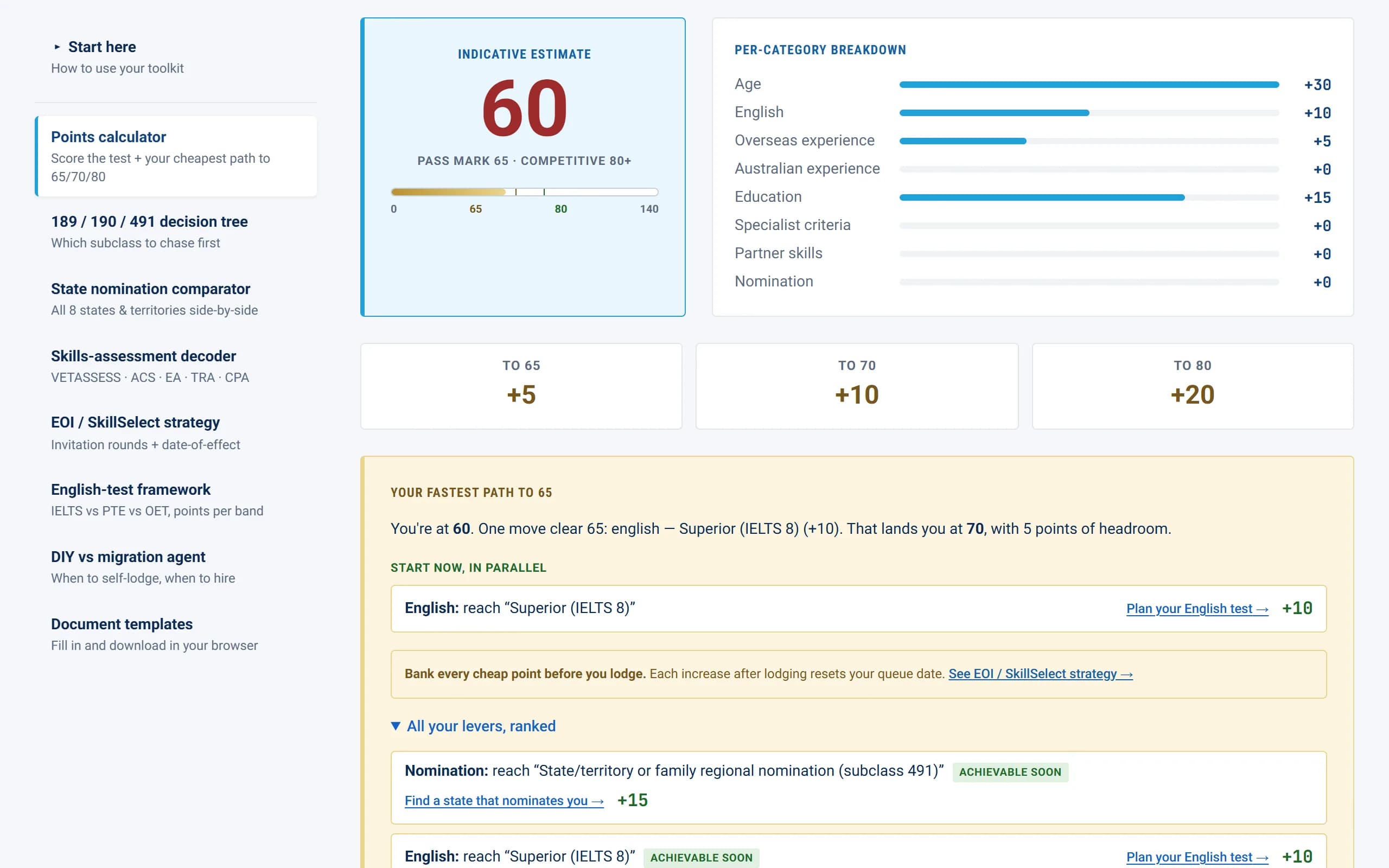
| Typical 189 Score | 65-75 points |
| Key Challenge | State and territory licensing requirements that vary across jurisdictions |
What a Locksmith Does in Australia
Australian locksmiths install, service, and repair mechanical and electronic locking systems for residential, commercial, automotive, and institutional clients. The trade has expanded beyond the traditional mechanical-key cutting and lock-fitting work to include electronic access control, master key systems for commercial buildings, automotive transponder programming, safe servicing, restricted-key system management, and integrated security installations combining mechanical and electronic components.
Work splits between three main streams. Retail and mobile locksmiths handle residential callouts, lockouts, and small-business security. Commercial and institutional locksmiths design and maintain master key systems for office blocks, schools, hospitals, government buildings, and shopping centres. Automotive locksmiths program transponder keys, replace immobiliser modules, and service modern smart-key systems for both individual customers and dealership networks.
Real employers and ecosystems include the major franchise networks (Lock Sense, Mr Minit, Master Locksmiths Association members), institutional in-house teams (universities, state government property services, hospital networks), and specialist providers servicing the resources, defence, and corrections sectors. The Master Locksmiths Association of Australasia (MLAA) accredits the higher-skill end of the trade.
The Australian locksmith pool is small relative to total skilled migration demand. Apprenticeship completions have declined over the past decade, and the increasing complexity of electronic and automotive locking systems has widened the skill gap. Most state licensing bodies require ongoing registration and continuing professional development, raising the entry barrier and keeping the supply tight.
ANZSCO Code 323313 — Locksmith
The 323313 code applies to locksmiths who install, service, and repair locks and security systems. Core duties include:
- Installing locks, deadbolts, and security devices on doors, windows, safes, vaults, and vehicles
- Cutting and matching keys for mechanical and electronic systems
- Repairing and servicing damaged or worn locks
- Designing and maintaining master key systems
- Opening locked premises for clients without keys (after identity verification)
- Programming and reprogramming electronic and transponder-based locking systems
- Maintaining restricted-key system records and security protocols
There is no nec ("not elsewhere classified") fallback for locksmithing. 323313 is the sole ANZSCO code for the trade. Adjacent codes that may apply for related work include 342315 Security Alarm Installer (for technicians whose work is dominated by alarm systems rather than mechanical locking) and 442217 Security Officer (for guarding work that does not include mechanical locksmithing). Choose 323313 if mechanical and electronic locking system work is the substantive part of your role.
Skills Assessment — Trades Recognition Australia
TRA assesses 323313 through the same three programs as other trades.
Job Ready Program (JRP) — the standard offshore pathway
Almost all offshore-trained locksmiths must complete the JRP. The four-step process:
- Provisional Skills Assessment (PSA) — documentary verification of qualification and 12 months recent employment in the previous three years
- Job Ready Employment (JRE) — TRA registration and commencement of 1,725 paid hours of Australian employment
- Job Ready Workplace Assessment (JRWA) — onsite assessment by a TRA assessor
- Job Ready Final Assessment (JRFA) — outcome document for visa lodgement
Combined cost across the four steps: AUD $3,000-$3,500 Total duration: 12-18 months minimum Required qualification: AQF Certificate III in Locksmithing, or formal training comparable to it, or three years of full-time equivalent post-qualification experience demonstrating current skills
The JRWA for 323313 specifically tests practical lock-fitting, key-cutting accuracy, master-key-system design, and (where the role includes it) electronic system programming. Failures most commonly arise from candidates placed in narrow retail-only roles where the workplace cannot demonstrate the full scope of the trade — TRA expects evidence across mechanical, master-key, and electronic work.
Migration Skills Assessment (MSA) — Australian-qualified only
The MSA is documentary and faster, but is available only to applicants who completed their qualification in Australia (typically through an Australian apprenticeship) or hold qualifications recognised under bilateral arrangements. Most offshore-trained locksmiths do not qualify.
Offshore Skills Assessment Program (OSAP) — limited
OSAP provides paper assessment for specific country qualifications. Confirm eligibility for your qualification with TRA before relying on it.
State and Territory Licensing — Critical for Locksmiths
Unlike most trades, locksmithing requires state or territory licensing in addition to the TRA skills assessment. Licensing is administered by the state security or fair trading regulator, and requirements vary by jurisdiction. The migration assessment does not automatically grant the right to work — you need both.
- New South Wales: Master Locksmith Licence issued by NSW Police Security Licensing and Enforcement Directorate
- Victoria: Locksmith licence under the Private Security Act administered by Victoria Police
- Queensland: Security Provider Licence (Locksmith) issued by the Office of Fair Trading
- South Australia: Security and Investigation Industry Act licence
- Western Australia: Security Officers Act licence
- Tasmania: Security and Investigation Agents Act licence
- ACT and NT: Separate territory schemes
Most state licensing schemes require police checks, fingerprinting, evidence of trade qualification, and ongoing renewals. Some require additional written or practical exams. Plan to apply for state licensing as soon as visa status permits — without it, sponsored employment is not possible.
Visa Pathways for Locksmiths
Subclass 482 — Skills in Demand
The 482 is the practical first move for most offshore locksmiths because it provides the Australian employment required for the JRP work hours.
- Visa fee: AUD $4,015 (primary applicant)
- Core Skills Income Threshold (CSIT): AUD $76,515 (FY2025-26), rising to AUD $79,423 from 1 July 2026
- Duration: Up to 4 years
- Stream: Core Skills (323313 is on the Core Skills Occupation List)
- Reality: Senior locksmith and master-key-specialist salaries clear CSIT; junior retail roles may not. Confirm the role pays above threshold before signing.
Subclass 186 — Employer Nomination Scheme
Permanent residency via employer sponsorship. Direct Entry stream (with a positive TRA outcome) or TRT stream (after two years on a 482).
- Visa fee: AUD $6,140 (primary applicant)
- Streams: Direct Entry or TRT
- Reality: TRT is the typical route — sponsored locksmiths transition after two years
Subclass 491 — Skilled Work Regional
A 5-year regional provisional visa with a 15-point boost. Regional Australia has acute locksmith shortages because the trade is concentrated in capital cities and regional callouts often require long travel.
- Visa fee: AUD $6,140 (primary applicant)
- Living obligation: 3 years in a regional area before applying for 191 PR
- Quirk: Many regional centres have only one or two locksmiths servicing entire districts, creating strong sponsorship demand
Subclass 190 — Skilled Nominated
State-sponsored permanent residency. NSW, Victoria, Queensland, and South Australia all currently nominate trades, including 323313.
- Visa fee: AUD $6,140 (primary applicant)
- Points boost: +5 from state nomination
- Live-in obligation: 2 years in the nominating state
Subclass 189 — Skilled Independent
Trade occupations face less competition than ICT in the 189 pool, but recent invitation rounds have been weighted toward healthcare. Lodge an EOI for 189 in parallel with the sponsored or regional pathway, but do not plan on 189 as the primary route.
- Visa fee: AUD $6,135 (primary applicant)
- Minimum points: 65 (realistic invitations 75+)
Points Test Strategy
| Points Factor | Points | Notes |
|---|---|---|
| Age (25-32) | 30 | Maximum |
| Age (33-39) | 25 | Strong |
| English (Proficient — IELTS 7) | 10 | Standard target |
| English (Superior — IELTS 8) | 20 | High-impact boost |
| Skilled Employment (5-7 yrs overseas) | 10 | Typical |
| Skilled Employment (8+ yrs overseas) | 15 | Common in this trade |
| Australian Skilled Employment (1-2 yrs) | 5 | Relevant once on 482 |
| Qualification (AQF Cert III/IV equivalent) | 10 | Standard |
| State Nomination (190) | 5 | Available in several states |
| Regional Nomination (491) | 15 | Strong demand in regional areas |
| Partner Skills | 5-10 | If partner holds a CSOL occupation |
Realistic Scenarios
Scenario 1 — Offshore locksmith, 30 years old, IELTS 6, 7 years experience
Age 30 + English 0 + Experience 10 + Qualification 10 = 50 points. Improve English to Proficient (+10) for 60, then add 491 regional nomination (+15) for 75 — competitive.
Scenario 2 — Onshore locksmith on 482 in regional NSW, 32 years old, IELTS 7, 8 years overseas plus 18 months Australian
Age 30 + English 10 + Overseas 15 + Australian 5 + Qualification 10 + 491 Regional 15 = 85 points. Highly competitive.
State Nomination
New South Wales
NSW nominates locksmiths in shortage areas under both 190 and 491 in the 2025-26 program. Sydney has a competitive market, but regional NSW — Newcastle, Wollongong, Wagga Wagga, Tamworth, Dubbo — has acute shortages and is a stronger sponsorship target. NSW typically requires three years of skilled employment in the nominated occupation.
Victoria
Victoria's 2025-26 nomination program includes locksmiths in trades-priority categories. Melbourne metro has reasonable supply, but Geelong, Ballarat, Bendigo, and regional Victoria face shortages. The state allocates 2,700 places to 190 and 700 to 491. Three years of recent post-qualification experience and either a current Victorian role or genuine intent is the typical bar.
Queensland
Migration Queensland's 2025-26 trades focus includes locksmiths, with particular shortages in regional centres such as Cairns, Townsville, Mackay, Rockhampton, and the Sunshine Coast. The 491 pathway is more accessible from offshore than 190.
South Australia
South Australia allocates 3,000 places to 190 and 800 to 491 in 2025-26, with reduced English thresholds for some shortage occupations. Adelaide qualifies as a Designated Regional Area for 491 purposes, making sponsorship in the metro defence and government sectors accessible under the regional visa.
Western Australia and Tasmania
Both smaller programs but both face documented locksmith shortages, particularly outside the capital city. WA's resources-sector institutional locksmiths and Tasmania's regional service network both sponsor offshore.
Salary and Employment Outlook
What Locksmiths Earn
| Role / Sector | Typical Salary Range (AUD) |
|---|---|
| Apprentice / Trainee Locksmith | $50,000-$65,000 |
| Qualified Locksmith (general retail) | $75,000-$90,000 |
| Mobile Locksmith (commercial) | $80,000-$100,000 |
| Master Key System Specialist | $90,000-$120,000 |
| Automotive Locksmith (transponder specialist) | $85,000-$115,000 |
| Institutional Locksmith (university, hospital, gov) | $80,000-$105,000 |
| Senior / Lead Locksmith | $95,000-$120,000 |
| Self-employed / Business Owner | Variable; AUD $120,000-$200,000+ at scale |
Source: SEEK Salary Hub 2026, PayScale 2026, ERI SalaryExpert 2026. SEEK April 2026 data shows the average locksmith salary in Australia at AUD $80,000-$100,000. Indeed records an average of AUD $78,378 (February 2026), and ERI SalaryExpert estimates AUD $84,488. Sydney averages AUD $89,931 (ERI 2026), with hourly rates around AUD $43.
Total packages typically include superannuation at 11.5%, vehicle allowances or company-provided vehicles for mobile locksmiths, on-call allowances for after-hours work, and tool allowances. Self-employed locksmiths who build a strong customer base can substantially exceed employee salaries but carry the standard small-business risks.
Highest-Paying Sectors
- Master key system specialists — large commercial property, education, healthcare
- Automotive locksmiths — transponder and smart-key specialists working with dealer networks
- Institutional in-house roles — universities, state governments, corrections, defence
- Resources sector — mining sites and offshore oil and gas (FIFO arrangements occasionally)
- High-security and forensic locksmithing — small specialist niche, well paid
Tips for a Successful Application
1. Start the state licensing process in parallel with the visa
The TRA assessment and the visa grant do not give you the right to practise locksmithing in Australia — state licensing does. Each state has its own application process, document requirements, and timeline. Start the licensing paperwork as soon as the 482 visa is granted. In some states the application takes months, including police checks and fingerprinting.
2. Frame your experience to cover the full scope of the trade
TRA assessors look for evidence of mechanical lock work, master key systems, automotive (where applicable), and electronic systems. Candidates whose entire experience is narrow retail key-cutting and lockouts can fail the JRWA. If your overseas role was broad, make sure references describe each work stream explicitly. If it was narrow, plan an Australian role that broadens the duty mix during the JRP period.
3. Target regional sponsorship for stronger access
Capital city locksmith markets are smaller and more competitive than regional ones. Most state nomination programs are easier to access for regional roles, and regional employers — particularly in Tasmania, regional WA, regional Queensland, and inland NSW — face the most acute shortages. The 491 visa pairs naturally with this regional bias.
4. Consider electronic and automotive specialisation early
Modern automotive transponder programming and electronic access control are the highest-paid specialisations within the trade and have the widest skill gap in Australia. Pre-arrival training in current automotive diagnostic systems (Autel, Lonsdor, Xhorse), and electronic access platforms (Salto, HID, Inception, Integriti) significantly improves both hireability and salary.
5. Join the Master Locksmiths Association of Australasia (MLAA) on arrival
MLAA membership signals competence to employers and clients, provides ongoing technical training, and is recognised as evidence of professional standing in many state licensing processes. The membership pathway also gives access to industry networks that drive both employment and the high-margin contract work for institutional clients.
Step-by-Step Migration Roadmap
- Confirm 323313 is the right code — review duties against the ANZSCO code finder
- Check the occupation list — confirm 323313 on the CSOL and SOL 2026
- Sit IELTS or PTE — aim for Proficient (7.0) minimum
- Lodge the TRA Provisional Skills Assessment — AUD $300
- Secure a sponsoring Australian employer with broad locksmithing scope — regional commercial, automotive, or institutional
- Apply for a subclass 482 visa — AUD $4,015
- Apply for state locksmith / security licence — varies by state; start as soon as visa is granted
- Register for Job Ready Employment — AUD $490
- Complete 1,725 paid hours of locksmith work — approximately 12 months
- Sit the JRWA — onsite assessment of mechanical, master key, and electronic competence
- Receive Job Ready Final Assessment — positive outcome for visa
- Apply for 186 (TRT) or 190 / 491 — AUD $6,140
Frequently Asked Questions
Is locksmithing really classified as a skilled trade for migration purposes?
Yes. ANZSCO 323313 sits at Skill Level 3, comparable to other Certificate III trades like fitter, machinist, electrician, and plumber. The Australian Bureau of Statistics has consistently classified locksmithing as a structured trade requiring formal qualification or extensive equivalent experience. Both the MLTSSL and the CSOL include the occupation in 2026.
Do I need separate state licensing on top of the TRA skills assessment?
Yes. The TRA assessment is required for the visa, but the right to operate as a locksmith is granted by state and territory regulators — typically the police licensing branch or the fair trading regulator. Every state has its own scheme, application process, and renewal requirements. Plan to apply for state licensing as soon as the visa is granted; sponsored employment is not legal without it.
Can I work as a self-employed locksmith on a 482 visa?
No. The 482 is an employer-sponsored visa that ties you to the nominating employer. Self-employment requires either permanent residency (186, 190, 491-to-191 pathway, 189) or a different visa class such as the Business Innovation and Investment visa. Many locksmiths arrive on 482 sponsorship, build PR over 2-5 years, and then transition to self-employment once unrestricted.
What if my country's locksmith qualification is informal or based on apprenticeship without formal certification?
TRA accepts three years of full-time equivalent post-qualification experience as a substitute for formal qualification. The experience must be current (12 months in the previous three years) and supported by employer references describing duties that match 323313. Informal apprenticeships in countries with weaker formal qualification frameworks are routinely accepted provided the experience evidence is strong and verifiable.
How does the 2026 transponder and smart-key landscape affect locksmith migration demand?
Demand for traditional mechanical locksmiths remains stable, but demand for automotive locksmiths with current-generation transponder and immobiliser expertise has grown sharply. Most Australian car dealerships still subcontract complex transponder work to independent locksmiths, and the rapid evolution of factory immobiliser systems means continuous skill development is required. Migrants arriving with current-generation diagnostic equipment training (Autel, Lonsdor, Xhorse) are sought after and often start above the standard salary range.
Are there any countries whose locksmith qualifications transfer particularly well to Australian recognition?
UK NVQ Level 3 in Locksmithing, German Schlosser qualifications, and New Zealand Certificate in Locksmithing have all been recognised through TRA processes, but recognition typically still requires the JRP workplace assessment to confirm current skills against Australian practice. There is no documents-only pathway that bypasses the JRP work-hours requirement for offshore applicants outside the bilateral MSA arrangements. Plan on the full JRP regardless of country of origin.