Medical Technicians nec Visa Pathway to Australia: Complete 2026 Guide
Updated: 16 August 2026
Australia classifies these specialist health technicians under ANZSCO 311299 Medical Technicians nec. VETASSESS conducts the migration skills assessment. The occupation sits on the Core Skills Occupation List, unlocking subclasses 190, 491, 482, and 186. Typical 2026 salaries range AUD $75,000-$115,000 depending on the sub-specialty (SEEK, April 2026).
Quick Facts: Medical Technicians nec Migration Pathway
| Detail | Information |
|---|---|
| ANZSCO Code | 311299 (Medical Technicians not elsewhere classified) |
| Skill Level | 2 (AQF Diploma or higher in a highly relevant clinical field) |
| Skills Assessment | VETASSESS (Vocational Education and Training Assessment Services) |
| Occupation List | Core Skills Occupation List (CSOL), STSOL |
| Visa Options | 190, 491, 482, 186 |
| Demand Level | Moderate to high — depending on sub-specialty (perfusion, sleep, audiometry, dialysis are persistently short) |
| Salary Range | AUD $75,000-$115,000 (SEEK, April 2026) |
| Typical 190 Score | 70-85 points (including nomination) |
| Key Challenge | "nec" catch-all code means scope-of-practice evidence must precisely match an accepted sub-occupation |
Role Context in Australia
ANZSCO 311299 is a residual ("not elsewhere classified") code covering specialist clinical technicians whose work does not fit any of the more specific Medical Technician codes (311211 Anaesthetic Technician, 311212 Cardiac Technician, 311213 Medical Laboratory Technician, 311214 Operating Theatre Technician, 311215 Pharmacy Technician, or 311216 Pathology Collector). The code captures roles where the technical work supports clinical decision-making — perfusion in cardiac surgery, sleep study acquisition and scoring, dialysis machine operation, audiometric testing, neurophysiology, and similar.
These roles are tightly clustered in tertiary hospitals (cardiothoracic, dialysis, sleep), specialist private clinics (audiometry, hearing aid dispensing), and pathology networks. Demand is concentrated in capital cities and major regional centres because the underpinning equipment and specialist supervision generally requires tertiary-hospital infrastructure. Some sub-specialties — notably perfusion and sleep science — are persistently short across Australia.
ANZSCO Code Mapping
The "nec" classification matters. ANZSCO 311299 covers, among others:
- Audiometrist — hearing test and hearing aid dispensing roles, often community-based
- Dialysis Technician — operating and maintaining renal dialysis equipment in hospitals and clinics
- Electroencephalographic Technician (EEG/Neurophysiology) — recording brain electrical activity for diagnostic purposes
- Mortuary Technician — supporting forensic and hospital mortuary services
- Ophthalmic Technician — assisting ophthalmologists with diagnostic imaging and testing
- Perfusionist — operating heart-lung bypass machines during cardiac surgery
- Renal Technician — dialysis equipment and process technician
- Respiratory Technician — pulmonary function testing and ventilation support
- Orthotic and Prosthetic Technician — fabricating orthotics and prosthetics from prescriptions
- Sleep Technician — polysomnography acquisition, scoring and analysis
If your role fits one of the more specific Medical Technician codes — for example, Anaesthetic Technician (311211) or Cardiac Technician (311212) — use that code instead. The "nec" code applies only when no specific code fits and the role is genuinely specialist clinical-support work.
Skills Assessment
VETASSESS Assessment
VETASSESS is the assessing authority for 311299.
Requirements (Group E, from VETASSESS published criteria):
- An AQF Diploma or higher (or assessed equivalent) in a highly relevant field. Examples include Audiometry or Speech and Hearing Sciences, Dialysis Technology or relevant Nursing qualifications, Neurophysiology or Electroneurodiagnostic Technology, Funeral Science or Mortuary Science, Clinical Prosthetics and Orthotics, Perfusion studies, or Sleep Science
- Minimum one year of post-qualification employment within the last five years
- Employment at 20+ hours per week
- Employment must be "highly relevant to the nominated occupation"
Assessment costs (VETASSESS Professional Occupations 2026):
- Full Skills Assessment: approximately AUD $1,205.60
- Priority Processing (optional add-on): approximately AUD $907.50
Processing time: VETASSESS publishes 7 weeks as the current standard window. Priority Processing is finalised within 10 business days from eligibility confirmation.
Common rejection reasons: Submitting evidence of generalist nursing or laboratory work rather than specialist clinical-support practice; qualifications without a clinical placement component; insufficient task-level detail in employment references.
Profession-Specific Registration
Most 311299 sub-occupations do not require AHPRA registration. Three exceptions to note:
- Audiometrists: not regulated under AHPRA but typically require accreditation with Audiology Australia or HASA (Hearing Aid Specialists Australia) for Office of Hearing Services contracting work
- Perfusionists: not AHPRA-regulated; the Australian and New Zealand College of Perfusionists (ANZCP) administers certification, which Australian hospitals will typically require
- Sleep Technicians: the Australasian Sleep Association maintains an accreditation framework for scoring and acquisition staff
Confirm any professional-body credential separately from your VETASSESS application — these credentials are typically required by Australian employers but are not visa prerequisites.
Visa Pathways for Medical Technicians
Subclass 482 — Skills in Demand
Specialist clinical employers — large public hospitals, tertiary cardiothoracic units, pathology networks, sleep-clinic chains — sponsor 482 visas where the role meets the Core Skills threshold and the candidate holds the underpinning qualification and registration.
- Visa fee: AUD $1,495 (Core Skills primary applicant)
- Core Skills Income Threshold: AUD $76,515 in 2025-26, rising to AUD $79,499 from 1 July 2026
- Processing time: Core Skills stream — 90% of applications finalised within approximately 8 months in 2026
- Duration: Up to 4 years; pathway to PR via subclass 186 TRT after 2 years
- Reality: Perfusionists and senior sleep scientists typically clear both income thresholds with margin; entry-level audiometry and dialysis roles may sit close to the threshold
Subclass 190 — Skilled Nominated Visa
Permanent residency via state nomination. The 190 is available where the state lists 311299 on its nomination list (verify the current list before lodging).
- Visa fee: AUD $6,140 (primary applicant, 2025-26 schedule)
- Points boost: +5 from state nomination
- Processing time: 6.5-8 months at the 50th percentile; commonly 9-19 months for complex files
- Obligation: Live and work in the nominating state for 2 years
Subclass 491 — Skilled Work Regional (Provisional)
Regional nomination, +15 points, five-year provisional period with a pathway to PR via subclass 191 after three years of regional residence and income compliance. South Australia, Tasmania and Western Australia treat the entire state as regional.
- Visa fee: AUD $6,140 (primary applicant)
- Points boost: +15 from regional nomination
- Processing time: Approximately 12-14 months at the 75th percentile
Subclass 186 — Employer Nomination Scheme
Permanent residency through employer sponsorship via Direct Entry or TRT streams.
- Visa fee: AUD $6,140 (primary applicant)
- Direct Entry processing: Around 12-13 months at the median, with 90th-percentile times reaching 18-19 months
- Skilling Australians Fund levy: Paid by the employer, AUD $3,000-$5,000 depending on business size
For broader visa eligibility, see the Core Skills Occupation List page.
Points Test Strategy
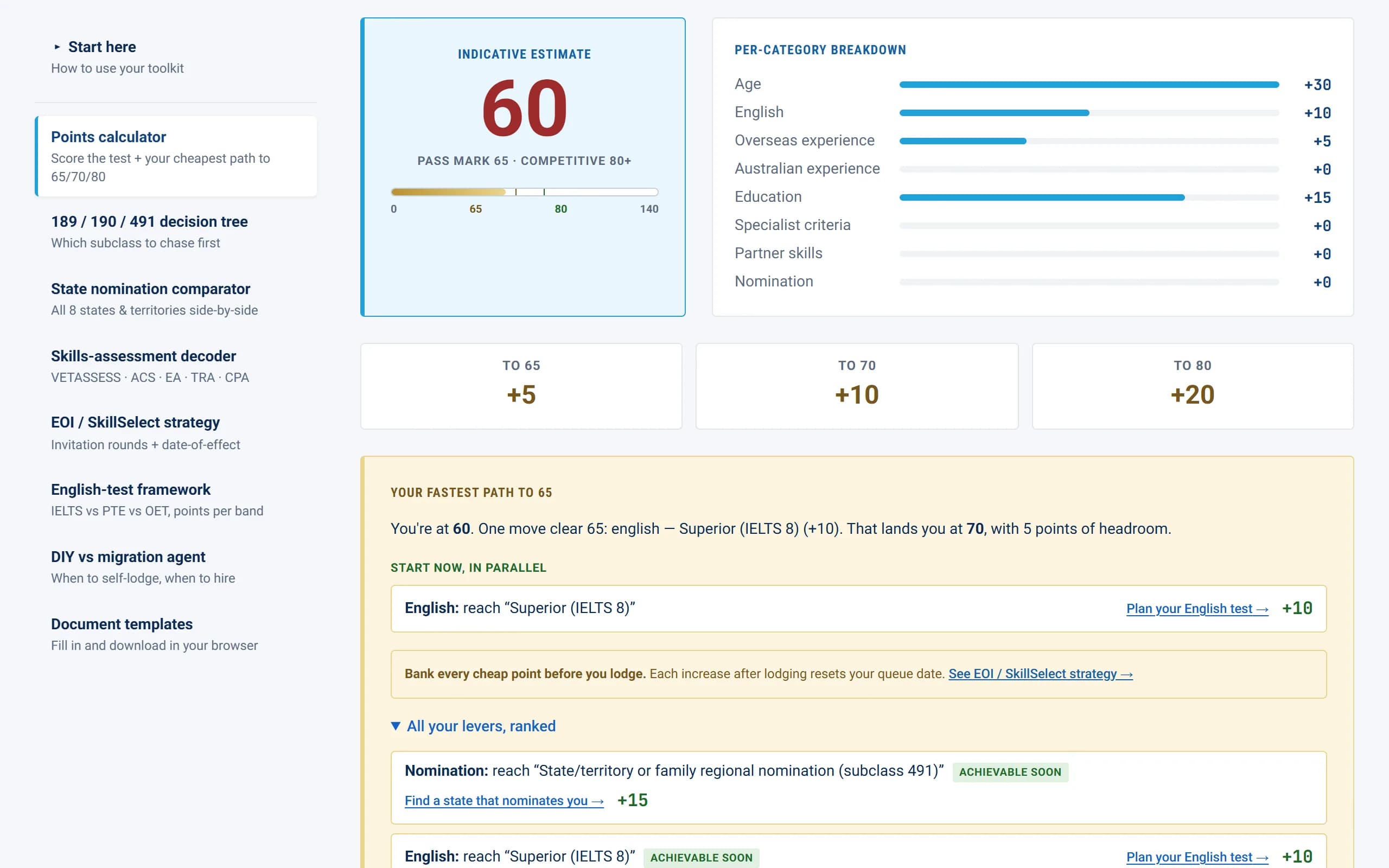
| Points Factor | Points | Notes |
|---|---|---|
| Age (25-32) | 30 | Maximum bracket |
| English (Superior — 8.0+) | 20 | Common for tertiary-trained applicants |
| English (Proficient — 7.0) | 10 | Typical baseline |
| Qualification (Bachelor or higher) | 15 | Many perfusion and sleep applicants hold this |
| Qualification (Diploma) | 10 | Acceptable per VETASSESS Group E |
| Overseas Skilled Experience (5-7 years) | 10 | Counted after VETASSESS outcome |
| Australian Skilled Experience | 5-20 | If already on 482 |
| State Nomination (190) | 5 | Required for 190 |
| Regional (491) | 15 | Strong lever for offshore applicants |
| Partner Skills | 5-10 | Where applicable |
Realistic Scenarios
Scenario 1 — Perfusionist, 31, OET B, Bachelor of Clinical Perfusion, 5 years cardiac unit experience: Age 30 + English 10 + Bachelor 15 + Overseas Experience 10 + 190 nomination 5 = 70 points. ANZCP-recognised qualifications and a tertiary hospital reference typically clear competitive invitations.
Scenario 2 — Sleep Technician, 33, IELTS 7.0, Diploma + Polysomnography certificate, 6 years experience: Age 25 + English 10 + Diploma 10 + Overseas Experience 10 + 491 nomination 15 = 70 points. Regional 491 invitations have cleared at this band in 2025-26 for shortage health occupations.
State Nomination
State nomination for 311299 is genuinely state-by-state — the "nec" code carries variable status across nomination lists. Always verify against the current published state list before lodging an Expression of Interest.
New South Wales
NSW Health is the largest employer of specialist clinical technicians, with major demand in cardiothoracic surgery, renal services, and sleep medicine across Westmead, Royal Prince Alfred, St Vincent's, and the John Hunter hospital networks. NSW allocated 2,100 places for 190 and 1,500 for 491 in 2025-26.
Victoria
Victoria works from the national CSOL/SOL with state priority criteria. Health is the top priority sector and Royal Melbourne Hospital, The Alfred and Monash Health are heavy employers of perfusionists and sleep scientists. Approximately 2,700 places for 190 and 700 for 491 are allocated for 2025-26.
Queensland
Queensland allocated 1,850 places for 190 and 750 for 491 in 2025-26. The Prince Charles Hospital (cardiothoracic) and Royal Brisbane and Women's Hospital are the major specialist employers. Regional Queensland demand for renal and dialysis technicians is genuine — Townsville, Cairns, and Toowoomba services recruit internationally.
South Australia, Western Australia, Tasmania
SA, WA and Tasmania classify the entire state as regional for 491 purposes. Sleep and respiratory roles in particular have been recruited offshore through these programs in 2025-26.
Salary and Employment Outlook
What Medical Technicians Earn in 2026 (by sub-specialty)
| Role | Typical Salary Range |
|---|---|
| Medical Laboratory Technician (Sydney avg) | Around AUD $83,000 |
| Cardiac Technician (PayScale, all-Australia) | AUD $56,000-$93,000 (1-8+ years) |
| Sleep Technician | AUD $70,000-$95,000 |
| Dialysis/Renal Technician | AUD $75,000-$95,000 |
| Perfusionist (specialist cardiac surgery) | AUD $110,000-$165,000+ |
| Audiometrist | AUD $70,000-$95,000 |
| Orthotic/Prosthetic Technician | AUD $75,000-$110,000 (ERI SalaryExpert range, 2026) |
| Medical Technologist (senior, all-Australia) | Around AUD $111,000 |
Total packages include superannuation at 11.5%, shift loadings for hospital-based roles, on-call payments (substantial for perfusion), and salary packaging for public hospital employees. Senior perfusionists in major public tertiary hospitals can earn AUD $160,000+ once on-call and overtime are loaded in.
Highest-Paying Sectors
- Major tertiary hospital cardiothoracic units — top tier for perfusionists
- Private sleep clinic chains — Resmed, Sonic Healthcare-owned providers
- Dialysis service providers — Fresenius, Diaverum, public renal units
- Audiology retail and government Office of Hearing Services contracting
- Pathology networks — Sonic, Australian Clinical Labs, Healius
Tips for a Successful Application
1. Pick the most specific code, not the catch-all
The "nec" code is genuinely residual. If your work fits Anaesthetic Technician (311211), Cardiac Technician (311212), Medical Laboratory Technician (311213), or another specific code, use that. VETASSESS will reject 311299 applications where a more specific code applies.
2. Provide task-level evidence
Group E assessment turns on the relevance of your day-to-day tasks. Build employment references that describe specific clinical-support procedures — for a perfusionist, this means cardiopulmonary bypass case logs; for a sleep technician, polysomnography scoring qualifications and acquisition shift logs.
3. Secure professional-body credentials early
Australian employers will typically require ANZCP certification (perfusionists), Audiology Australia membership (audiologists), or Australasian Sleep Association credentialling (sleep technicians) before clinical deployment. These are separate from VETASSESS but should be in motion before you migrate.
4. Target metropolitan tertiary hospitals for sponsorship
The largest employers — public tertiary hospitals and large private networks — have established 482 sponsorship pipelines. Approach the human-resources teams of identifiable cardiothoracic, sleep and dialysis units directly. Recruitment agencies specialising in allied-health placement have visible 311299 pipelines.
5. Match qualification to sub-occupation
VETASSESS lists specific underpinning qualifications for each sub-occupation. A Bachelor of Nursing is highly relevant for some 311299 sub-occupations (dialysis) but not others (perfusion). Confirm the relevance mapping before paying the assessment fee.
Step-by-Step Migration Roadmap
- Confirm your occupation code — verify 311299 over the more specific Medical Technician codes using the ANZSCO code finder
- Sit an approved English test — IELTS Academic, OET, PTE Academic or TOEFL iBT
- Lodge VETASSESS skills assessment — AUD $1,205.60, 7 weeks standard
- Apply for any required professional-body credential — ANZCP, Audiology Australia, ASA, in parallel
- Engage Australian specialist employers — for 482 sponsorship
- Submit Expression of Interest in SkillSelect — for 190 or 491
- Apply for state nomination — verify the state list lists 311299 currently
- Receive invitation and lodge the visa application — within 60 days
- Complete health checks, police clearances, character requirements
- Receive visa grant
- Complete employer onboarding and clinical credentialing
- Begin clinical practice
For broader context, see the most in-demand occupations for 2026 and the skills assessment bodies complete list.
Frequently Asked Questions
Why is "Data Scientist for Health" or "Genetic Counsellor" not classified here?
ANZSCO 311299 is restricted to clinical-support technician roles operating at AQF Diploma to Bachelor level. Genetic counsellors, health data scientists, and clinical informaticians sit in different ANZSCO families entirely (frequently 224xxx Statisticians, 261xxx ICT, or 251xxx Health diagnostic professionals). Confirm the correct code before lodging — using 311299 for a non-technician role is the most common rejection reason.
Is Perfusionist a separate code?
No. Despite Perfusion being a clearly distinct specialist clinical profession, ANZSCO does not yet assign it a dedicated code. Perfusionists migrate under 311299. The ANZCP certification operates as the professional gatekeeper for clinical employment in Australia.
Can I use a Bachelor of Nursing as the underpinning qualification?
For dialysis-technician and renal-technician roles, yes — VETASSESS lists Nursing as a highly relevant qualification for those sub-occupations. For perfusion, sleep science and audiometry, no — those require specialist underpinning qualifications. Always check VETASSESS's published "highly relevant" qualification table for your specific sub-occupation.
Is 482 sponsorship realistic for an offshore audiometrist?
Yes, but the salary threshold matters. Office of Hearing Services-contracted clinics and large retail audiology chains do sponsor 482 visas — the Core Skills threshold rises to AUD $79,499 from 1 July 2026. Confirm the proposed remuneration clears that floor with a margin.
What's the demand outlook through 2030?
Steady to strong across most sub-specialties. Perfusion remains chronically short in Australia. Sleep science and dialysis demand tracks population ageing and chronic disease prevalence. Audiology is in long-term growth driven by hearing-loss prevalence and Hearing Services Program reforms. Demand is concentrated in capital cities and the larger regional centres.