Print Journalist Visa Pathway to Australia: Complete 2026 Guide
Updated: 16 August 2026
Australia classifies Print Journalist under ANZSCO 212413, a Skill Level 1 occupation. VETASSESS conducts the skills assessment as a Group B occupation. The role sits on the Core Skills Occupation List and the STSOL, opening subclasses 190, 491, 482 and 186. Typical 2026 salaries run AUD $70,000 to $95,000. Print Journalist is not on the MLTSSL, so the 189 independent visa is closed.
Quick Facts: Print Journalist Migration Pathway
| Detail | Information |
|---|---|
| ANZSCO Code | 212413 (Print Journalist) |
| Skill Level | 1 (Bachelor degree or higher, or five years' relevant experience) |
| Skills Assessment | VETASSESS (Vocational Education and Training Assessment Services) |
| Occupation List | CSOL and STSOL — not on the MLTSSL |
| Visa Options | 190, 491, 482, 186 |
| Demand Level | Moderate — print media is contracting, but digital and regional newsrooms still recruit |
| Salary Range | AUD $70,000-$95,000 (SEEK, 2026) |
| Typical 190/491 Score | 65-80 points plus state nomination, where a state nominates the code |
| Key Challenge | No 189 access, and few states nominate the occupation in 2026 |
What Print Journalists Do in Australia
Print journalists research, write and edit news reports, features and commentary for newspapers, magazines and their online editions. The work covers everything from local council rounds at a regional masthead to investigative features at a metropolitan title. Most modern print journalists also file for digital platforms, shoot basic video and manage their own social feeds. The "print" label in ANZSCO describes the original publishing medium, not the daily reality of the job.
Australian print media has shrunk over the past decade. Major publishers such as News Corp Australia, Nine and Australian Community Media have consolidated titles and moved readers online. That said, demand has not disappeared. Regional and suburban newsrooms struggle to fill reporting roles, specialist trade and B2B publications keep hiring, and digital subscription models at the larger mastheads have stabilised some newsroom budgets. A journalist willing to work regionally or in a niche vertical still finds openings.
The work concentrates in Sydney and Melbourne, where the national publishers base their major newsrooms. Brisbane, Adelaide, Perth and Canberra carry state and federal press galleries. Regional centres across New South Wales, Victoria and Queensland run local mastheads that frequently advertise for reporters and chronically struggle to retain them.
ANZSCO Code 212413: Print Journalist
ANZSCO 212413 covers professionals who collect and analyse facts about newsworthy events through interview, investigation and observation, then write reports for newspapers, magazines and websites. The ABS places it in unit group 2124 (Journalists and Other Writers) within the Arts and Media Professionals major group.
Indicative tasks include gathering and verifying facts, interviewing sources, attending events and writing copy to deadline. The code also captures sub-specialisations such as feature writers, leader writers and newspaper or periodical editors who began as reporters.
Choose 212413 only if your duties genuinely match print or online news reporting. Broadcast roles map to separate codes: Television Journalist (212416) and Radio Journalist (212414). If you produce or coordinate content rather than report it, look at Video Producer (212318) instead. The ANZSCO code finder helps confirm the closest match before you commit.
Skills Assessment: VETASSESS
VETASSESS assesses Print Journalist as a Group B professional occupation. Group B means your qualification must be highly relevant to the nominated occupation, and your employment must be at an appropriate skill level.
Required qualification: An AQF Bachelor degree or higher, in a field highly relevant to the occupation. VETASSESS names journalism, media studies and written communication as the relevant fields of study.
Employment requirement: VETASSESS offers four pathways. The standard pathway requires a highly relevant degree plus at least one year of post-qualification employment in the past five years. Applicants with a non-relevant degree but a relevant diploma need two years; those with only a non-relevant qualification need three years; and a degree in any field can work with six years of employment, including at least one highly relevant year in the past five. All pathways require at least 20 hours per week of highly relevant paid work.
Assessment cost: AUD $1,205.60 if you apply from within Australia (GST inclusive), or AUD $1,096.00 from outside Australia. Priority processing costs an extra AUD $825.
Processing time: VETASSESS introduced a fixed seven-week target for professional occupations from 1 December 2025. Priority applications are assessed within 10 business days.
Common rejection reasons: Employment references that read like a job advertisement rather than describing actual duties performed, and qualifications that VETASSESS judges insufficiently relevant to journalism. Freelance and casual work is also harder to evidence, because VETASSESS wants proof of consistent paid employment at the required hours.
See the full skills assessment bodies list for how VETASSESS compares to other authorities.
Visa Pathways for Print Journalists
Print Journalist is on the CSOL and the STSOL but not the MLTSSL. That shapes which visas are open. The 189 independent visa is closed. Employer sponsorship and state nomination carry the load.
Subclass 482 — Skills in Demand Visa
The most reliable pathway for a print journalist, because it does not depend on a state choosing to nominate the code. As a CSOL occupation, 212413 qualifies for the Core Skills stream.
- Base application charge: AUD $3,115 (primary applicant)
- Salary floor: The employer must pay at least the Core Skills Income Threshold of AUD $76,515 (from 1 July 2025), rising to AUD $79,499 from 1 July 2026, or the market rate if higher
- Duration: Up to four years
- Quirk: Most reporting salaries sit close to the income threshold, so an employer offer needs to clear it. Senior, specialist and metropolitan roles do this comfortably; junior regional roles sometimes do not.
Subclass 186 — Employer Nomination Scheme
Permanent residency through an employer. Print Journalist is eligible because it appears on the CSOL.
- Base application charge: AUD $3,520 (primary applicant)
- Streams: Direct Entry, or Temporary Residence Transition after holding a 482 with the same employer
- Quirk: Direct Entry needs three years of relevant work experience and a positive VETASSESS assessment, so most journalists reach the 186 through the 482 transition route.
Subclass 190 — State Nominated Visa
A permanent points-tested visa that adds five points, available because the occupation is on the CSOL. The catch is state demand. Few states nominate journalism codes in 2026, so confirm against the current state list before relying on this route.
- Base application charge: AUD $6,140 (primary applicant)
- Points boost: +5 for state nomination
- Obligation: Live and work in the nominating state, usually for two years
Subclass 491 — Skilled Work Regional (Provisional) Visa
A five-year provisional visa with a pathway to permanent residency through subclass 191. State or family nomination adds 15 points.
- Base application charge: AUD $6,140 (primary applicant)
- Points boost: +15 for regional nomination
- Quirk: Regional newsrooms are exactly where print journalism vacancies cluster, so a 491 can line up neatly with the available work.
Points Test Strategy
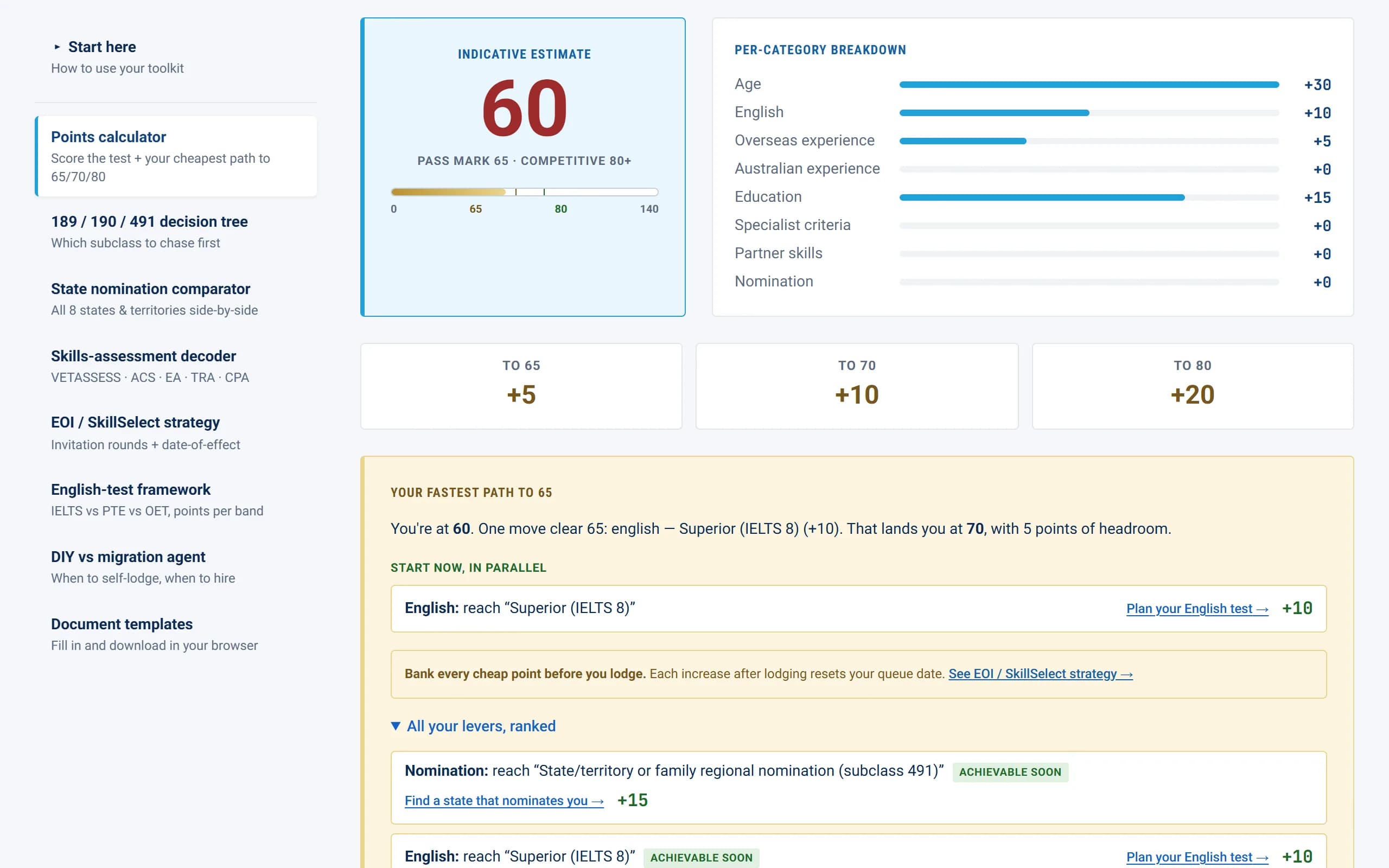
Print Journalist sits on the CSOL, not the MLTSSL, so the points-tested 189 is unavailable. The points test still matters for the 190 and 491, but only if a state nominates the code. Lodge an Expression of Interest through SkillSelect and pair it with a state nomination application.
| Points Factor | Points | Notes |
|---|---|---|
| Age (25-32) | 30 | Maximum bracket |
| Age (33-39) | 25 | Still strong |
| English (Superior, IELTS 8/PTE 79) | 20 | Achievable for native and fluent speakers |
| English (Proficient, IELTS 7/PTE 65) | 10 | The common result |
| Bachelor degree | 15 | Skill Level 1 minimum |
| Skilled employment (8-10 years) | 15 | Overseas plus Australian combined |
| State nomination (190) | 5 | Only where a state nominates 212413 |
| Regional nomination (491) | 15 | Only where a state nominates 212413 |
| Partner skills | 5-10 | If your partner has a skilled occupation |
Realistic Scenarios
Scenario 1: Experienced reporter, 31, Superior English, eight years' work. Age 30 + English 20 + degree 15 + experience 15 = 80 points, before nomination. With a 491 regional nomination (+15), the total reaches 95. The binding constraint is finding a state that nominates the code, not the score.
Scenario 2: Mid-career journalist, 36, Proficient English, six years' work. Age 25 + English 10 + degree 15 + experience 10 = 60 points. A 491 nomination (+15) lifts this to 75. For this applicant, employer sponsorship through the 482 is usually the faster and more certain route.
State Nomination
State nomination for journalism codes is limited and changes each program year. Most state and territory lists prioritise health, engineering, trades and core ICT, where shortages are acute. Print Journalist appears on few state lists in 2026, and where it does, allocations are small and conditions tight.
Before building a plan around the 190 or 491, check the current nominated occupation list published by each state or territory. Treat employer sponsorship as the primary route and state nomination as a secondary option that depends on a state actively listing 212413 in the program year you apply.
Salary and Employment Outlook
| Role | Typical Salary Range |
|---|---|
| Cadet / Junior Reporter | AUD $55,000-$70,000 |
| Print Journalist (mid-level) | AUD $70,000-$95,000 |
| Senior Reporter / Feature Writer | AUD $90,000-$120,000 |
| Section Editor | AUD $100,000-$140,000 |
| Editor (metro masthead) | AUD $130,000-$180,000+ |
Figures reflect SEEK 2026 advertised salary data for journalist and reporter roles, cross-checked against PayScale Australia. Total packages add superannuation at 11.5 per cent. Bylined specialists in finance, law and politics command the upper bands.
The highest-paying employers are the national publishers, News Corp Australia and Nine, along with the public broadcasters and well-funded specialist trade titles. Regional and suburban mastheads pay less but recruit more consistently. Pay sits highest in Sydney and Melbourne, where the major newsrooms operate.
Tips for a Successful Application
-
Document consistent paid hours, not bylines. VETASSESS wants evidence of at least 20 hours per week of relevant employment. Collect contracts, payslips and detailed reference letters, not just clippings. A wall of published articles does not prove employment at the required skill level.
-
Match references to the ANZSCO description. Reference letters must describe researching, interviewing, fact-checking and writing news copy. Generic "valued team member" letters fail Group B assessments. Brief your referees on the task list.
-
Lead with the 482, not state nomination. Because few states nominate 212413, an employer offer is usually the most certain path. Confirm the employer can pay at or above the Core Skills Income Threshold before lodging.
-
Consider regional roles for the 491. Regional newsrooms have the most vacancies and the 491 grants 15 nomination points. The work and the visa pathway align well outside the capital cities.
-
Separate print from broadcast in your evidence. If your career mixes print, radio and television, present the duties that map cleanly to 212413. Mixed evidence invites VETASSESS to question whether your work fits the print code at all.
Step-by-Step Migration Roadmap
- Confirm your ANZSCO code using the ANZSCO code finder — make sure your work is print or online news reporting, not broadcast.
- Check list status against the Core Skills Occupation List and the skilled occupation list.
- Gather employment evidence — contracts, payslips, detailed references showing 20+ hours per week.
- Sit an English test — aim for Superior if you are pursuing points-tested visas.
- Lodge a VETASSESS skills assessment (AUD $1,205.60 in Australia / $1,096 outside).
- Secure an employer sponsor for the 482, or check whether a state nominates 212413.
- Submit an Expression of Interest through SkillSelect if pursuing the 190 or 491.
- Apply for state nomination if a state lists the occupation.
- Lodge the visa once invited or once the employer nomination is approved.
- Complete health and character checks.
- Receive the grant and relocate.
Frequently Asked Questions
Can a print journalist get a 189 independent visa in Australia?
No. Print Journalist (212413) is on the Core Skills Occupation List and the STSOL, but not on the MLTSSL. The subclass 189 Skilled Independent visa draws only from the MLTSSL, so it is closed to this occupation. The realistic pathways are employer sponsorship (482, 186) and, where a state nominates the code, the points-tested 190 and 491.
Is journalism still in demand in Australia given the decline of print?
Demand is moderate and uneven. Metropolitan print media has contracted, but regional and suburban newsrooms struggle to fill reporting roles, and specialist trade and digital publications keep hiring. The occupation remains on the CSOL because employers still report shortages, particularly outside the major cities.
Which states nominate Print Journalist in 2026?
Few. Most state and territory programs prioritise health, engineering, trades and core ICT. Print Journalist appears on a small number of state lists, with limited allocations and tight conditions, and the lists change each program year. Confirm against the current published list of the state you are targeting before relying on a 190 or 491.
What qualification do I need for the VETASSESS assessment?
An AQF Bachelor degree or higher in a relevant field, which VETASSESS defines as journalism, media studies or written communication, plus at least one year of relevant post-qualification employment in the past five years. Alternative pathways accept non-relevant qualifications paired with more experience, up to six years.
How long does the whole process take?
The VETASSESS assessment now targets seven weeks, or 10 business days with priority processing. After that, an employer-sponsored 482 typically takes a few months, while a state-nominated visa depends on nomination timing and the SkillSelect invitation round. Budget six to twelve months end to end, longer if state nomination is involved.