Production Manager (Forestry) Visa Pathway to Australia: Complete 2026 Guide
Updated: 16 August 2026
Australia classifies Production Manager (Forestry) under ANZSCO 133511. VETASSESS conducts the skills assessment as a Group B professional occupation. The occupation sits on the CSOL and STSOL but not the MLTSSL, which unlocks subclasses 190, 491, 482 and 186. Typical 2026 salaries range AUD $110,000-$160,000. Demand sits in Tasmania, regional Victoria's Green Triangle, and the Hunter and South West Slopes of NSW.
Quick Facts: Production Manager (Forestry) Migration Pathway
| Detail | Information |
|---|---|
| ANZSCO Code | 133511 (Production Manager — Forestry) |
| Skill Level | 1 (Bachelor degree or higher, or five years of relevant experience) |
| Skills Assessment | VETASSESS (Group B professional occupation) |
| Occupation List | CSOL + STSOL — not on MLTSSL |
| Visa Options | 190, 491, 482, 186 |
| Demand Level | Moderate — concentrated in plantation states and softwood processing |
| Salary Range | AUD $110,000-$160,000 base (industry surveys, 2026) |
| Typical 491 Score | 75-90 points after regional nomination |
| Key Challenge | Narrow employer pool — limited to plantation operators, sawmills and forestry services |
The Forestry Production Manager Role in Australia
Production Managers in forestry plan, organise, direct, control and coordinate the production activities of plantation operations, sawmills, harvesting contractors, and integrated forestry businesses. The role covers silviculture programs, harvest planning, road and infrastructure management, log haulage scheduling, mill throughput, safety systems, certification compliance (FSC, PEFC, Responsible Wood) and environmental approvals.
Australia's commercial forestry sector splits into native forest harvesting (largely wound down in Victoria and Western Australia, still active in Tasmania and NSW), softwood plantations (the dominant commercial base in Tasmania, Green Triangle, Tumut/Bombala, South West WA), and hardwood plantations (Gippsland, Tasmania, South West WA). Major employers include Forico, Sustainable Timber Tasmania, HVP Plantations, OneFortyOne, Forestry Corporation NSW, Hancock Victorian Plantations, AKD Softwoods, Visy Pulp and Paper at Tumut, Borg Manufacturing, and Boral. The Tasmanian Forest and Forest Products Network reports the sector contributes more than $1.2 billion annually to the state economy.
Demand has lifted modestly on the back of the federal government's Future Forest Industries strategy, growing softwood processing capacity in Tumut and Mount Gambier, and the imminent retirement of a generation of senior production managers across the plantation estate.
ANZSCO Code 133511 — What Counts
The ABS describes Production Managers (Forestry) as professionals who plan, organise, direct, control and coordinate the production activities of a forestry operation including physical and human resources. Genuine 133511 work includes:
- Leading the production function across a plantation estate, sawmill or integrated operation
- Setting and approving harvest schedules, silviculture programs and capital plans
- Managing technical, operational and contractor teams
- Owning production budget, safety performance and environmental compliance
- Liaising with regulators (Forestry Commission, EPA, FSC/PEFC auditors) and Aboriginal cultural heritage stakeholders
- Coordinating log supply with downstream sawmills and pulp customers
- Approving R&D in silviculture, harvesting technology and processing
Operational supervisors and harvest planners without function-head accountability map to lower codes (such as 312911 Maintenance Planner or trade-level forestry roles). The 133511 code is reserved for the manager-of-managers tier.
Skills Assessment — VETASSESS
VETASSESS assesses Production Manager (Forestry) as a Group B professional occupation. The qualification must be in a highly relevant field — typically forestry, forest science, forest engineering, agricultural science, natural resource management, or a closely related discipline.
Body and link: Vocational Education and Training Assessment Services — vetassess.com.au/check-my-occupation/professional-occupations/production-manager-forestry
Requirements (one pathway must be met):
- AQF Bachelor degree or higher in a highly relevant field PLUS at least one year of post-qualification highly relevant employment at an appropriate skill level in the last five years
- AQF Bachelor degree or higher PLUS an AQF Diploma in a highly relevant field PLUS at least two years of post-qualification highly relevant employment in the last five years
- AQF Bachelor degree or higher NOT in a highly relevant field PLUS at least three years of post-qualification highly relevant employment at an appropriate skill level in the last five years
At least five years of relevant pre-qualification experience plus one year of highly relevant employment in the last five years may also be considered.
Assessment cost (2026): AUD $1,096 offshore (ex-GST) / AUD $1,205.60 onshore (incl. GST). Priority Processing adds AUD $825 for a 10-business-day turnaround.
Processing time: 12-20 weeks for forestry production roles — longer than other Group B occupations due to the technical complexity of role verification.
Common rejection reasons: Roles in primary forestry harvesting that lack management authority (logging supervisors, fallers, harvest planners). Engineering backgrounds without genuine forestry production experience. Sawmill supervisor roles that map better to 133512 (Production Manager — Manufacturing). Insufficient evidence of leading production teams across silviculture, harvest and supply chain.
Visa Pathways
133511 sits on the CSOL and STSOL but not the MLTSSL. Subclass 189 is unavailable. The realistic pathways are 482 sponsorship, 190 state nomination, 491 regional, and 186 permanent employer nomination.
Subclass 482 — Skills in Demand
The strongest route for offshore Forestry Production Managers. Plantation operators and integrated mill operations routinely sponsor experienced foreign managers, particularly from New Zealand, Scandinavia, the US Pacific Northwest, and South Africa.
- Visa fee: AUD $4,015 (Core Skills or Specialist Skills)
- Salary threshold: Core $79,423 / Specialist $146,576
- Duration: Up to 4 years
- Quirk: Senior Production Manager packages at HVP, OneFortyOne and Forico typically clear or sit near the Specialist threshold
Subclass 491 — Skilled Work Regional (dominant points route)
Regional nomination adds 15 points. Five-year provisional with a 191 pathway to permanent residency.
- Visa fee: AUD $6,140 (primary applicant)
- Useful where: All Australian forestry production is regional by definition — Tasmania, Green Triangle SA/VIC, Tumut/Bombala NSW, South West WA
- Quirk: This is the natural fit — every major forestry estate sits in a 491 zone
Subclass 190 — Skilled Nominated
State nomination adds 5 points. Permanent residency on grant.
- Visa fee: AUD $6,140 (primary applicant)
- Best states: Tasmania and South Australia consistently nominate 133511
- Realistic score floor: 80-85 points after the 5-point nomination
Subclass 186 — Employer Nomination Scheme
Permanent residency through employer sponsorship.
- Visa fee: AUD $6,140 (primary applicant)
- Streams: Direct Entry or TRT after two years on a 482
Points Test Strategy
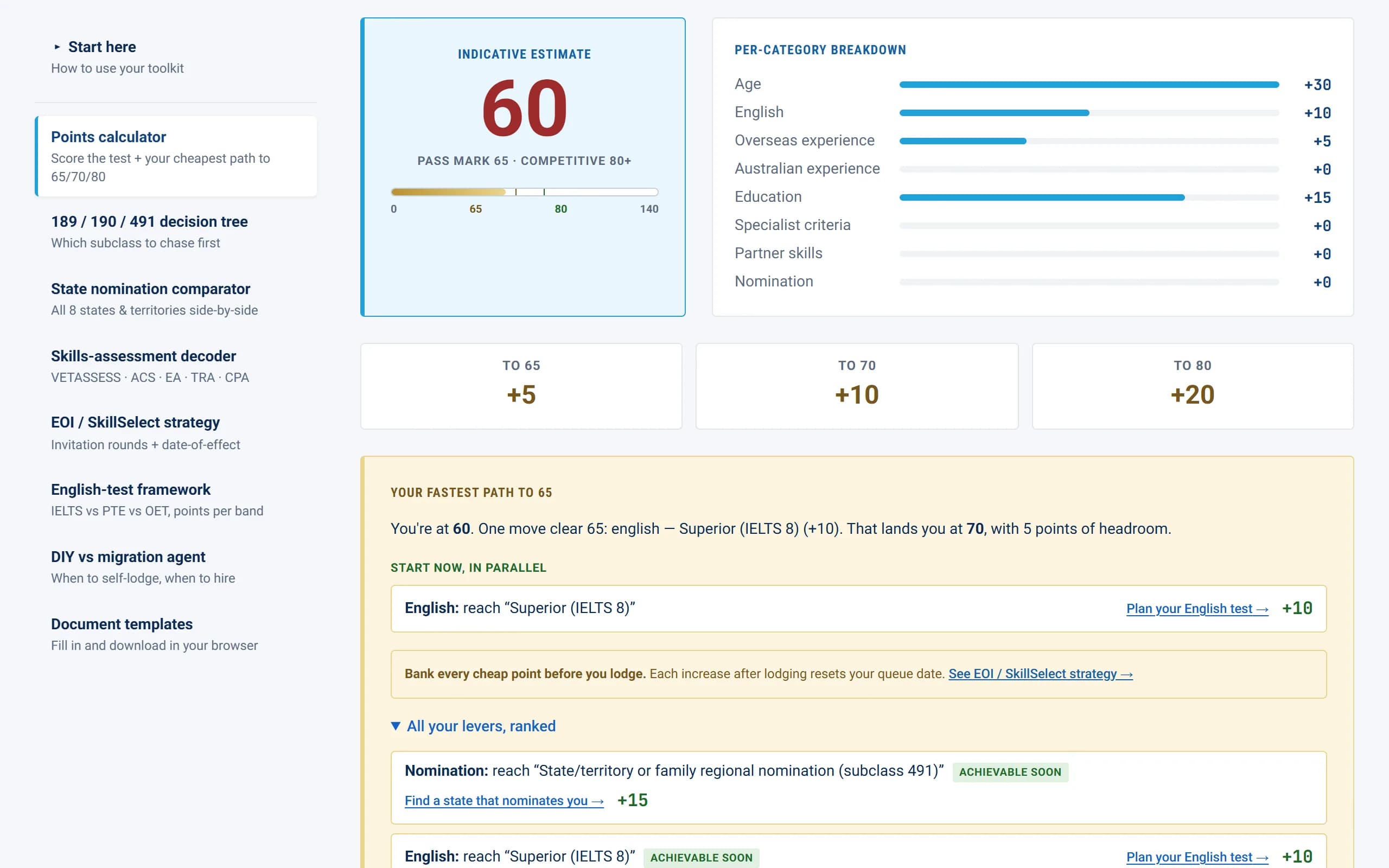
| Points Factor | Points | Notes |
|---|---|---|
| Age 25-32 | 30 | Maximum band |
| Age 33-39 | 25 | Common for experienced production managers |
| Master's | 15 | Common in modern forestry careers |
| Bachelor | 15 | Minimum |
| English Superior (8.0+) | 20 | Plausible for NZ, US, UK candidates |
| English Proficient (7.0) | 10 | Realistic for European, African candidates |
| Overseas experience 8+ years | 15 | The typical profile |
| Regional nomination (491) | 15 | The dominant booster |
| State nomination (190) | 5 | If 190 route |
Realistic Score Scenario
Scenario A — New Zealand softwood Production Manager, 38 years old, BForSc, IELTS 8.0
- Age 25 + Bachelor 15 + English 20 + 8 years experience 15 = 75 points
- Add 491 nomination (+15) = 90 → strong invitation profile in Tasmania or SA
State Nomination
Only states currently nominating 133511 are listed.
Tasmania
Tasmania is the natural home for forestry skilled migration. The state hosts Forico, Sustainable Timber Tasmania, Reliance Forest Fibre, Norske Skog and a network of harvest contractors. Tasmania consistently nominates 133511 under both the 190 and 491 streams, with priority for candidates holding confirmed Tasmanian employer offers. UTAS graduates of the Bachelor of Agricultural Science or Master of Forest Science programs receive additional weighting.
South Australia
South Australia's Green Triangle (Mount Gambier and surrounds) is the centre of Australia's softwood industry. OneFortyOne, Timberlands Pacific, and Carter Holt Harvey Wood Products run substantial operations there. SA nominates 133511 with broader access for offshore senior candidates with confirmed offers.
Victoria
Victoria's plantation estate sits primarily with HVP Plantations across Gippsland and the central highlands. Following the 2024 native forest harvesting wind-down, Victorian demand is concentrated in softwood plantation management. Victoria includes 133511 within its supplementary skilled list for regional candidates outside Melbourne.
Western Australia
WA's South West softwood and hardwood estate, managed by the Forest Products Commission and private operators, occasionally nominates 133511 for candidates with confirmed regional offers. The state's hardwood R&D programs at Murdoch University and DPIRD also create occasional pathways.
Salary and Employment Outlook
| Role | Typical Salary Range (AUD, base) |
|---|---|
| Plantation Production Supervisor | $90,000-$115,000 |
| Production Manager (single estate or mill) | $110,000-$145,000 |
| Senior Production Manager (multi-site) | $140,000-$180,000 |
| Estate Manager / Operations Director | $170,000-$220,000 |
| General Manager Forestry Operations | $200,000-$280,000 |
| CEO mid-cap plantation operator | $280,000-$450,000+ |
Sources: Industry pay surveys (IFA, AFCA), employer-published EBA rates for plantation operators, SEEK Career Advice (2026 — Forester average $85,000-$105,000; senior production roles trend above), the Australian state-of-the-forests reporting framework.
Total packages add 11.5% superannuation, with most regional roles including a vehicle (operational 4WD), housing or housing subsidy at remote locations, and FIFO loading for the most isolated estates. Bonuses of 10-20% are common in private equity-owned plantation operators (HVP, OneFortyOne). Government-owned operators (Sustainable Timber Tasmania, Forestry Corporation NSW) pay lower bases but offer stronger long-service entitlements and 17% superannuation.
Highest-Paying Employer Types
- Private equity-owned plantation operators — HVP, OneFortyOne, Forico, Timberlands Pacific
- Integrated processors — Visy Tumut, AKD Softwoods, Borg Manufacturing
- Forestry consultancies — Margules Groome, Forisk Australia, IndustryEdge
- Major sawmilling groups — Hyne Timber, Carter Holt Harvey Wood Products
- State-owned operators — Sustainable Timber Tasmania, Forestry Corporation NSW (lower base, stronger conditions)
Tips for a Successful Application
-
Position your CV against the Australian production manager profile, not the harvest-supervisor profile. Australian forestry production management spans silviculture, harvest, transport and processing — a wider scope than many overseas roles. Employment references must demonstrate strategic authority across this full chain. Logging-only or sawmill-only experience may require role-bridging language in references.
-
Engage Tasmania or SA early. These are the two states with the deepest forestry employer base and the most active 190/491 nomination for 133511. Lodge EOIs to both jurisdictions if eligible. ACT and metropolitan NSW/VIC do not nominate this occupation in 2026.
-
Demonstrate certification fluency. Australian forestry runs on FSC and Responsible Wood (PEFC) certification. References that show you have managed certification audits, chain-of-custody compliance, and stakeholder engagement on certified estates strengthen the VETASSESS assessment and shorten the on-arrival learning curve.
-
Allow for the longer VETASSESS processing time. 133511 sits at 12-20 weeks for standard processing — twice as long as some other Group B occupations because the role definition requires careful verification against forestry-specific evidence. Use Priority Processing ($825 add-on) if state nomination timelines are tight.
-
Don't confuse 133511 with 133512. Production Manager (Forestry) is forestry-specific. If your role manages a sawmill, particleboard plant or pulp mill in isolation from upstream silviculture, you may sit better under 133512 (Production Manager — Manufacturing). VETASSESS will redirect mis-classified applications, costing time.
Step-by-Step Migration Roadmap
- Confirm 133511 vs 133512 alignment using the ANZSCO code finder
- Verify CSOL inclusion on the Skilled Occupation List 2026
- Gather employment evidence — payslips, contracts, organisation charts, references emphasising silviculture, harvest and supply chain authority
- Sit your English test — IELTS 7.0 minimum, 8.0 for full points
- Lodge VETASSESS skills assessment ($1,096 offshore / $1,205.60 onshore); consider Priority Processing
- Choose visa strategy — 482 sponsorship, 190 (TAS, SA), or 491 (TAS, SA, VIC regional, WA regional)
- If sponsored: confirm employer Standard Business Sponsorship and lodge 482 nomination
- If EOI: submit Expression of Interest in SkillSelect
- Apply for state or regional nomination via the relevant portal
- On invitation, lodge visa within 60 days
- Complete health and character checks
- Receive grant and relocate to the plantation estate
Frequently Asked Questions
How does ANZSCO 133511 differ from 133512 Production Manager (Manufacturing)?
133511 is forestry-specific — silviculture, harvest, transport and downstream processing of forest products. 133512 covers production management in general manufacturing, including standalone sawmill or panel-product operations without upstream forestry responsibility. If your role manages plantation establishment through to log delivery, use 133511. If your role manages a manufacturing facility that buys logs as input, 133512 is the correct code. Mis-classification triggers VETASSESS redirects and delays.
Is the Australian forestry sector still hiring after the native forest wind-down?
Yes. Victoria's native forest harvesting ended in 2024 and WA wound down state-managed native harvesting in 2022, but Australia's commercial forestry future is overwhelmingly softwood and hardwood plantations. Tasmania, the Green Triangle, Tumut/Bombala and South West WA continue to expand plantation throughput. The federal government's Future Forest Industries strategy targets a billion new trees by 2030, which requires senior production management talent.
Can I work in forestry research instead of operations on this code?
Generally no — research-only roles in forestry map better to ANZSCO 234111 (Agricultural Consultant) or 132511 (Research and Development Manager) if you lead a forestry R&D function. The 133511 code requires genuine operational production authority. Forestry researchers at CSIRO, university research forests, or Forest and Wood Products Australia should consider the alternatives.
What's the difference between FSC and Responsible Wood (PEFC) certification, and do I need both?
Both are operational on Australian forestry estates. FSC (Forest Stewardship Council) is the internationally recognised standard, more common in export-oriented operations. Responsible Wood (the Australian endorsed scheme for PEFC) is the dominant domestic standard, particularly for softwood plantations. Most large operators hold both. Familiarity with audit processes, chain-of-custody documentation and stakeholder consultation under either system is essential — and demonstrated experience strengthens VETASSESS submissions.
How long does the full migration timeline take?
Realistic timelines: 10-16 months for the 491 pathway (VETASSESS 12-20 weeks, EOI to invitation 2-6 months, visa processing 5-9 months), or 4-7 months for the 482 with a confirmed sponsoring employer. Tasmania's 190 stream for offshore candidates with employer offers can also move quickly — 6-10 months end-to-end is common when documentation is clean.