Complementary Health Therapists nec Visa Pathway to Australia: Complete 2026 Guide
Updated: 16 August 2026
Australia classifies Complementary Health Therapists nec under ANZSCO 252299. VETASSESS conducts the skills assessment. The occupation sits on the Core Skills Occupation List (CSOL) and STSOL, unlocking subclasses 190, 491, 482 and 186. Typical 2026 salaries range AUD $55,000-$95,000. The "nec" code is a catch-all for complementary therapies without a dedicated ANZSCO code — including Ayurvedic medicine, kinesiology, reflexology and shiatsu.
Quick Facts: Complementary Health Therapists nec Migration Pathway
| Detail | Information |
|---|---|
| ANZSCO Code | 252299 (Complementary Health Therapists not elsewhere classified) |
| Skill Level | 1 (Bachelor degree or higher in a relevant therapy) |
| Skills Assessment | VETASSESS (Vocational Education and Training Assessment Services) |
| Occupation List | CSOL and STSOL — no 189 access |
| Visa Options | 190, 491, 482, 186 |
| Demand Level | Low to moderate — driven by private practice and wellness sector growth |
| Salary Range | AUD $55,000-$95,000 (cross-referenced SEEK, Indeed, PayScale 2026) |
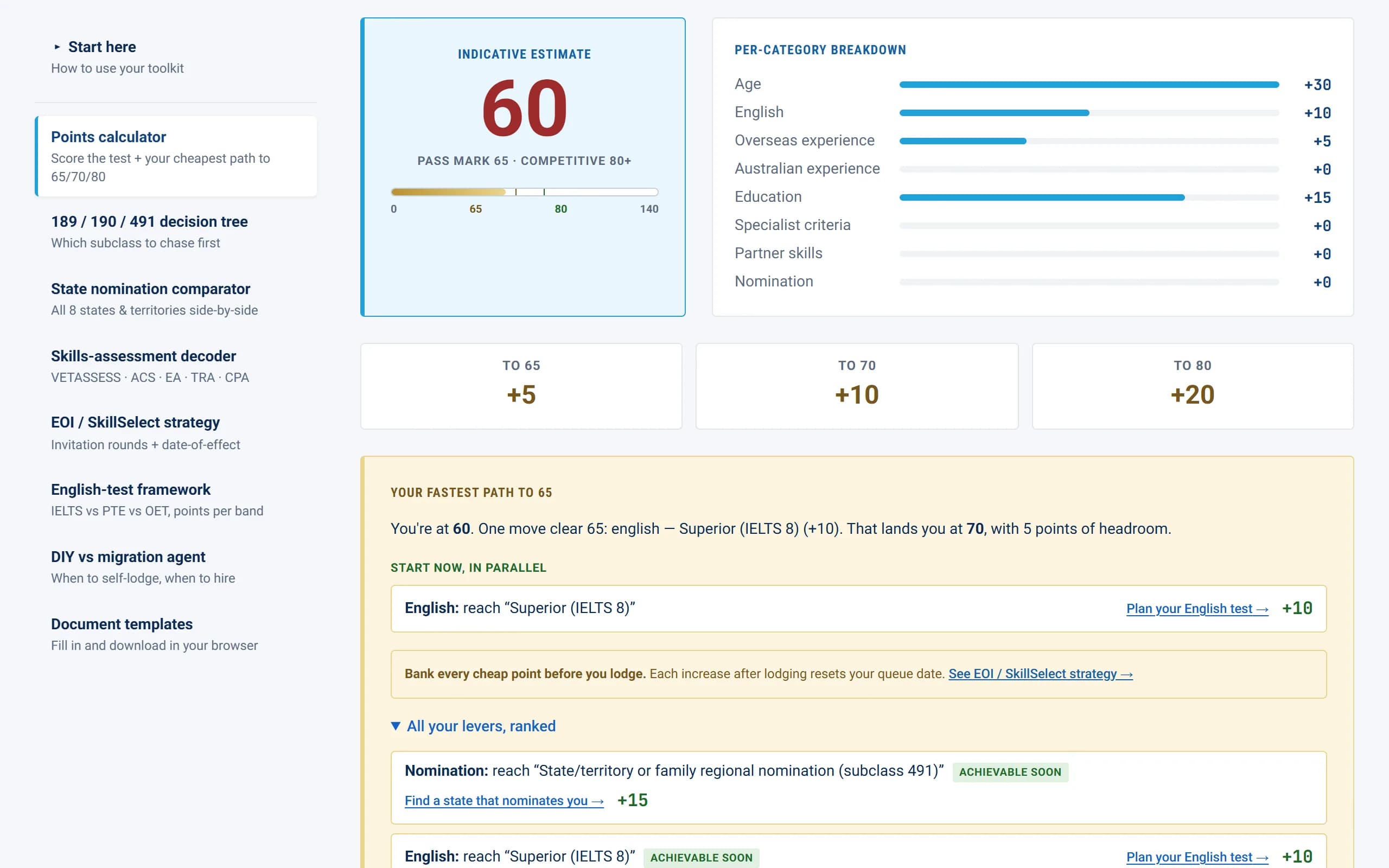
| Typical 190 Score | 75-90 points after state nomination |
| Key Challenge | "nec" classification requires precise mapping — VETASSESS rejects applicants whose duties fit a dedicated code (Acupuncturist, Naturopath, Massage Therapist) |
Role Context: Who Falls Under 252299
ANZSCO 252299 is a residual classification — a not-elsewhere-classified (nec) catch-all for complementary health therapy professionals whose work does not fit one of the dedicated codes in Unit Group 2522 Complementary Health Therapists. Practitioners typically captured under 252299 include:
- Ayurvedic medicine practitioners — the largest applicant group, particularly from India
- Kinesiologists — applying muscle testing to identify imbalances
- Reflexologists — therapeutic foot, hand and ear pressure-point work
- Shiatsu therapists — Japanese pressure-point bodywork beyond standard massage scope
- Iridologists — though now rare given regulatory scrutiny
- Bowen therapists — Australian-origin soft tissue technique
- Aromatherapists — clinical-level, beyond cosmetic spa work
- Music therapists, art therapists — when not assessed under a more specific code
Massage therapists (411611) and Naturopaths (252213) have their own codes and should not use 252299. Acupuncturists (252211) and Traditional Chinese Medicine practitioners (252214) are regulated by CMBA and migrate via separate pathways.
Demand exists primarily in private practice. Multi-disciplinary wellness centres, day spas, integrative health clinics and the cruise/resort sector employ complementary therapists. The Australian Bureau of Statistics estimates that complementary medicine generates over AUD $4 billion annually across product sales and services. The federal government does not subsidise complementary therapies through Medicare, but most private health insurers cover modalities like remedial massage, naturopathy and (in some policies) Ayurvedic consultations under extras.
ANZSCO 252299 — Code Mapping and Tasks
The ANZSCO descriptor for Complementary Health Therapists nec includes practitioners who diagnose, treat and prevent physical and mental disorders, illnesses and injuries through methods that include — but are not limited to — Ayurveda, kinesiology, polarity therapy, reflexology and shiatsu. The unit group sits at Skill Level 1, requiring a Bachelor degree or higher qualification, or equivalent on-the-job experience.
Critical mapping question: does your specific practice have a dedicated ANZSCO code? Run through this filter before nominating 252299:
- Acupuncture only → 252211 Acupuncturist
- Chinese herbal medicine and acupuncture → 252214 TCM Practitioner
- Homoeopathy → 252212 Homoeopath
- Naturopathy → 252213 Naturopath
- Massage therapy (remedial, sports, Swedish) → 411611 Massage Therapist
- Osteopathy → 252112 Osteopath (regulated by AHPRA)
- Chiropractic → 252111 Chiropractor (regulated by AHPRA)
If your primary modality is in the list above, you must nominate the dedicated code, not 252299. VETASSESS rejects 252299 applications where the applicant's duties cleanly fit a more specific code.
Typical tasks under 252299:
- Patient consultation, history-taking, and assessment using the discipline's framework
- Designing individualised treatment plans
- Applying therapy techniques (varies by modality)
- Recommending dietary, lifestyle and herbal supplements where within scope
- Maintaining clinical records compliant with state and modality body standards
Skills Assessment: VETASSESS
VETASSESS is the sole assessing body for 252299. It is classified as a Group A occupation — qualification and employment must both align tightly with the modality claimed.
Qualification requirement:
- An AQF Bachelor degree or higher in a field highly relevant to the specific therapy claimed
- Equivalent overseas qualifications — Ayurveda graduates from accredited Indian universities (BAMS — Bachelor of Ayurvedic Medicine and Surgery) are commonly recognised; Chinese kinesiology and reflexology certifications below degree level usually require additional evidence
Employment requirement:
- At least one year of post-qualification employment at an appropriate skill level in the last five years
- Minimum 20 hours per week in roles highly relevant to the specific modality
Assessment fee: AUD $1,205.60 (within Australia, GST included) or AUD $1,096.00 (non-resident). Priority processing adds AUD $907.50 / $825.00.
Processing time: 7 weeks standard. Priority: 10 business days post-eligibility confirmation.
Common rejection reasons:
- Wrong code choice — applicants nominating 252299 when their work fits Naturopath (252213) or Acupuncturist (252211)
- Insufficient degree level — diploma-level qualifications without supplementary evidence of equivalent learning hours rarely meet the AQF Bachelor standard
- Modality not credibly aligned with ANZSCO 2522 scope — therapies the ABS does not consider "complementary health" (e.g. life coaching, energy healing without a recognised modality framework, reiki without supporting qualifications)
- Employment evidence too generic — references describing "wellness consultations" without naming the specific therapy
Visa Pathways
Subclass 482 — Skills in Demand Visa
Employer sponsorship is the most viable pathway given the niche nature of 252299 roles.
- Visa fee: AUD $4,015 (Core Skills stream)
- Salary threshold: AUD $79,423 minimum (Core Skills, FY2026-27)
- Processing time: Median ~4 months, 90% within 7 months
- Quirk: Most 482 sponsorships for 252299 come from established multi-modality wellness centres, Ayurvedic clinics in metropolitan areas, and a small number of cruise/resort employers
Subclass 190 — Skilled Nominated Visa
PR via state nomination plus 5 points.
- Visa fee: AUD $6,140 (primary applicant)
- Nominating states in 2026: State lists for 252299 are highly limited; South Australia and selected DAMA regions have historically nominated specific Ayurvedic and complementary roles. Verify current rolling lists before lodging
- Processing time: 6-12 months after nomination
Subclass 491 — Skilled Work Regional Visa
Five-year provisional regional visa with PR pathway via subclass 191.
- Visa fee: AUD $6,140 (primary applicant)
- Quirk: Regional Australia has rising demand for complementary health practitioners; some DAMA agreements (e.g. Far North Queensland, Goldfields WA) have included complementary therapy roles where rural communities lack access
Subclass 186 — Employer Nomination Scheme
Permanent residency via employer sponsorship.
- Visa fee: AUD $6,140 (primary applicant)
- Processing time: Direct Entry stream median 12-13 months
- Quirk: Direct Entry requires three years of relevant experience; TRT after two years on 482 is the more accessible route
State Nomination for Complementary Health Therapists
South Australia
South Australia is the most accessible state for 252299, particularly for Ayurvedic practitioners with a confirmed Adelaide-based clinic offer or strong settlement evidence. The 2025-26 program has 2,250 nomination places, with approximately 30% remaining as of March 2026.
Victoria
Victoria nominates from broad healthcare priority sectors. Melbourne's Indian-Australian community supports demand for Ayurvedic clinics, particularly in Dandenong, Wyndham and Casey. State lists update periodically — confirm 252299 status at EOI time.
States that do not currently nominate ANZSCO 252299 should be confirmed against published rolling lists. NSW, QLD, WA, TAS, ACT and NT have not consistently nominated this occupation in 2025-2026.
Salary and Employment Outlook
What Complementary Health Therapists Earn in 2026
| Role | Typical Salary Range (AUD) |
|---|---|
| Entry-level practitioner (employee, 1-3 yrs) | $52,000-$68,000 |
| Established Ayurvedic practitioner | $65,000-$90,000 |
| Senior practitioner / clinic lead (8+ yrs) | $80,000-$110,000 |
| Clinic owner (principal) | $80,000-$160,000+ (revenue-dependent) |
| Hourly contractor rate | $75-$120 per hour |
Source: PayScale Australia 2026, Indeed Australia salary aggregator, Endeavour College of Natural Health career data, cross-referenced against published 252299 SEEK listings.
Income is highly modality-dependent. Ayurvedic practitioners in established Indian-community clinics earn at the upper end. Kinesiologists, reflexologists and Bowen therapists more commonly work as contractors or sole traders, with income tracking client volume. The combined effect of private health insurance coverage and out-of-pocket fees means most established practitioners can sustain a viable practice within 3-5 years.
Sectors and Employers
- Multi-disciplinary wellness clinics — primary employer type in metropolitan Sydney, Melbourne and Brisbane
- Ayurvedic centres — particularly in Melbourne (Dandenong, Wyndham), Sydney (Parramatta, Liverpool) and Perth
- Day spas and resort wellness centres — Gold Coast, Cairns, Byron Bay
- Sports medicine and rehabilitation centres — for kinesiology and Bowen therapy
- Integrative oncology and palliative care — small but emerging segment
Tips for a Successful Application
1. Make the code choice deliberate and defensible
If your work could plausibly fit either 252299 or a more specific code (Acupuncturist, Naturopath, Massage Therapist), choose the specific code. VETASSESS rejects 252299 applications where a dedicated code applies. Document the reasoning in your supporting statement.
2. Demonstrate Bachelor-equivalent learning, not just experience
Diploma-level qualifications below 1,200 hours of formal training rarely clear the Bachelor-equivalent standard. Ayurveda graduates with BAMS or BSc (Hons) Ayurveda have the strongest foundation. Practitioners with diploma-level training should expect to provide supplementary evidence of post-graduate hours, mentor supervision and continuing professional development to bridge the gap.
3. Align employment evidence to the specific modality
Generic "complementary health consultations" wording invites VETASSESS scepticism. References must name the modality, describe the assessment framework, list typical techniques applied, and quantify patient volumes. References from registered industry bodies (Australian Traditional Medicine Society, Ayurvedic Association of Australia) carry weight.
4. Verify state list status before paying assessment fees
State nomination for 252299 is volatile. Lists update at the start of each program year and rolling updates occur throughout. Pay the VETASSESS fee only after confirming at least one viable state nomination path, or that employer sponsorship is in motion.
5. Target employer sponsorship at established multi-location clinics
Sole-practitioner clinics struggle to sponsor under 482 because the labour market test and genuine need requirements are demanding. Multi-location wellness brands, established Ayurvedic groups and integrative medicine centres are stronger sponsors.
Step-by-Step Migration Roadmap
- Confirm your role maps to 252299 — review the ANZSCO code finder and rule out dedicated codes first
- Check CSOL and state list status — confirm 252299 remains on the Core Skills Occupation List
- Collect qualification evidence — degree certificates, transcripts, syllabus, clinical hours documentation
- Gather employment references — modality-specific, on letterhead, signed by clinic owner or department head
- Sit your English test — IELTS, PTE, OET; aim for Superior if pursuing 190
- Submit VETASSESS application — AUD $1,205.60, expect 7 weeks
- Submit EOI in SkillSelect for 190/491, or secure employer sponsorship for 482/186
- Apply for state nomination — South Australia is the most accessible path
- Receive invitation and lodge visa within 60 days
- Complete health and character checks
- Receive grant and relocate — register with relevant modality body (e.g. ATMS, AAA) on arrival
Frequently Asked Questions
What therapies fall under ANZSCO 252299?
Ayurveda, kinesiology, polarity therapy, reflexology, shiatsu, Bowen therapy, and other complementary health modalities without a dedicated ANZSCO code. Acupuncture, TCM, naturopathy, homoeopathy, massage therapy, osteopathy and chiropractic each have their own codes and cannot use 252299.
Is Ayurveda recognised by VETASSESS under 252299?
Yes. Graduates of accredited Indian Ayurvedic programs (BAMS — Bachelor of Ayurvedic Medicine and Surgery, or equivalent five-and-a-half-year degree including internship) are the largest group assessed under 252299. The qualification must be from a university recognised by India's Central Council of Indian Medicine or its successor body, and employment must demonstrate Ayurvedic consultations as the primary work.
Do I need AHPRA registration for 252299?
No. The therapies grouped under 252299 are not regulated by AHPRA — they are self-regulated through industry bodies such as the Australian Traditional Medicine Society (ATMS) and the Australian Natural Therapists Association (ANTA). Voluntary registration with one of these bodies is required by most private health insurers for rebates and is strongly recommended for credibility.
Why is 252299 not on the MLTSSL?
Jobs and Skills Australia does not classify the residual complementary health category as a critical national shortage. 252299 sits on the CSOL and STSOL, which restricts visa options to 190, 491, 482 and 186. The subclass 189 independent skilled visa is not available.
Can I work as a sole trader from grant date?
Yes, on the 190 and 491 visas. Both permit self-employment from grant. Employer-sponsored visas (482 and 186) tie you to the sponsor until you complete the visa requirements and apply for an alternative pathway. Most complementary health therapists eventually transition to sole-trader practice or open their own clinics within 3-5 years of arrival.
Which Australian industry body should I join?
The Australian Traditional Medicine Society (ATMS) and the Australian Natural Therapists Association (ANTA) are the two largest peak bodies covering 252299 modalities. Membership requires evidence of qualification, professional indemnity insurance, continuing professional development, and adherence to a code of conduct. Private health fund rebates almost always require membership of one of these bodies.