Gasfitter Visa Pathway to Australia: Complete 2026 Guide
Updated: 16 August 2026
Australia classifies Gasfitter under ANZSCO 334114. Trades Recognition Australia (TRA) conducts the skills assessment, ordinarily through the Job Ready Program. The occupation is on the Core Skills Occupation List, unlocking subclasses 189, 190, 491, 482 and 186. Typical 2026 salaries range AUD $75,000-$110,000. Trades remain Australia's deepest persistent shortage category in 2026.
Quick Facts: Gasfitter Migration Pathway
| Detail | Information |
|---|---|
| ANZSCO Code | 334114 (Gasfitter) |
| Skill Level | 3 (AQF Certificate III or IV with relevant work experience) |
| Skills Assessment | TRA (Trades Recognition Australia) — Job Ready Program |
| Occupation List | CSOL and MLTSSL |
| Visa Options | 189, 190, 491, 482, 186 |
| Demand Level | High — trades sit at the centre of Australia's persistent shortage profile |
| Salary Range | AUD $75,000-$110,000 (SEEK Salary Hub, 2026) |
| Typical 189 Score | 65-80 (trades clear at lower thresholds than ICT) |
| Key Challenge | TRA Job Ready Program runs 12+ months and requires paid employment in Australia |
Role Context in Australia
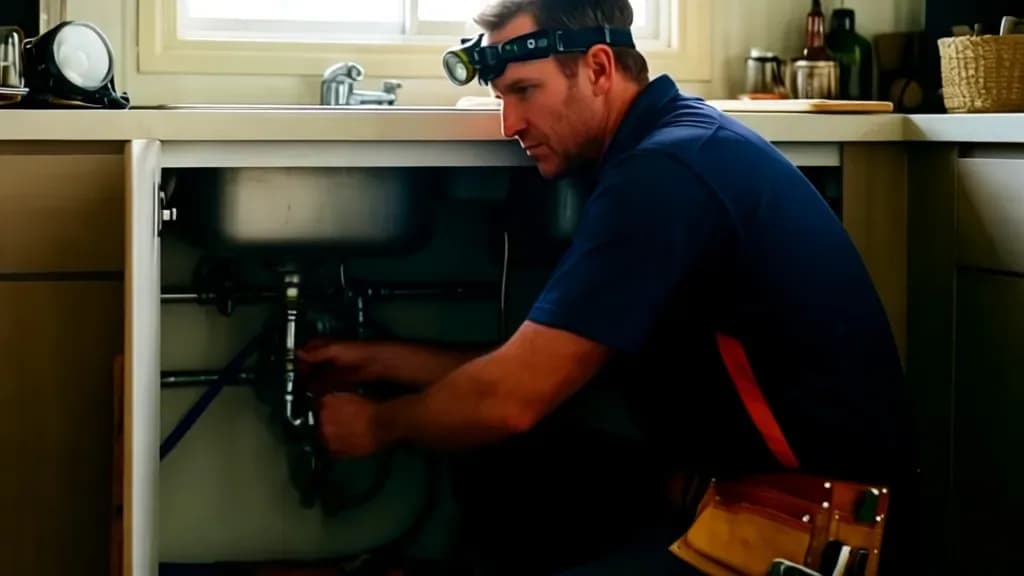
Gasfitters install, maintain and repair gas mains, piping systems downstream of the billing meter, and the appliances and ancillary equipment associated with fuel gases — natural gas, LPG and increasingly hydrogen blends. The work is licensed in every state and territory. In most jurisdictions you cannot legally connect a gas appliance unless you hold the relevant state licence, which sits on top of your trade qualification.
Demand is structural rather than cyclical. Australia's housing pipeline, the gradual electrification of inner-city dwellings, the LPG conversion work that follows mains decommissioning, and the continuing rollout of commercial kitchens, hospitals and aged-care facilities all keep the trade in deficit. Western Australia, Queensland and Victoria carry the heaviest load — WA because of mining and resources camps, Queensland because of new residential builds in the south-east, and Victoria because of the continuing volume of gas-fed housing stock undergoing renovation. Jobs and Skills Australia rates Technicians and Trades Workers as the single largest contributor to persistent national shortage, with trade fill rates well below 60%.
ANZSCO Code Mapping: 334114
ANZSCO 334114 covers the installation, maintenance and repair of gas systems downstream of the meter. Day-to-day tasks include reading plans and specifications, marking the position of installations, cutting and threading pipe, installing fittings and appliances, testing for leaks, commissioning systems, and certifying work against the relevant Australian Standard (AS/NZS 5601).
The code is distinct from 334111 Plumber (General) and 334115 Roof Plumber, but gasfitting work is frequently combined with general plumbing in practice. Tradespeople holding a dual ticket usually nominate based on the work that dominates their last three to five years of experience. If your work is split roughly evenly, TRA will look at the volume of evidence for each — choosing the wrong code triggers an unfavourable outcome.
Skills Assessment: Trades Recognition Australia
Trades Recognition Australia is the assessing body for all gasfitter applicants. Offshore applicants almost always run through the Job Ready Program (JRP), which is the only TRA pathway that ends in a full skills assessment outcome for visa purposes for most non-Australian-trained candidates.
Job Ready Program — the four stages
Stage 1 — Provisional Skills Assessment (PSA)
Documentary review of your overseas qualification and employment history against the Australian benchmark (Certificate III in Gasfitting or equivalent). Requires identity documents, qualifications, employment references, and at least three years of relevant post-qualification employment. Fee: AUD $1,130. Outcome ordinarily issued in 10-12 weeks. A positive PSA lets you apply onshore for a subclass 485 Temporary Graduate or arrive in Australia to commence paid employment for stage 2.
Stage 2 — Job Ready Employment (JRE)
Minimum 12 months of full-time paid employment in Australia in the nominated occupation, with at least 360 hours logged and verified. Fee: AUD $400. You must be paid award wages, work for an Australian-registered employer, and submit quarterly evidence (payslips, employer reports, work diaries).
Stage 3 — Job Ready Workplace Assessment (JRWA)
On-site practical assessment by a TRA-approved assessor. The assessor observes you completing tasks across the gasfitter unit competencies. Fee: AUD $2,575. Failures usually centre on gaps in compliance documentation rather than the practical work itself.
Stage 4 — Job Ready Final Assessment (JRFA)
Final documentary check. Fee: AUD $400. A successful JRFA is the skills assessment outcome you cite on your visa application.
Total TRA cost: approximately AUD $4,500 across the four stages, with the full cycle running 14-18 months from PSA lodgement. Common rejection reasons include employment references that do not describe the full range of gasfitter duties, qualifications that lack the gas-specific units, and incomplete payslip evidence during JRE.
Offshore Skills Assessment Program (OSAP)
A smaller cohort qualifies for the offshore pathway, which compresses the entire process into a single in-country technical interview and practical assessment. Eligibility is narrow — it is open to applicants from a defined list of countries with reciprocal qualification frameworks. Most applicants from South Asia, the Middle East and Africa are not eligible for OSAP and must use the Job Ready Program.
State licensing — a separate requirement
A positive TRA outcome lets you migrate. It does not let you work as a gasfitter. Every state and territory requires a separate gasfitting licence, issued by the relevant plumbing or energy regulator (Victorian Building Authority, NSW Fair Trading, Queensland Plumbers and Drainers Licensing Council, etc.). Begin the licensing application as soon as your visa is granted — most states process licences in 6-12 weeks once the documentary trail is complete.
Visa Pathways for Gasfitters
Subclass 482 — Skills in Demand (SID)
In practice the dominant onshore route for offshore-trained gasfitters, because the Job Ready Program requires Australian employment. An Australian employer sponsors you for up to four years.
- Visa fee: AUD $4,015 (Core Skills stream, primary applicant)
- Salary threshold: Core Skills Income Threshold AUD $79,423 (2026)
- Processing time: 1-3 months in the Core Skills stream
- Quirk: Trades nominations on 482 frequently arrive in 4-8 weeks once nomination is approved — well faster than ICT roles
Subclass 189 — Skilled Independent
Permanent residency through the points test. Gasfitter sits on the MLTSSL so it is eligible.
- Visa fee: AUD $6,135 (primary applicant)
- Realistic invitation score: 65-80 points
- Processing time: 6-18 months from invitation
- Quirk: Trades historically clear at lower scores than ICT and accounting. A gasfitter at 70 points has a realistic chance of invitation — an ICT business analyst at 70 points does not.
Subclass 190 — Skilled Nominated
State nomination adds 5 points and grants permanent residency, with a two-year residency commitment to the nominating state.
- Visa fee: AUD $6,140
- Best states: Victoria, South Australia, Queensland, Tasmania — all carry gasfitter on their 2025-26 lists
- Processing time: 6-12 months post-invitation
Subclass 491 — Skilled Work (Regional)
Five-year provisional regional visa with a pathway to PR (subclass 191) after three years of regional residency and a qualifying income. Adds 15 points. Strong fit for gasfitters willing to settle in regional Victoria, South Australia, Tasmania or regional WA.
- Visa fee: AUD $6,140
- Processing time: 6-9 months
- Quirk: Regional Australia is where gasfitter shortages are most acute. State invitations for trades are noticeably easier to secure outside the major capitals.
Subclass 186 — Employer Nomination Scheme
Permanent residency through employer sponsorship. Available via the Direct Entry stream (three years post-qualification skilled experience plus skills assessment) or the Temporary Residence Transition stream (typically after two years on 482).
- Visa fee: AUD $6,140
- Processing time: 3-7 months (Direct Entry), 6-12 months (TRT)
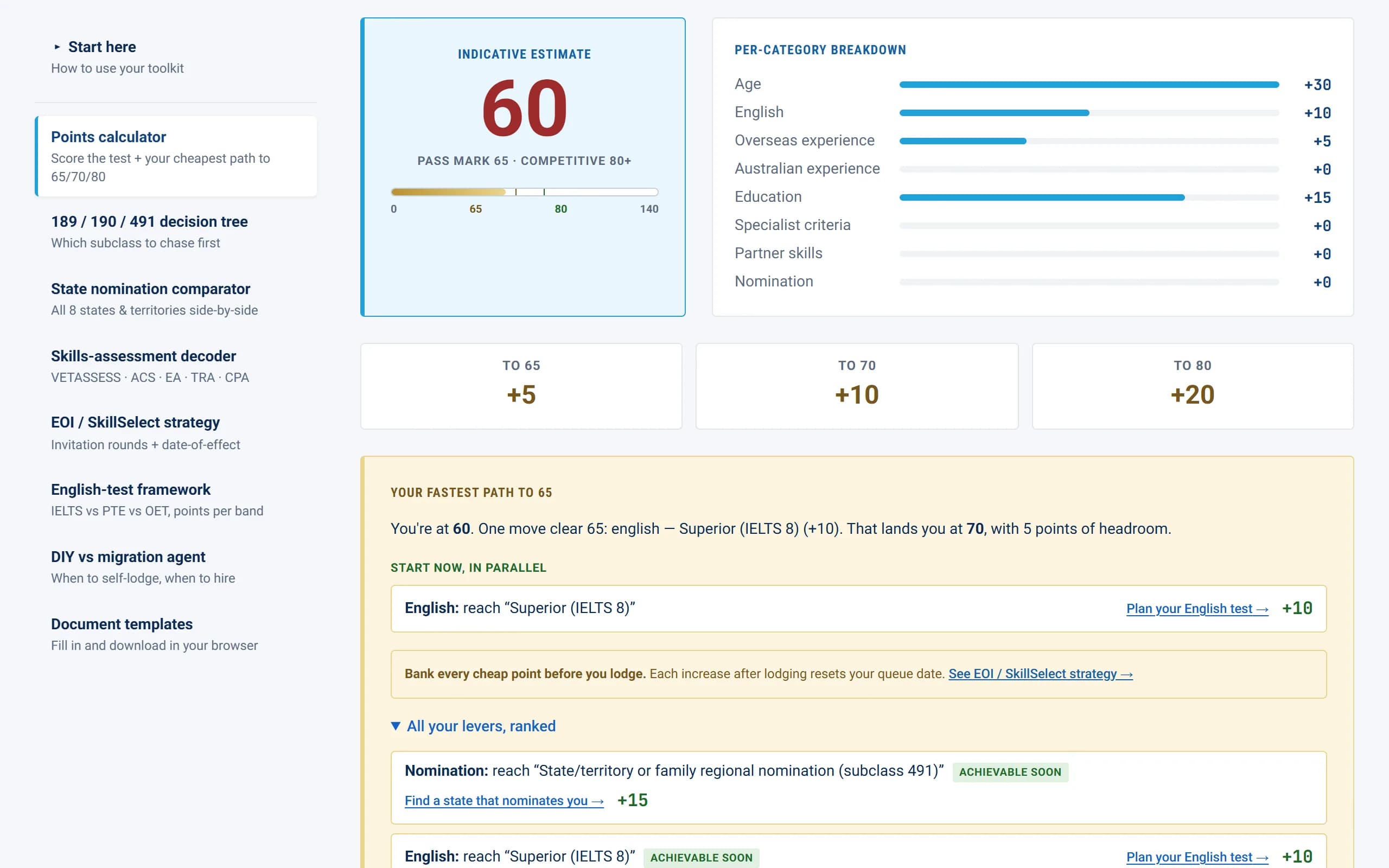
Points Test Strategy for Gasfitters
Most successful gasfitter applicants land between 65 and 80 points before state nomination. The two scenarios below are typical.
| Points Factor | Points | Notes |
|---|---|---|
| Age 25-32 | 30 | Maximum band |
| Age 33-39 | 25 | Most experienced gasfitters sit here |
| AQF Diploma / Cert IV | 10 | Trade qualification |
| English Competent (IELTS 6) | 0 | Floor |
| English Proficient (IELTS 7) | 10 | Realistic stretch |
| Australian work 1-3 yrs | 5 | After Job Ready Employment |
| Overseas work 5-8 yrs | 10 | Common for mid-career applicants |
| State 190 nomination | 5 | |
| Regional 491 nomination | 15 | |
| Partner skills (skilled occupation + Competent English) | 10 |
Scenario A — Mid-career applicant, 34, two years post-JRP, Proficient English Age 25 + Cert III 10 + English 10 + Overseas exp 10 + Australian exp 5 = 60. Add state nomination (190) = 65. Realistic for invitation given trade thresholds.
Scenario B — Younger applicant, 28, just completed JRP, Competent English, partner skilled Age 30 + Cert III 10 + English 0 + Overseas exp 10 + Partner 10 = 60. Add 491 regional nomination (+15) = 75. Strong position for regional invitation.
State Nomination
Victoria
Victoria carries plumbing and gasfitting trades on its priority list for 2025-26, with explicit weighting toward construction and energy transition roles. The Live in Melbourne program requires a registration of interest before any invitation. Offshore candidates need at least three years of post-qualification experience.
South Australia
South Australia opened its 2025-26 list to all skilled occupations and treats trades as a priority category. Regional SA (Adelaide is metropolitan, the rest of the state is regional for 491 purposes) has consistently strong invitation rates for gasfitters and roof plumbers.
Queensland
Queensland Skilled Occupation List (QSOL) places trades under the Building and Construction Pathway, which attracts higher invitation priority. Brisbane, the Gold Coast and the Sunshine Coast all have residential construction pipelines that absorb gasfitter capacity.
Tasmania
Tasmania includes gasfitter on its skilled migration list and runs one of the most accessible 491 pathways for trades. Two years of full-time work in Tasmania satisfies the regional residency for transition to PR via subclass 191.
Western Australia
The WA Graduate stream and Skilled Migration stream both list 334114. WA's resources sector and the volume of LPG conversion work outside Perth keep demand high.
Salary and Employment Outlook
| Role | Typical Salary Range (AUD) |
|---|---|
| Gasfitter (entry, post-trade) | $75,000-$85,000 |
| Gasfitter (3-5 years) | $85,000-$100,000 |
| Senior gasfitter / leading hand | $100,000-$120,000 |
| Commercial / industrial gasfitter | $110,000-$140,000 |
| Fly-in fly-out (resources) | $130,000-$180,000 |
| Self-employed gasfitter (gross) | $150,000-$250,000+ |
Source: SEEK Salary Hub 2026, cross-checked against Jora and Builders Academy industry data. Salaries quoted are base pay; superannuation (11.5% in FY26) and tool/vehicle allowances sit on top.
Highest-paying sectors and employer types:
- Resources and energy — FIFO contracts in WA and Queensland resources camps pay the largest premiums, often with rosters of 2-on/1-off
- Commercial construction — high-rise residential and commercial fit-outs in Sydney, Melbourne and Brisbane
- Hospitals and aged care — institutional plumbing contractors with long-term maintenance contracts
- Government utilities — Jemena, AGN, Multinet and equivalent network operators
- Self-employed domestic and commercial work — the highest ceiling but the longest path to it
Tips for a Successful Application
-
Verify gas-specific units before you lodge the PSA. A general plumbing certificate without dedicated gas units (typical of many South Asian programs) will not pass TRA's qualification benchmark. If your qualification lacks the gas units, plan for an Australian gap-training pathway through a TAFE.
-
Run state licensing in parallel with TRA, not after. Each state has its own evidentiary requirements, and the documents TRA accepts are not always identical to what NSW Fair Trading or the VBA expects. Build both files at the same time.
-
Pick your nominated employer carefully for JRE. The Job Ready Employment stage requires an Australian-registered employer paying award wages with full superannuation. Cash-in-hand subcontract arrangements do not count, and TRA audits the evidence aggressively.
-
For partnered applicants, get your partner's skills assessment moving early. A skilled partner with Competent English contributes 10 points and a partner Professional Year contributes another 5. This is often the difference between a 60-point file and a 75-point file.
-
If you can flex to regional, do. The shortest path to permanent residency for a gasfitter in 2026 is a 491 in regional South Australia or Tasmania, not a 189 in Sydney. The points maths and the invitation cadence both favour regional applications.
Step-by-Step Migration Roadmap
- Confirm your trade qualification maps to Certificate III in Gasfitting using the ANZSCO code finder
- Sit your English test — aim for IELTS 7 across all bands for Proficient points
- Lodge the TRA Provisional Skills Assessment (AUD $1,130)
- Secure an Australian employer for Job Ready Employment — many migrants arrive on a 485 or short-stay work visa
- Complete 12 months / 360 hours of paid employment (JRE)
- Pass the Job Ready Workplace Assessment (JRWA)
- Receive your JRFA outcome — this is your skills assessment for visa purposes
- Lodge the SkillSelect EOI for 189, 190 or 491 — or pursue 482 employer sponsorship in parallel
- Apply for state nomination if pursuing 190 or 491
- Receive invitation and lodge visa within 60 days
- Apply for the state gasfitting licence in your destination state
- Complete health and character checks, receive grant, commence work
Frequently Asked Questions
Do I need a separate state licence after my TRA assessment?
Yes. The TRA outcome qualifies you for a skilled migration visa. It does not authorise you to perform gasfitting work in Australia. Each state and territory issues its own gasfitter licence — Victorian Building Authority, NSW Fair Trading, QBCC in Queensland, Building and Energy in WA, and so on. Apply for the relevant licence as soon as you arrive; most states clear the application in 6-12 weeks.
Can I migrate as a gasfitter without doing the Job Ready Program?
In most cases, no. The JRP is the standard pathway for offshore-trained tradespeople. The narrow exception is the Offshore Skills Assessment Program (OSAP), which is limited to a small set of qualifying countries with reciprocal qualification frameworks. Applicants from most South Asian, Middle Eastern and African qualification systems route through the JRP.
Which state has the highest demand for gasfitters in 2026?
Western Australia, Queensland and Victoria lead on volume. Regional South Australia and Tasmania often have the lowest invitation thresholds for state nomination because the candidate pool is smaller. If you optimise for fastest grant rather than highest pay, look at SA and Tasmania. If you optimise for income, look at WA resources work.
How long does the full pathway take?
From PSA lodgement to a permanent residency grant is typically 24-36 months. The JRP itself accounts for 14-18 months. State nomination adds 2-6 months. Visa processing adds 6-12 months. Applicants who go via 482 employer sponsorship can be in Australia and working within 6-9 months but then face a separate pathway to PR.
Are gasfitter qualifications from the UK, Ireland or New Zealand recognised more easily?
Generally yes. Qualifications from countries with reciprocal frameworks (UK Gas Safe, NZ certifying gasfitter, Irish RGI) are recognised through OSAP or the trans-Tasman arrangement and may bypass parts of the Job Ready Program. Applicants from these jurisdictions should confirm eligibility directly with TRA before assuming the OSAP route is open.
What's the most common reason a gasfitter application fails?
Employment references that do not match the ANZSCO description. TRA reads the references against the gasfitter unit competencies — if your references describe general plumbing without naming gas-specific work (LPG conversion, appliance commissioning, leak testing, pressure testing), the application stalls. Get your referees to use the exact ANZSCO language and the AS/NZS 5601 reference points.