Roof Plumber Visa Pathway to Australia: Complete 2026 Guide
Updated: 16 August 2026
Australia classifies Roof Plumber under ANZSCO 334115. Trades Recognition Australia (TRA) conducts the skills assessment via the Job Ready Program. The occupation is on the Core Skills Occupation List and MLTSSL, opening subclasses 189, 190, 491, 482 and 186. Typical 2026 salaries range AUD $75,000-$110,000, with commercial high-rise roofers exceeding $130,000. Trades are Australia's deepest shortage category in 2026.
Quick Facts: Roof Plumber Migration Pathway
| Detail | Information |
|---|---|
| ANZSCO Code | 334115 (Roof Plumber) |
| Skill Level | 3 (AQF Certificate III in Roof Plumbing or equivalent) |
| Skills Assessment | TRA (Trades Recognition Australia) — Job Ready Program |
| Occupation List | CSOL and MLTSSL |
| Visa Options | 189, 190, 491, 482, 186 |
| Demand Level | High — construction trades sit at 51% of national persistent shortages |
| Salary Range | AUD $75,000-$110,000 (SEEK Salary Hub, 2026); $130,000+ in commercial high-rise |
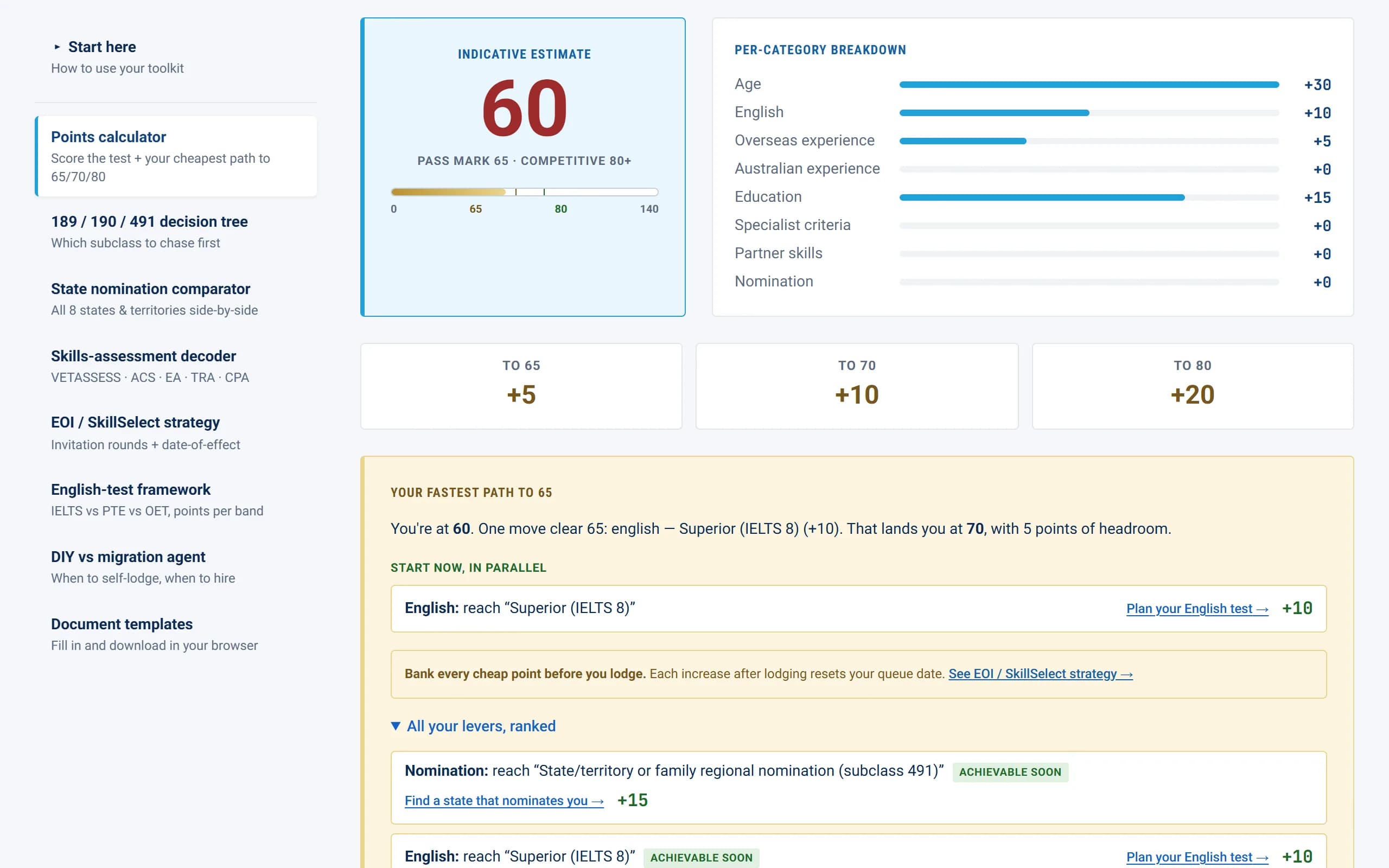
| Typical 189 Score | 65-80 (trades clear lower than ICT) |
| Key Challenge | Cert III in Roof Plumbing is a narrow qualification — generalist plumbing certificates often need supplementary training |
Role Context in Australia
Roof plumbers install, maintain and repair metallic roof and wall claddings, gutters, downpipes, flashings, box gutters and rainwater systems. The work overlaps with metal roofing and sheet metal trades but is regulated separately in most jurisdictions because of the integrated stormwater and waterproofing scope. The trade is licensed in every state and territory; you cannot legally connect a downpipe to mains stormwater without a roof plumbing licence in NSW, Victoria, Queensland or WA.
Demand is driven by Australia's residential construction pipeline, the volume of insurance-driven roof replacements after hail and storm events (Sydney and South-East Queensland both have heavy insurance cycles), the rollout of commercial warehouse and industrial sheds, and the ongoing solar PV installation work that often requires roof plumbing involvement. Queensland, NSW and Victoria carry the deepest pipelines. Jobs and Skills Australia lists Plumbers (the parent unit group 3341, which includes 334115) as a persistent shortage occupation; trade fill rates nationally dropped to 54.3% on the most recent shortage survey.
ANZSCO Code Mapping: 334115
ANZSCO 334115 covers the installation, maintenance and repair of metal roof claddings, gutters, downpipes and ancillary rainwater goods. Tasks include reading plans and specifications, marking out roofs, fabricating flashings, installing sheeting, sealing penetrations, and ensuring stormwater discharge complies with the Plumbing Code of Australia and the National Construction Code.
The code is distinct from 334111 Plumber (General), 334114 Gasfitter and 334117 Fire Protection Plumber. Many tradespeople hold a dual ticket (general plumber + roof plumber), but TRA assesses against the dominant occupation evidenced in the last three to five years of employment. If your work is roughly even, the safer ANZSCO is the one your employer references describe most thoroughly.
Skills Assessment: Trades Recognition Australia
Trades Recognition Australia is the assessing body for all roof plumber applicants. Most offshore-trained candidates run through the Job Ready Program (JRP), which delivers the full skills assessment outcome required for skilled migration.
Job Ready Program — the four stages
Stage 1 — Provisional Skills Assessment (PSA)
Documentary review of your overseas qualification and employment history against the Australian Certificate III in Roof Plumbing benchmark. Requires identity documents, qualifications, employment references (minimum three years post-qualification), and English evidence at functional level. Fee: AUD $1,130. Typical outcome in 10-12 weeks.
Stage 2 — Job Ready Employment (JRE)
Minimum 12 months of full-time paid employment in Australia in the nominated occupation (360 hours minimum). Must be with an Australian-registered employer paying award wages with superannuation. Fee: AUD $400. Most candidates use a 485 graduate visa, 482 sponsorship or a short-stay work visa to satisfy this stage.
Stage 3 — Job Ready Workplace Assessment (JRWA)
On-site practical assessment by a TRA-approved assessor across the roof plumbing competencies — flashings, downpipe fabrication, sheet installation, and stormwater connection. Fee: AUD $2,575.
Stage 4 — Job Ready Final Assessment (JRFA)
Final documentary review. Fee: AUD $400. Issues the final skills assessment outcome you cite on the visa application.
Total TRA cost: approximately AUD $4,500. Full cycle: 14-18 months. The most common rejection driver is qualification mismatch — many general plumbing qualifications from South Asia and the Middle East do not contain dedicated roof plumbing units. In that case, TRA requires gap-training through an Australian RTO before the workplace assessment can proceed.
Offshore Skills Assessment Program (OSAP)
OSAP is open to a limited list of countries with reciprocal qualification arrangements. Most South Asian, Middle Eastern and African applicants are not eligible and must use the JRP. UK, Irish and New Zealand qualifications typically qualify for OSAP, which can compress the timeline to 4-6 months.
State licensing — separate from TRA
A positive TRA outcome qualifies you for a skilled visa. It does not authorise you to perform roof plumbing work in Australia. Every state requires a separate restricted plumbing licence in the roofing sub-class:
- NSW — NSW Fair Trading roof plumbing endorsement
- Victoria — Victorian Building Authority (VBA) registration in the roofing class
- Queensland — QBCC roof drainage and stormwater licence
- WA — Building and Energy plumbing permit
- SA — Consumer and Business Services plumbing licence
Build your state licensing file in parallel with TRA — the evidence overlap is large and the timing avoids a 3-month gap between visa grant and your first paid job.
Visa Pathways for Roof Plumbers
Subclass 482 — Skills in Demand (SID)
The dominant route for offshore-trained roof plumbers, because the JRP requires Australian employment. An employer sponsors you for up to four years.
- Visa fee: AUD $3,210 (Core Skills stream, primary applicant)
- Salary threshold: Core Skills Income Threshold AUD $73,150 (2026)
- Processing time: 1-3 months in the Core Skills stream
- Quirk: Trade nominations on 482 clear faster than professional occupations — often inside 6 weeks once nomination is approved
Subclass 189 — Skilled Independent
Permanent residency through the points test. Roof Plumber sits on the MLTSSL.
- Visa fee: AUD $6,135
- Realistic invitation score: 65-80 points
- Processing time: 6-18 months from invitation
- Quirk: Trade occupations clear at materially lower scores than ICT — a roof plumber at 70 points has a realistic chance of a 189 invitation
Subclass 190 — Skilled Nominated
State nomination adds 5 points plus permanent residency with a two-year residency commitment.
- Visa fee: AUD $6,140
- Best states: Victoria, South Australia, Queensland, Tasmania all list 334115 in 2025-26
- Processing time: 6-12 months post-invitation
Subclass 491 — Skilled Work (Regional)
Five-year provisional regional visa, +15 points, with a PR pathway via subclass 191 after three years of regional residency and a qualifying income.
- Visa fee: AUD $6,140
- Processing time: 6-9 months
- Quirk: Regional Australia carries the most acute roof plumber shortage. State invitations for trades come faster outside the capital metros.
Subclass 186 — Employer Nomination Scheme
Permanent residency via employer sponsorship. Direct Entry stream requires three years of skilled post-qualification experience plus the TRA outcome; TRT stream typically follows two years on a 482.
- Visa fee: AUD $6,140
- Processing time: 3-7 months Direct Entry; 6-12 months TRT
Points Test Strategy for Roof Plumbers
| Points Factor | Points | Notes |
|---|---|---|
| Age 25-32 | 30 | Maximum band |
| Age 33-39 | 25 | Common mid-career range |
| Cert IV or Diploma | 10 | Trade qualification |
| English Competent (IELTS 6) | 0 | Floor |
| English Proficient (IELTS 7) | 10 | Stretch but achievable |
| Australian work 1-3 yrs | 5 | After JRE |
| Overseas work 5-8 yrs | 10 | Typical mid-career |
| State 190 nomination | 5 | |
| Regional 491 nomination | 15 | |
| Partner skills (skilled occupation + Competent English) | 10 |
Scenario A — 32-year-old roof plumber, 6 years experience, Competent English, post-JRP Age 30 + Cert III 10 + English 0 + Overseas exp 10 + Australian exp 5 = 55. Add 190 (+5) = 60. Marginal — typically needs IELTS 7 (+10) or 491 instead of 190 to clear.
Scenario B — 28-year-old, 4 years experience, Proficient English, partner skilled Age 30 + Cert III 10 + English 10 + Overseas exp 5 + Partner 10 = 65. Add 491 (+15) = 80. Strong invitation position.
State Nomination
Victoria
Victoria's 2025-26 list places construction trades, including roof plumbing, in the priority category. The Live in Melbourne program runs through a registration of interest before any invitation. Offshore applicants generally need three years of full-time post-qualification experience and at least Competent English.
South Australia
South Australia opened all skilled occupations to its 2025-26 program. Trades sit in the highest-priority cluster. Regional SA — anywhere outside metropolitan Adelaide — has the most accessible invitation pathway for offshore roof plumbers.
Queensland
Queensland Skilled Occupation List places trades under the Building and Construction Pathway. Brisbane, the Gold Coast and the Sunshine Coast all run heavy residential construction pipelines. QSOL prioritises candidates with a confirmed job offer.
Tasmania
Tasmania includes 334115 on its skilled migration list and is one of the most accessible 491 pathways for trades. Two years of full-time Tasmanian work satisfies the residency requirement for the subclass 191 PR transition.
Western Australia
WA's resources sector and the residential construction pipeline in Perth's outer suburbs keep roof plumbers in deficit. WA's Graduate stream and Skilled Migration stream both list 334115.
Salary and Employment Outlook
| Role | Typical Salary Range (AUD) |
|---|---|
| Roof plumber (entry, post-trade) | $75,000-$85,000 |
| Roof plumber (3-5 years) | $85,000-$95,000 |
| Senior roof plumber / leading hand | $95,000-$115,000 |
| Commercial high-rise roofer | $110,000-$135,000 |
| Insurance roof restoration specialist | $100,000-$130,000 |
| Self-employed (gross, including labour-hire) | $140,000-$220,000+ |
Source: SEEK Salary Hub 2026, cross-referenced with Builders Academy and Jora data. Base salaries quoted; superannuation (11.5%), site allowances, height allowances and overtime sit on top.
Highest-paying sectors and employer types:
- Commercial high-rise construction — Sydney, Melbourne and Brisbane CBD towers
- Insurance roof restoration — Suncorp, IAG and contractor networks after hail and storm events
- Industrial sheds and warehouses — large-format builds in outer-metro and regional industrial zones
- Solar PV adjacent work — roof plumbers handle penetrations and flashings around panel arrays
- Self-employed domestic — highest ceiling, longest path to it
Tips for a Successful Application
-
Confirm your overseas qualification contains roof-specific units. General plumbing certificates from many South Asian and Middle Eastern training systems do not include the dedicated roof plumbing units that TRA benchmarks against. If yours doesn't, plan for a gap-training course at an Australian TAFE — usually 6-12 weeks of supplementary units.
-
Build employer references around roofing-specific work, not "general plumbing." TRA reads each reference against the unit competencies. Phrases like "installed metal roof claddings," "fabricated and installed flashings," "connected downpipes to stormwater" carry the assessment. Generic phrases like "performed plumbing work" do not.
-
Sequence JRE with an employer in your target state. If you intend to settle in regional Victoria for 491, completing JRE with a Victorian employer aligns your work history with the eventual state nomination — and state nomination committees notice.
-
Run state licensing in parallel. The roof plumbing licence in each state requires Australian-specific units (e.g. NSW requires units on AS/NZS 3500 stormwater code). Begin assembling the file during JRE, not after grant.
-
For partnered applicants, optimise partner points. A skilled partner with Competent English contributes 10 points. A partner Professional Year adds 5. For applicants stuck at 65-70 points, partner points are usually the cheapest pathway to invitation.
Step-by-Step Migration Roadmap
- Confirm your trade qualification maps to Certificate III in Roof Plumbing via the ANZSCO code finder
- Sit your English test — aim for IELTS 7 across all four bands
- Lodge the TRA Provisional Skills Assessment (AUD $1,130)
- Secure an Australian employer for Job Ready Employment — typically via 485, 482 or a short-stay work visa
- Complete 12 months / 360 hours of paid employment (JRE) at award wages
- Pass the Job Ready Workplace Assessment (JRWA)
- Receive your Job Ready Final Assessment outcome
- Lodge the SkillSelect EOI for 189, 190 or 491
- Apply for state nomination (Victoria, SA, Queensland, Tasmania) if pursuing 190 or 491
- Receive invitation and lodge visa within 60 days
- Apply for the state roof plumbing licence in your destination state
- Complete health and character checks, receive grant, commence work
Frequently Asked Questions
Is roof plumber a separate licence from general plumbing?
Yes, in every Australian state and territory. The roof plumbing endorsement is a sub-class of the plumbing licence and requires either a Certificate III in Roof Plumbing or a Certificate III in Plumbing with the roofing units completed. Without the endorsement you cannot legally connect to stormwater systems or commission roof drainage.
Can a general plumber migrate as a roof plumber?
Only if your last three to five years of employment evidence demonstrates that roofing work was the dominant component. TRA assesses against the actual duties described in your references and supporting documentation. A general plumber who occasionally fabricated flashings is not a roof plumber for TRA purposes — but a plumber whose last four years were in residential metal roofing is.
How long does the full pathway take?
24-36 months from PSA lodgement to PR grant in most cases. The Job Ready Program is the main timeline driver (14-18 months). State nomination adds 2-6 months. Visa processing adds 6-12 months. The 482 employer-sponsored pathway gets you on the ground inside 6-9 months but PR via TRT takes a further 2-3 years.
Which state has the easiest pathway for roof plumbers?
Regional South Australia and Tasmania both have lower competition for trade nominations than NSW or Victoria. If permanent residency is the priority and salary is secondary, the 491 pathway in regional SA or Tasmania is usually the shortest route. If salary is the priority, Sydney and Melbourne commercial high-rise work pays the highest base rates.
Are UK or Irish roofing qualifications recognised more easily?
Yes. UK and Irish qualifications generally route through the Offshore Skills Assessment Program (OSAP), which is faster and cheaper than the Job Ready Program. Confirm eligibility with TRA before assuming OSAP applies — the country and qualification list is updated periodically.
What's the most common reason a roof plumber application fails?
Two reasons dominate. The first is qualification mismatch — the overseas certificate does not contain roof-specific units. The second is employment references that describe generic plumbing without naming the specific roofing tasks. Both are fixable: gap training resolves qualification gaps, and revised references with the right unit language resolve the documentary problem.