Metallurgical or Materials Technician Visa Pathway to Australia: Complete 2026 Guide
Updated: 16 August 2026
Australia classifies Metallurgical or Materials Technician under ANZSCO 312912. VETASSESS conducts the skills assessment. The occupation is on the Core Skills Occupation List (CSOL), opening subclasses 190, 491, 482 and 186 — but not 189. Typical 2026 salaries run AUD $80,000-$130,000, with the strongest demand in Western Australia, Queensland and South Australia where mining and refining operations recruit heavily.
Quick Facts: Metallurgical or Materials Technician Migration Pathway
| Detail | Information |
|---|---|
| ANZSCO Code | 312912 (Metallurgical or Materials Technician) |
| Skill Level | 2 (AQF Associate Degree, Advanced Diploma or Diploma) |
| Skills Assessment | VETASSESS (Vocational Education and Training Assessment Services) |
| Occupation List | CSOL — also appears on STSOL for state and regional purposes |
| Visa Options | 190, 491, 482, 186, 494 |
| Demand Level | High — concentrated in mining states and metal processing regions |
| Salary Range | AUD $80,000-$130,000 (SalaryExpert and SEEK 2026 data) |
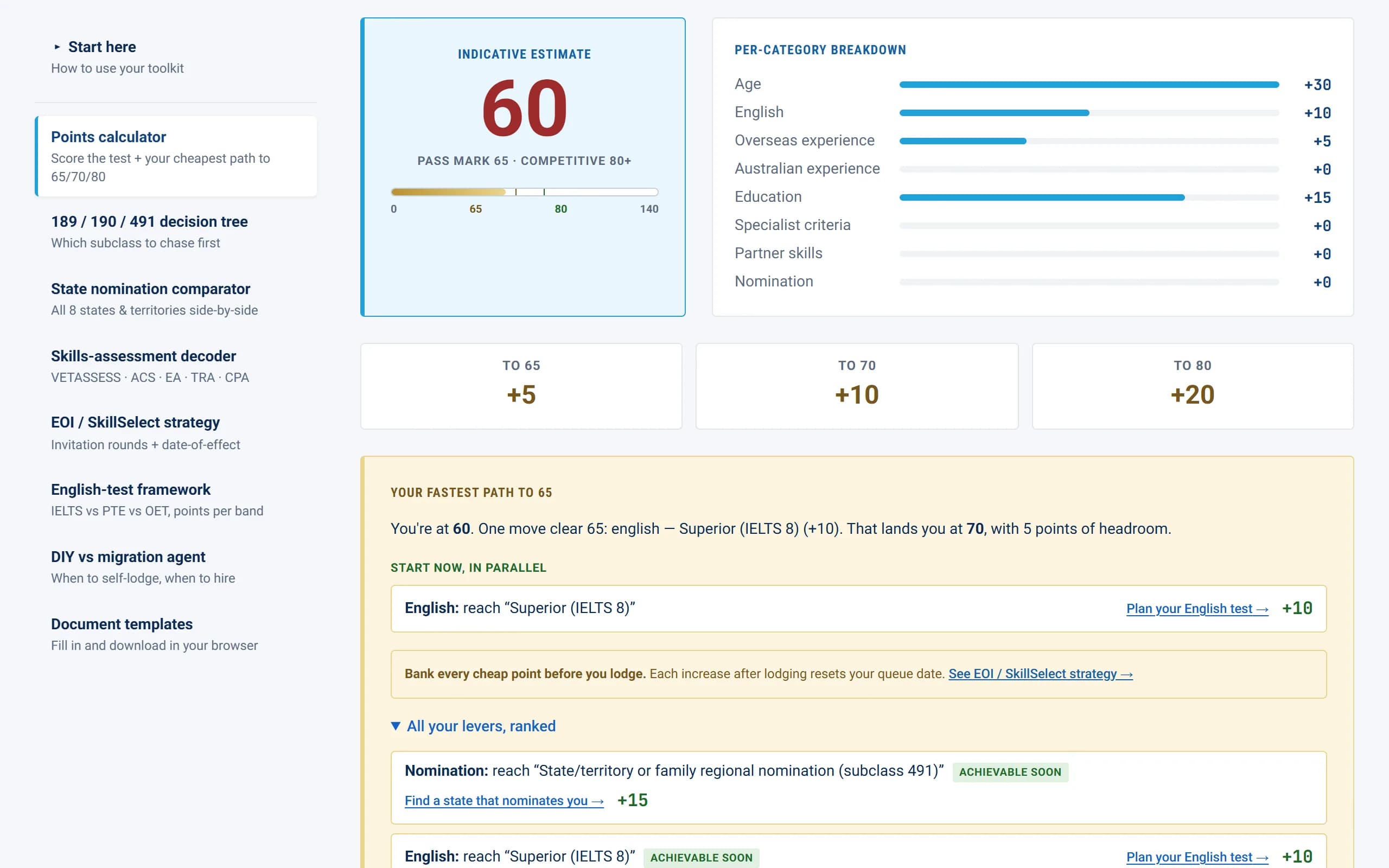
| Typical 491 Score | 65-75 points with regional nomination |
| Key Challenge | Not on the MLTSSL, so subclass 189 is unavailable — state or employer route is mandatory |
What a Metallurgical or Materials Technician Does in Australia
A Metallurgical or Materials Technician tests metals, alloys, ceramics, polymers and composite materials as part of mineral processing, refining and quality control. The role supports metallurgists and materials engineers by running laboratory and on-site tests, sampling ore and product streams, interpreting results, and documenting compliance against Australian and international standards.
In Australia, the work concentrates in three economic zones. The Pilbara and Goldfields regions of Western Australia employ technicians across iron ore, lithium, nickel and gold operations — Rio Tinto, BHP, Fortescue, Newmont and IGO all maintain large technical workforces. Queensland's Bowen Basin and Mount Isa region carry coking coal, copper and zinc processing roles. South Australia and the Northern Territory cover copper, uranium and rare earths at operations such as Olympic Dam. Outside mining, you'll find roles in steelmaking at Whyalla and Port Kembla, aluminium smelting in Tasmania and Queensland, and specialty alloy and additive-manufacturing testing in research-adjacent labs in Melbourne and Adelaide.
Demand is steady rather than explosive. Critical-minerals investment under the Australian Government's strategy is opening lithium refining and rare-earths processing roles, which has lifted technician hiring in WA and the NT. Non-destructive testing (NDT) specialists with API, AINDT or PCN certifications attract premiums in oil and gas and structural inspection.
ANZSCO 312912: Code Mapping and Tasks
The Australian Bureau of Statistics defines ANZSCO 312912 as covering technicians who test materials supporting metals, mining and materials engineering operations. Typical tasks include:
- Preparing samples for chemical, physical and mechanical testing
- Operating spectrometers, microscopes, hardness testers and tensile rigs
- Conducting on-site NDT inspections — ultrasonic, radiographic, magnetic particle, dye penetrant
- Recording test results and producing certificates of compliance
- Calibrating laboratory equipment and maintaining quality systems to ISO 17025
- Assisting metallurgists with research, process improvement and failure analysis
If your work crosses into building products, civil materials testing or concrete laboratory work, consider whether ANZSCO 312511 (Civil Engineering Technician) or 312999 (Building and Engineering Technicians nec) is a closer fit. VETASSESS assesses all three, but a mismatched code is the most common rejection trigger.
Skills Assessment with VETASSESS
VETASSESS is the sole assessing authority for ANZSCO 312912. The body evaluates two things: whether your qualification sits at AQF Diploma level or above in a highly relevant field, and whether your post-qualification employment is genuinely at the appropriate skill level.
Highly relevant fields of study include:
- Manufacturing Engineering and Technology
- Metallurgical Technology
- Materials Engineering
- Chemical Engineering (where the work is materials-focused)
Employment pathways (you must satisfy one):
- AQF Diploma or higher in a highly relevant field plus one year of highly relevant post-qualification employment in the last five years (20+ hours per week)
- AQF Diploma or higher in a highly relevant field plus an additional Certificate IV in a highly relevant area, plus one year of employment
- Two years of highly relevant post-qualification employment in the last five years where the qualification is at AQF level but not in a highly relevant field
- Four years total employment with at least one highly relevant year in the last five (where qualifications fall short)
Assessment cost: AUD $1,096 for non-residents, AUD $1,205.60 for Australian residents (inclusive of GST). Priority processing adds AUD $825 (non-residents) for a 10-business-day outcome.
Processing time: 8-10 weeks for standard skills assessment for professional and general occupations.
Common rejection reasons: routine production-line work (the role must be technical, not operator-level), insufficient detail in employment references about test methods used and standards applied, and qualifications in unrelated fields such as general chemistry without a metallurgy or materials specialisation.
A useful preparation step is the skills assessment guide — VETASSESS publishes occupation-specific information sheets, and reading the 312912 sheet before lodging will save rework.
Visa Pathways for Metallurgical and Materials Technicians
Because 312912 is on the CSOL but not the MLTSSL, the subclass 189 (Skilled Independent) route is closed. The four practical options are 190, 491, 482 and 186.
Subclass 491 — Skilled Work Regional (Provisional)
For most candidates, 491 is the strongest pathway. Mining and refining operations sit outside Sydney, Melbourne and Brisbane CBDs, which means the work itself is regional under the Department's geography rules.
- Visa fee: AUD $6,140 (primary applicant)
- Points boost: +15 from regional nomination
- Duration: 5-year provisional visa with a pathway to permanent residency via subclass 191
- Processing time: 9-14 months at the 75th percentile, 15-28 months at the 90th percentile
- Quirk: WA's Pilbara, Goldfields-Esperance, Mid-West, South-West and Great Southern regions all count as regional. So does almost all of Queensland and South Australia outside the Adelaide metro area.
Subclass 190 — Skilled Nominated
Permanent residency through state nomination. Strongest fit for technicians targeting metropolitan refineries (Whyalla, Port Kembla, Geelong) or Perth-based corporate technical roles.
- Visa fee: AUD $6,140 (primary applicant)
- Points boost: +5 from state nomination
- Obligation: Live and work in the nominating state for two years
- Processing time: Currently 9-19 months at typical percentiles
Subclass 482 — Skills in Demand (Core Skills Stream)
Employer-sponsored. Common for technicians joining established sponsors such as Rio Tinto, BHP, Glencore, South32, Bechtel and Worley.
- Visa fee: AUD $4,015 (primary applicant)
- Minimum salary: AUD $79,423 per year (Core Skills threshold, from 1 July 2026; previously AUD $76,515)
- Duration: Up to four years, with a pathway to subclass 186 after two years
- Processing time: 6-14 months end-to-end including sponsorship and nomination
Subclass 186 — Employer Nomination Scheme
Direct permanent residency through employer sponsorship, either as a fresh Direct Entry application or after two years on a 482.
- Visa fee: AUD $6,140 (primary applicant)
- Streams: Direct Entry (need three years' work experience) or Temporary Residence Transition (after two years on 482)
State Nomination for Metallurgical and Materials Technicians
Western Australia
The dominant state for this occupation. WA's General Stream lists 312912 across its 190 and 491 schedules in 2026, with the strongest invitations going to candidates with current Pilbara, Goldfields or Mid-West work experience. The March 2026 invitation round prioritised mining technical roles.
South Australia
South Australia includes the occupation under its 491 regional pathways and offers concessions for offshore applicants with copper, lithium and rare-earths experience aligned to projects at Whyalla, Port Pirie and Olympic Dam.
Northern Territory
NT nominates 312912 under both 190 and 491 streams. The territory's nickel-cobalt and rare-earths projects (including the McArthur River and Browns Range deposits) drive most invitations. Offshore candidates are accepted but onshore applicants who have already secured a Darwin or Katherine role move faster.
Queensland
Queensland places 312912 on its regional 491 pathways for the Bowen Basin, Mount Isa and Mackay regions. The 2025-26 program allocated 2,600 places across 190 and 491 combined, with critical-minerals and metals occupations receiving priority.
Tasmania
Tasmania nominates the occupation for technicians targeting the Bell Bay aluminium smelter, Mount Lyell copper redevelopment and Avebury nickel restart. The state's Skilled Employment Pathway requires an existing Tasmanian job offer or onshore graduation.
Salary and Employment Outlook
What You'll Earn
| Role / Stage | Typical Salary Range (AUD) |
|---|---|
| Junior / Trainee Technician | $70,000-$85,000 |
| Laboratory Technician | $80,000-$100,000 |
| Senior Metallurgical Technician | $95,000-$120,000 |
| NDT Specialist (certified) | $110,000-$140,000 |
| Site / Shift Technician (FIFO) | $115,000-$150,000+ |
| Lead Technician / Lab Supervisor | $130,000-$170,000 |
Source: SalaryExpert Australia 2026, SEEK salary insights, and Hays Mining and Resources Salary Guide 2026. Figures exclude superannuation (11.5% from July 2025) and FIFO site allowances which can add 20-40% to base pay.
Highest-Paying Employers and Sectors
- Iron ore majors — Rio Tinto, BHP, Fortescue, Hancock-Roy Hill, Mineral Resources
- Lithium and rare earths — Pilbara Minerals, Liontown, IGO, Lynas
- Gold and copper — Newmont, Northern Star, OZ Minerals, Glencore
- Engineering and testing services — SGS, Bureau Veritas, ALS, Intertek
- Specialty alloys and additive manufacturing — Amaero, Titomic, defence primes (BAE, Lockheed Martin Australia)
FIFO rotations (8/6, 2/1, 9/5) carry significant uplift but compress family time. Residential roles in Perth, Adelaide and Brisbane pay less but suit migrants with school-age children.
Tips for a Successful Application
-
Pick a highly relevant field of study or accept the longer employment pathway. VETASSESS treats metallurgical engineering, materials engineering and manufacturing technology as in-scope. A chemistry or general science degree forces you into Pathway 3 or 4 — two-plus years of post-qualification experience minimum.
-
Quantify your testing work in employment references. Generic references describing "lab work" or "quality control" fail. Strong references list specific instruments (XRF, ICP-OES, OES spark spectrometer, Vickers hardness, Charpy impact), standards followed (AS, ASTM, ISO numbers), and percentage of time spent on each.
-
NDT certifications are a points multiplier in the job market. AINDT Level 2 in ultrasonic, radiographic or magnetic particle testing routinely lifts offers by 15-25%. Bring these certifications, translated and notarised, to your skills assessment.
-
Target WA and Queensland nominations first. The mining states have the largest allocations and the closest sector match. NSW and Victoria nominate the occupation but invite far fewer technicians per year.
-
If you're under 33 with a Bachelor degree in metallurgy or materials engineering and Proficient English, run the numbers on 491 before 190. The +15 regional point boost often clears the invitation threshold where +5 does not, and the 191 onshore pathway converts to PR after three years of regional residence and income compliance.
Step-by-Step Migration Roadmap
- Confirm your duties match ANZSCO 312912 using the how to find your ANZSCO code guide
- Verify the occupation's CSOL and state-list status for your target state
- Translate and notarise your qualification and academic transcripts
- Gather employment references with quantified, instrument-level detail
- Sit IELTS, PTE Academic or equivalent — aim for Proficient (7.0) or Superior (8.0)
- Lodge a VETASSESS skills assessment ($1,096) with priority processing if time-critical
- Submit an EOI in SkillSelect targeting 190 and 491
- Apply for state nomination from WA, SA, Queensland or NT
- Alternatively, secure a 482 offer from a sponsor such as Rio Tinto, BHP or Bureau Veritas
- Receive invitation and lodge your visa within 60 days
- Complete health (Bupa Medical Visa Services) and AFP character checks
- Receive grant and relocate, then meet your post-arrival state or regional obligations
Frequently Asked Questions
Can I get a subclass 189 visa as a Metallurgical or Materials Technician?
No. Subclass 189 requires the nominated occupation to be on the MLTSSL. ANZSCO 312912 sits on the CSOL and the STSOL, which means your routes are subclass 190 (state nomination), 491 (regional nomination), 482 (employer-sponsored) and 186 (employer permanent).
Is FIFO experience enough to satisfy VETASSESS employment requirements?
Yes, provided the duties are technical rather than operator-level. FIFO roles count when the work involves laboratory analysis, sample preparation, NDT inspection or quality control rather than running production equipment. Your references must be specific about the technical content of your shifts.
How does Australia's critical minerals push affect demand for this occupation in 2026?
The Critical Minerals Strategy is funding new lithium hydroxide, rare-earths and battery-grade nickel and cobalt facilities in WA, NT and Queensland. Each project generates 30-80 technician roles across commissioning and steady-state operations. Demand has lifted noticeably since 2024 and is forecast to stay elevated through 2028.
Will my non-Australian NDT certification be recognised?
Most employers accept ASNT, PCN, ISO 9712 and equivalent international NDT certifications, but many require an AINDT recertification within 6-12 months of starting on Australian sites. Budget AUD $1,500-$3,000 for recertification across your active methods.
What if my degree is in chemistry rather than metallurgy?
You can still qualify, but the path is longer. Without a highly relevant qualification you'll need either two years of post-qualification highly relevant employment (Pathway 3) or four years total employment with at least one highly relevant year in the last five (Pathway 4). Your references must demonstrate the work was at AQF Diploma skill level.
Which adjacent ANZSCO codes are worth considering?
If you supervise a small team or run a section, ANZSCO 312511 Civil Engineering Technician, 233512 Materials Engineer (a higher Skill Level 1 code) or 312999 Building and Engineering Technicians nec may suit. The most in-demand occupations page lists adjacent engineering roles with stronger MLTSSL pathways.