Procurement Manager Visa Pathway to Australia: Complete 2026 Guide
Updated: 16 August 2026
Australia classifies Procurement Manager under ANZSCO 133612. The Institute of Managers and Leaders (IML ANZ) conducts the skills assessment. The occupation sits on the CSOL and the Regional Occupation List (ROL), unlocking subclasses 491, 494, 482 and 186 — but not 189 or 190. Typical 2026 salaries range AUD $135,000-$185,000. Defence, resources and government procurement drive most senior demand.
Quick Facts: Procurement Manager Migration Pathway
| Detail | Information |
|---|---|
| ANZSCO Code | 133612 (Procurement Manager) |
| Skill Level | 1 (Bachelor degree or higher, or five years of relevant experience) |
| Skills Assessment | IML ANZ (Institute of Managers and Leaders Australia and New Zealand) |
| Occupation List | CSOL and ROL — not on MLTSSL or STSOL |
| Visa Options | 491, 494, 482, 186 |
| Demand Level | High in defence, resources and public sector procurement |
| Salary Range | AUD $135,000-$185,000 (SEEK, 2026) |
| Typical 491 Score | 75-95 points (regional dependent) |
| Key Challenge | No 189 or 190 access — regional or employer-sponsored only |
What Procurement Managers Do in Australia
Procurement managers control the purchasing strategy and supplier relationships of an organisation. Where supply and distribution managers move goods, procurement managers buy them. The discipline has grown sharply over the past five years as Australian government and corporate buyers professionalised sourcing, embedded ESG and modern slavery compliance into supplier contracts, and reorganised supply bases after the China trade frictions of the early 2020s.
The biggest demand pockets in 2026 are defence procurement (driven by the AUKUS submarine and surface fleet programmes), the resources sector (BHP, Rio Tinto, Fortescue, Woodside all run large procurement organisations), federal and state government (Defence, Health, Transport for NSW, VicRoads), and consulting firms with category-management practices. Pharmaceutical, telecommunications and major bank procurement teams round out the senior-role market.
Work is concentrated in Canberra (federal procurement), Sydney (banking, telco, head-office category management), Melbourne (corporate procurement, defence), Perth and Adelaide (resources and defence).
ANZSCO 133612: What the Code Actually Covers
ANZSCO 133612 covers managers who plan, organise, direct, control and coordinate the purchasing of materials, products and services for an organisation. The role typically owns sourcing strategy, supplier selection, contract negotiation, supplier relationship management, and procurement governance.
Indicative tasks include developing category strategies, leading tenders and RFPs, negotiating contract terms and pricing with suppliers, managing supplier performance and risk, ensuring procurement compliance with regulations (modern slavery, anti-bribery, government procurement rules), and reporting on cost savings and supplier KPIs.
If your role focuses on the physical movement of goods, the closer code is 133611 Supply and Distribution Manager. If you manage purchasing only at a coordinator or analyst level, you will not meet IML's Skill Level 1 threshold for 133612 — you would need to wait for senior responsibility before applying.
ANZSCO Skill Level 1 requires a bachelor degree or higher qualification, with at least five years of relevant experience potentially substituting for the formal qualification.
Skills Assessment Through IML
The Institute of Managers and Leaders Australia and New Zealand is the only assessing authority for 133612 for skilled migration. IML's assessment looks at your higher education qualification and your employment history of up to 10 years. Outcomes are valid for three years.
Requirements:
- AQF Bachelor degree or higher, preferably in business, commerce, supply chain management, engineering or law. CIPS Diploma or MCIPS is recognised as supplementary evidence but does not substitute for a degree.
- Senior procurement role with documented contract authority. IML wants to see signing limits, category ownership, supplier portfolio size, and team management.
- Evidence covering 5-10 years of employment, with at least one senior role within the last 5 years.
Assessment fees (effective 8 September 2025):
- Standard assessment: AUD $788 (offshore) / AUD $866 (onshore)
- Express service: additional AUD $210 / $231
Processing time: 10 weeks standard, 6 weeks express.
Common rejection reasons: Procurement specialists or sourcing analysts at coordinator level routinely fail because their authority sits below management. IML also rejects applicants whose duties are dominantly tactical (placing purchase orders, processing invoices, expediting deliveries) rather than strategic (category strategy, supplier selection, contract negotiation).
Visa Pathways for Procurement Managers
Procurement Manager is not eligible for 189 or 190 because it sits on the ROL rather than the MLTSSL or STSOL. The dominant routes are employer sponsorship and regional nomination.
Subclass 482 — Skills in Demand Visa
The 482 is the most common pathway for 133612. Defence primes (BAE Systems, Lockheed Martin Australia, Thales, Hanwha Defense Australia), resources majors, and Big Four consultancies sponsor regularly.
- Visa fee: AUD $4,015 (Core or Specialist Skills stream)
- Salary threshold: Core stream from AUD $79,423; Specialist Skills from AUD $146,576
- Duration: Up to 4 years
- Pathway to PR: Yes, via 186 TRT after two years
- Note: Most senior procurement roles clear the Specialist Skills threshold, which speeds processing
Subclass 186 — Employer Nomination Scheme
Permanent residency through employer sponsorship. Direct Entry for offshore applicants with strong experience, or Temporary Residence Transition after two years on a 482.
- Visa fee: AUD $6,140
- Best fit: Senior procurement leaders with a long-term Australian employer commitment
Subclass 491 — Skilled Work Regional Visa
A 5-year provisional visa for regional Australia, with a pathway to PR through subclass 191. The state-nominated stream of the 491 is the only points-tested route available for 133612.
- Visa fee: AUD $6,140
- Points boost: +15
- Best fit: Regional resources and defence procurement (Perth's outskirts, Adelaide, regional Queensland, Darwin)
Subclass 494 — Skilled Employer Sponsored Regional
Employer-sponsored regional visa, 5-year provisional, with a PR pathway via 191.
- Visa fee: AUD $6,140
- Best fit: Regional employers in mining, agriculture or regional government
Subclass 189 and 190
133612 is not on the MLTSSL or STSOL, so subclasses 189 and 190 are not available in 2026. Applicants seeking permanent residency without an employer must use the regional 491 route and meet the residency and income conditions for subsequent subclass 191 grant.
Points Test Strategy
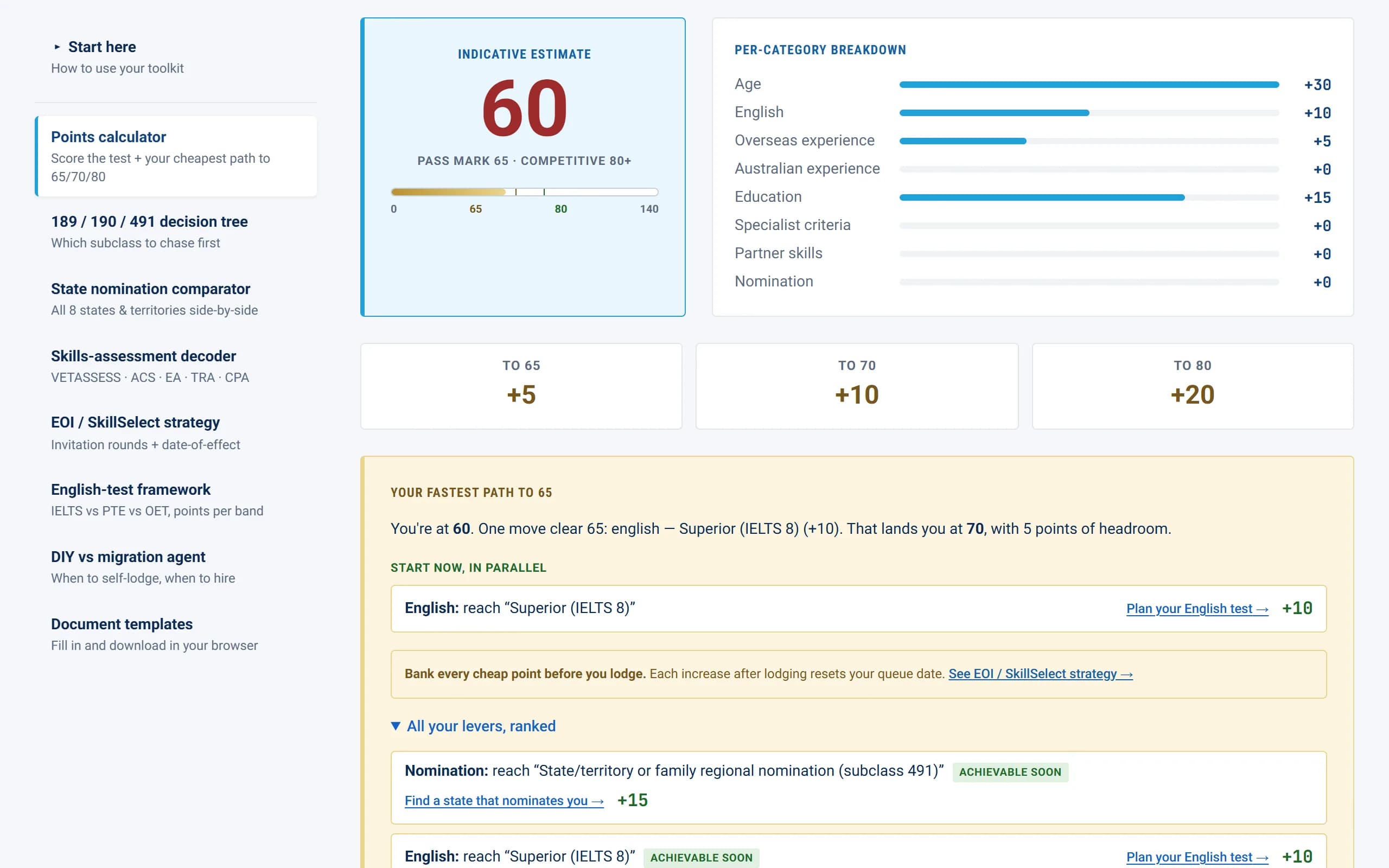
The points test applies for 491 and 494 applications. Most successful procurement candidates score 75-95 points after regional nomination.
| Points Factor | Points | Notes |
|---|---|---|
| Age 25-32 | 30 | Maximum |
| Age 33-39 | 25 | Common for senior procurement |
| Bachelor degree | 15 | Standard |
| Master's | 15 | No premium without STEM coding |
| PhD | 20 | Uncommon |
| English Superior (8.0) | 20 | Worth the test cost |
| English Proficient (7.0) | 10 | Acceptable |
| Overseas experience 8+ years | 15 | Standard for senior procurement |
| Regional Nomination (491) | 15 | |
| Partner skills | 5-10 | If applicable |
Scenario: 33-Year-Old Defence Procurement Lead from London
Age 25 + Bachelor 15 + Superior English 20 + 8 years overseas experience 15 + 491 regional 15 = 90 points. Strongly competitive for Adelaide-based defence procurement roles linked to AUKUS.
Scenario: 38-Year-Old Resources Procurement Manager from Johannesburg
Age 25 + Master's 15 + Proficient English 10 + 8 years overseas experience 15 + 491 regional 15 = 80 points. Viable for Western Australia regional or Queensland mining regions.
Regional and State Nomination for Procurement Managers
Because 133612 is on the ROL, only the regional 491 nomination stream applies. The state-nominated 190 is not available.
Western Australia (Regional)
Perth's outskirts and regional WA recruit procurement managers for mining and gas operations. BHP, Rio Tinto and Woodside all use the regional 491 to attract overseas talent into Karratha, Newman and the Pilbara more broadly.
South Australia
Adelaide and regional SA actively nominate procurement managers, particularly those with defence industry experience. The AUKUS submarine programme has created sustained demand for procurement and contract managers familiar with defence sourcing and ITAR-controlled supply chains.
Queensland
Regional Queensland (Townsville, Mackay, Gladstone) nominates procurement managers for mining, ports and infrastructure projects. The state's hydrogen and critical minerals strategy is creating additional capital procurement roles.
Northern Territory
Darwin nominates procurement managers for mining, defence and remote area projects, including the ongoing Defence base expansion. NT has lower applicant volumes and often invites at competitive point levels.
Tasmania
Tasmania nominates procurement managers across renewable energy, aquaculture and government infrastructure. Hobart applicants with a job offer or local study history have priority.
NSW and Victoria do not nominate 133612 for the 491 because their regional areas are limited; check the most recent state announcements before applying.
Salary and Employment Outlook
| Role | Typical Salary Range |
|---|---|
| Procurement Specialist | AUD $95,000-$125,000 |
| Procurement Manager (Mid) | AUD $135,000-$155,000 |
| Senior Procurement Manager | AUD $155,000-$185,000 |
| Category Director / Head of Procurement | AUD $185,000-$260,000 |
| Chief Procurement Officer (ASX) | AUD $260,000-$420,000 |
Source: SEEK Salary Hub 2026, Hays CIPS Salary Guide 2026, Glassdoor Australia.
Total packages include superannuation at 11.5%, performance bonuses commonly at 15-25% in resources and consulting, and equity components in listed companies. CIPS qualifications (MCIPS, FCIPS) typically add 5-10% to the salary band.
Highest-Paying Sectors
- Defence and aerospace — BAE Systems, Lockheed Martin Australia, Thales, Hanwha, Anduril
- Resources — BHP, Rio Tinto, Fortescue, Woodside, South32
- Government — Department of Defence, Department of Health, Transport for NSW
- Major banks — CBA, NAB, Westpac, ANZ (all run substantial procurement organisations)
- Pharmaceutical — CSL, Sigma, EBOS
Tips for a Successful Application
1. Lead With Contract Authority Numbers
The strongest IML files quote signing limits and category spend ("authorised to approve procurement contracts up to AUD $5 million; managed an annual category spend of AUD $80 million across IT services and telecommunications"). Vague descriptions of "managing procurement activities" rarely satisfy IML's senior-manager test.
2. Use Defence and Resources Experience as Leverage
Procurement experience in defence, oil and gas, or mining is highly portable to Australia and well-recognised by Australian employers. If your overseas role involved government procurement frameworks, ITAR, FAR, or modern slavery compliance, document it explicitly — these capabilities are scarce in the Australian market.
3. Get CIPS Recognition Onshore
The Chartered Institute of Procurement and Supply (CIPS) has an Australian chapter, and MCIPS is widely valued by Australian employers and recruiters. While CIPS qualifications do not affect the IML assessment, they improve sponsorship outcomes and unlock category-management roles inside ASX-listed firms.
4. Distinguish Strategic from Operational Procurement
IML rejects files where the duties read as tactical purchasing (raising purchase orders, expediting suppliers, managing day-to-day stock procurement). Restructure your reference letters around strategy, negotiation, supplier development and contract authority. If your current role is operational, take a senior step before applying.
5. Choose Regional Carefully
Because 133612 has no 190 access, the points-tested route is regional-only. The most productive regional pathways in 2026 are Adelaide-and-around (defence), regional WA (resources), and Darwin (defence and remote infrastructure). Avoid speculative applications to Tasmania or Queensland without a clear job market thesis.
Step-by-Step Migration Roadmap
- Confirm the right ANZSCO code — review duties against ANZSCO code finder; use 133611 for supply roles, 133612 for procurement
- Verify CSOL/ROL eligibility — check the Core Skills Occupation List and list comparisons
- Build employment evidence — contract authority, category spend, supplier portfolio size, team reporting lines
- Sit English test — Proficient minimum, Superior for points advantage
- Lodge IML skills assessment — AUD $788-$866, express optional
- Submit EOI in SkillSelect — nominate 491 or pursue employer sponsorship
- Apply for regional state nomination — SA, WA, QLD, NT or TAS
- Alternatively, secure 482 or 186 employer sponsorship — common via defence and resources
- Receive invitation and lodge visa — within 60 days
- Complete health and character checks
- Receive grant — and complete regional residency conditions if on 491
Frequently Asked Questions
Why is Procurement Manager only on the ROL?
The Department of Home Affairs places 133612 on the Regional Occupation List because procurement skills shortages are concentrated outside the main capital cities — particularly in defence-industry regions like Adelaide, resources regions like the Pilbara, and remote infrastructure programmes. Metropolitan procurement labour markets are reasonably well supplied domestically, so the list design pushes overseas skilled procurement workers toward regional employers and regional state nomination.
Can I get permanent residency as a Procurement Manager?
Yes, but the path is indirect. Subclass 491 is provisional for 5 years, with PR available via subclass 191 after three years of regional work meeting the minimum income threshold. Subclass 186 grants PR directly when employer-sponsored, either as Direct Entry from offshore or as Temporary Residence Transition after two years on a 482. There is no points-tested PR route equivalent to the 189.
Does an MCIPS qualification help with the IML assessment?
MCIPS does not change the IML assessment outcome — IML evaluates degree and employment evidence regardless of professional certifications. MCIPS does strengthen employer sponsorship outcomes and helps with category-management role applications inside Australia, so it is worth pursuing in parallel rather than as a substitute.
What are the most common reasons 133612 applications fail?
The top three failure modes are insufficient evidence of senior managerial authority (the work was real procurement but the title and chart were junior), incorrect code selection (the actual work was supply chain rather than procurement, or vice versa), and incomplete employment references (referees omitted contract authority or budget responsibility). Each of these is preventable with careful preparation of evidence before lodging the IML application.
Is the defence procurement market really hiring overseas applicants?
Yes, particularly through the AUKUS programme and the broader defence industrial strategy. BAE Systems, Lockheed Martin Australia, Thales and Anduril have all sponsored overseas procurement and contract managers under 482 in the past 18 months. The constraint is security clearance — Australian Government Security Vetting Agency (AGSVA) clearance requires permanent residency or Australian citizenship for higher levels, so most overseas hires start in roles cleared at Baseline or NV1 with a pathway to higher clearance after PR. See most in-demand occupations 2026 for cross-sector demand context.