Metal Machinist (First Class) Visa Pathway to Australia: Complete 2026 Guide
Updated: 16 August 2026
Australia classifies Metal Machinist (First Class) under ANZSCO 323214. Trades Recognition Australia performs the skills assessment, usually through the Job Ready Program. The occupation sits on both the MLTSSL and the Core Skills Occupation List, unlocking subclasses 189, 190, 491, 482, and 186. Typical 2026 salaries range AUD $75,000-$103,000, with senior CNC operators in defence and aerospace reaching higher.
Quick Facts: Metal Machinist (First Class) Migration Pathway
| Detail | Information |
|---|---|
| ANZSCO Code | 323214 (Metal Machinist (First Class)) |
| Skill Level | 3 (AQF Certificate III or IV) |
| Skills Assessment | TRA (Trades Recognition Australia) via Job Ready Program |
| Occupation List | CSOL and MLTSSL |
| Visa Options | 189, 190, 491, 482, 186 |
| Demand Level | High — metal machinist on the 2025 Occupation Shortage Priority List |
| Salary Range | AUD $75,000-$103,000 (SEEK Salary Hub, 2026) |
| Typical 189 Score | 65-75 points |
| Key Challenge | First-class certification level and Australian-Standards CNC programming evidence |
What a Metal Machinist (First Class) Does in Australia
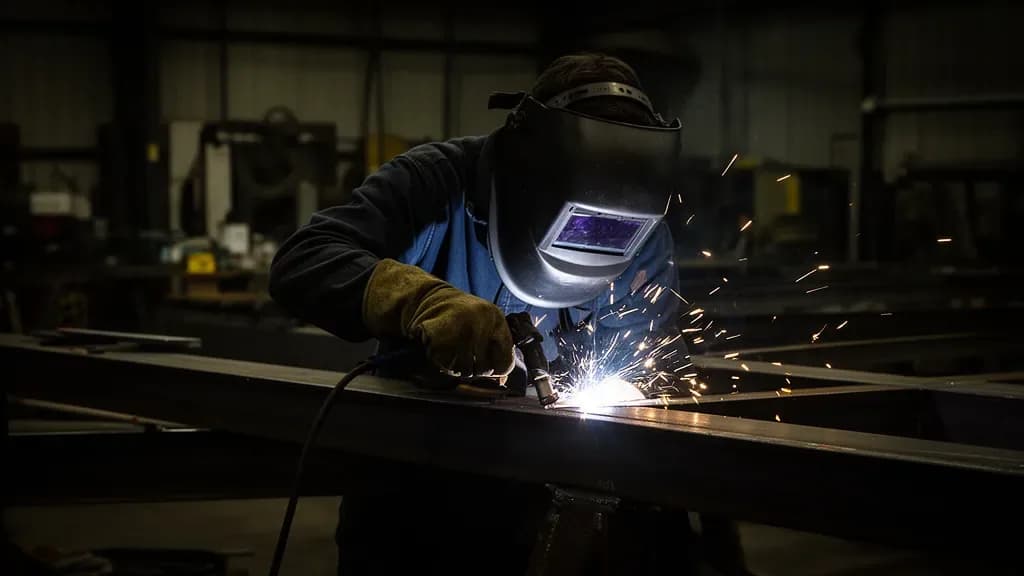
Metal machinists (first class) produce precision metal components on lathes, milling machines, grinders, drills, and increasingly CNC machine tools. They work to engineering drawings and produce parts to tolerances measured in hundredths or thousandths of a millimetre. The "first class" designation refers to the higher-skill end of the trade — machinists who can set up complex jobs, program CNC machines, interpret intricate drawings, and produce one-off and small-batch precision work, as opposed to production-line machine operators who run pre-set programs.
Work concentrates in toolrooms, aerospace and defence manufacturing, mining equipment maintenance, precision-engineering job shops, and the sustainment workshops of major defence and resources operators. Real employers include BAE Systems (defence aerospace and naval), ASC (submarines), Boeing Australia (aircraft components), Quickstep Holdings (defence composites), MEC Mining workshops, and hundreds of mid-sized contract machining firms serving the mining and infrastructure sectors.
Jobs and Skills Australia added metal machinist to the Priority List in 2025. Skill Level 3 trade fill rates dropped to 54.3% nationally, and precision machining is hit particularly hard because the skill set takes years to develop and Australian apprenticeship intakes have been declining since the 2010s. Defence sector growth — particularly the AUKUS submarine program — is now pulling against a depleted national pool.
ANZSCO Code 323214 — Metal Machinist (First Class)
The 323214 code applies to skilled machinists who set up and operate a range of metal machine tools, interpret detailed engineering drawings, work to tight tolerances, and either program or supervise CNC operations. Core duties include:
- Studying engineering drawings, including geometric dimensioning and tolerancing
- Setting up and operating centre lathes, milling machines, grinders, drills, and shapers
- Programming CNC machine tools (lathes, mills, machining centres)
- Calculating speeds and feeds for varied materials
- Inspecting finished components against drawing tolerances
- Producing one-off and small-batch precision components
Two adjacent codes overlap:
- 323212 Fitter and Turner — for machinists whose work also routinely includes fitting and assembling components into mechanical equipment. If you turn and then fit the turned parts into machinery, Fitter and Turner is the better match.
- 711712 Metal Engineering Process Worker — for production machine operators who run pre-set programs without first-class setup or programming responsibilities. This is a Skill Level 4 code and does not appear on the MLTSSL.
323214 is specifically for the higher-skilled end. TRA expects employment evidence of setting up jobs, programming or significantly modifying CNC programs, and producing precision work — not just running production cells.
Skills Assessment — Trades Recognition Australia
TRA assesses 323214 through three programs.
Job Ready Program (JRP) — the standard offshore pathway
Almost all offshore-trained metal machinists must complete the JRP. The four-step process:
- Provisional Skills Assessment (PSA) — documentary verification of qualification and 12 months recent employment
- Job Ready Employment (JRE) — TRA registration and start of 1,725 paid hours of Australian work
- Job Ready Workplace Assessment (JRWA) — onsite assessment with TRA assessor observing machining work
- Job Ready Final Assessment (JRFA) — outcome document for visa lodgement
Combined cost across the four steps: AUD $3,000-$3,500 Total duration: 12-18 months minimum Required qualification: AQF Certificate III in Engineering — Mechanical Trade (Machinist) or comparable overseas qualification, or three years of full-time equivalent post-qualification experience
The JRWA for 323214 specifically tests setup, programming proficiency, and precision. Common failure modes include candidates placed in production-machine-operator roles (which fit 711712, not 323214) and failure to demonstrate independent CNC programming capability. Negotiate genuine first-class machinist duties at the Australian workplace before signing the employment contract.
Migration Skills Assessment (MSA) — Australian-qualified only
The MSA is documentary and faster but requires either Australian apprenticeship completion or qualification under a bilateral arrangement. Most offshore machinists do not qualify.
Offshore Skills Assessment Program (OSAP) — limited
OSAP provides paper assessment for select country qualifications. Verify eligibility with TRA before relying on it.
Visa Pathways for Metal Machinists
Subclass 482 — Skills in Demand
The 482 is the practical first move for most offshore machinists because it pairs with the JRP work-hours requirement.
- Visa fee: AUD $3,210 (primary applicant)
- Core Skills Income Threshold (CSIT): AUD $76,515 (FY2025-26), rising to AUD $79,499 from 1 July 2026
- Duration: Up to 4 years
- Stream: Core Skills (323214 is on the Core Skills Occupation List)
- Reality check: Machinist salaries sit closer to the CSIT than welders or fitters. Confirm the role meets or exceeds threshold before signing.
Subclass 186 — Employer Nomination Scheme
Permanent residency via employer sponsorship. Direct Entry (with positive TRA outcome) or TRT (after two years on 482).
- Visa fee: AUD $6,140 (primary applicant)
- Streams: Direct Entry or TRT
- Reality: TRT is the most common route
Subclass 491 — Skilled Work Regional
A 5-year regional provisional visa carrying 15 points. Many precision-machining shops operate in regional areas, particularly around defence precincts and resources hubs.
- Visa fee: AUD $6,140 (primary applicant)
- Living obligation: 3 years in a regional area before 191 PR
- Quirk: Adelaide qualifies as a Designated Regional Area for 491 purposes — meaning shipbuilding-precinct roles count
Subclass 190 — Skilled Nominated
State-sponsored PR. NSW, Victoria, Queensland, and South Australia all nominate 323214.
- Visa fee: AUD $6,140 (primary applicant)
- Points boost: +5 from state nomination
- Live-in obligation: 2 years in the nominating state
Subclass 189 — Skilled Independent
Trade occupations face less competition than ICT, but invitation rounds since late 2024 have been heavily weighted toward healthcare and selected priority occupations. Lodge in parallel but plan on 482/186 or 491.
- Visa fee: AUD $6,135 (primary applicant)
- Minimum points: 65 (realistic invitations 75+)
Points Test Strategy
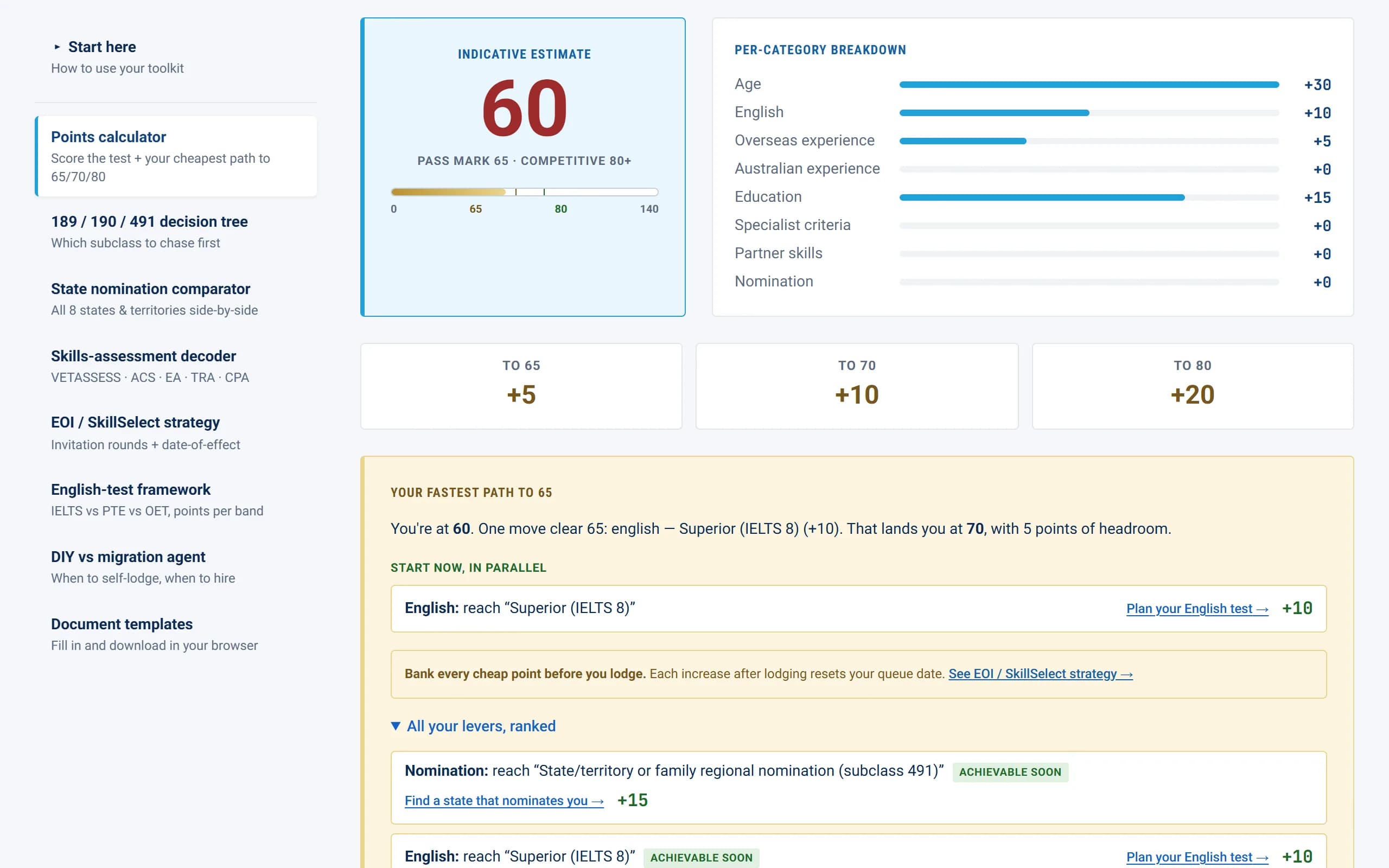
| Points Factor | Points | Notes |
|---|---|---|
| Age (25-32) | 30 | Maximum |
| Age (33-39) | 25 | Strong |
| English (Proficient — IELTS 7) | 10 | Standard target |
| English (Superior — IELTS 8) | 20 | High-impact boost |
| Skilled Employment (5-7 yrs overseas) | 10 | Typical |
| Skilled Employment (8+ yrs overseas) | 15 | Common for experienced machinists |
| Australian Skilled Employment (1-2 yrs) | 5 | Relevant once on 482 |
| Qualification (AQF Cert III/IV equivalent) | 10 | Standard |
| State Nomination (190) | 5 | Multiple states nominate 323214 |
| Regional Nomination (491) | 15 | Dominant trade booster |
| Partner Skills | 5-10 | If partner holds a CSOL occupation |
Realistic Scenarios
Scenario 1 — Offshore machinist, 30 years old, IELTS 6, 8 years experience
Age 30 + English 0 + Experience 15 + Qualification 10 = 55 points. Improve English to Proficient (+10) for 65, or pursue 491 regional nomination (+15) for 70.
Scenario 2 — Onshore machinist on 482 in Adelaide defence sector, 31 years old, IELTS 7, 6 years overseas plus 18 months Australian
Age 30 + English 10 + Overseas 10 + Australian 5 + Qualification 10 + 491 Regional 15 = 80 points. Strongly competitive.
State Nomination
South Australia — the strongest match
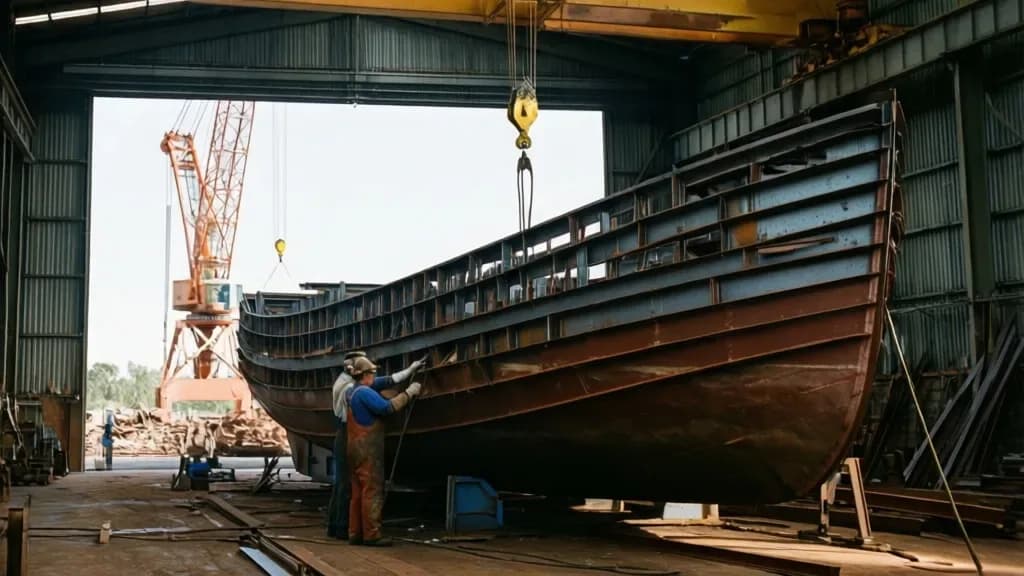
South Australia is the natural fit for metal machinists in 2026 because of the Osborne defence shipbuilding precinct (BAE Hunter-class frigates, ASC Collins-class and AUKUS submarines). The state allocates 3,000 places to 190 and 800 to 491 in 2025-26, with reduced English thresholds for some shortage occupations. Most of greater Adelaide qualifies as a Designated Regional Area for 491 purposes. SA requires three years of skilled employment in the previous five.
New South Wales
NSW nominates 323214 under both 190 and 491 in the 2025-26 program. Demand concentrates in Western Sydney precision-engineering firms, the Hunter Valley mining-services workshops, and the Illawarra defence-adjacent fabrication sector. Three years of skilled employment in the nominated occupation is the typical bar.
Victoria
Victoria's 2025-26 program nominates metal machinists. The state allocates 2,700 places to 190 and 700 to 491. Demand is heaviest in Melbourne's defence and aerospace-adjacent precision shops (Fishermans Bend, Avalon), the Geelong defence ecosystem, and contract machining in Melbourne's western industrial belt. Three years of recent post-qualification experience plus a current Victorian role or genuine intent is the standard bar.
Queensland
Migration Queensland prioritises trades. Machinist demand is heaviest in Mackay and Gladstone for mining-equipment maintenance, and in Brisbane's southern industrial corridor. The 491 pathway is more accessible from offshore than 190.
Western Australia
WA's nomination program targets resources-sector trades for the Pilbara mining and Karratha LNG operations. Machinists with mining-equipment experience are particularly sought after, especially for FIFO maintenance roles.
Salary and Employment Outlook
What Metal Machinists Earn
| Role / Sector | Typical Salary Range (AUD) |
|---|---|
| Entry-level Machinist (Cert III, 0-2 yrs) | $60,000-$75,000 |
| Experienced Metal Machinist (5+ yrs) | $80,000-$95,000 |
| CNC Machinist (general industry) | $80,000-$100,000 |
| Senior CNC Machinist (8+ yrs) | $95,000-$120,000 |
| Defence/Aerospace Precision Machinist | $95,000-$130,000 |
| Toolroom Machinist (precision job shop) | $90,000-$120,000 |
| Mining-sector Machinist (FIFO) | $110,000-$160,000 |
Source: SEEK Salary Hub 2026, PayScale 2026, Hays Salary Guide 2026. Average annual salary for general machinists is around AUD $77,750-$85,000 (SEEK 2026), with CNC machinists averaging AUD $84,144 (ERI SalaryExpert 2026). PayScale records an average hourly rate of AUD $28.79 in 2026, ranging from AUD $23.02 at entry level to AUD $40.55 for senior practitioners.
Total packages typically include superannuation at 11.5%, overtime at penalty rates, and site or shift allowances. Defence-sector roles often include long-service incentives and clearance loadings.
Highest-Paying Sectors
- Defence and aerospace — BAE, ASC, Boeing Australia, Lockheed Martin Australia
- Mining-equipment maintenance — fixed-plant and mobile-plant precision repair
- Toolmaking — high-tolerance contract machining for specialist sectors
- Medical-device manufacturing — precision titanium and stainless components
- Energy and resources — turbine and rotating-equipment repair workshops
Tips for a Successful Application
1. Make sure your role is genuinely first-class, not production machine operation
The most common TRA decision against 323214 is "candidate operates pre-set CNC programs without setup or programming responsibility — should be 711712, which is not on the MLTSSL." References must explicitly describe setting up jobs, writing or modifying CNC programs, selecting tooling, calculating speeds and feeds, and inspecting precision work. "Operated CNC machine" alone is insufficient.
2. Document your CNC programming experience specifically
CNC programming is the differentiator between first-class machinist and machine operator. If you program in Fanuc, Heidenhain, Siemens, or Mazak controls, name the controls and the typical job complexity in your CV and references. CAM software experience (Mastercam, NX CAM, Fusion 360 Manufacturing) is also a significant plus.
3. Target Adelaide defence sponsorship if your background is naval or aerospace
The Hunter-class frigate program at Osborne, the AUKUS submarine program, and the Boeing Australia precision-machining work in regional SA all sponsor offshore. Adelaide's status as a 491 Designated Regional Area makes it unusually accessible. Defence work typically requires security clearance considerations — investigate the citizenship pathway before committing if national security work is your goal.
4. Build a portfolio of inspection-ready work
Migration agents have noted that machinists who arrive with photographs of precision work, GD&T-toleranced drawings they have worked from, and a portfolio of complex setups have significantly stronger employer outcomes. For the JRWA, this portfolio can also help the TRA assessor evaluate the depth of experience beyond the immediate observation.
5. Confirm the role pays above CSIT before signing
Machinist salaries can sit close to the AUD $76,515 Core Skills Income Threshold (rising to AUD $79,499 from 1 July 2026). Roles below threshold cannot proceed under 482. Confirm the offered package in writing before resigning your current job — and check that it is base salary, not inclusive of overtime or allowances that may not count toward CSIT.
Step-by-Step Migration Roadmap
- Confirm 323214 is the right code — review duties against the ANZSCO code finder
- Check the occupation list — confirm 323214 on the CSOL and SOL 2026
- Sit IELTS or PTE — Proficient (7.0) minimum
- Lodge the TRA Provisional Skills Assessment — AUD $300
- Secure a sponsoring Australian employer with genuine first-class machining work — defence, aerospace, precision job shops
- Apply for a subclass 482 visa — AUD $3,210, confirm role pays above CSIT
- Register for Job Ready Employment — AUD $490
- Complete 1,725 paid hours of first-class machinist work — approximately 12 months
- Sit the JRWA — onsite assessment of setup, programming, and precision
- Receive Job Ready Final Assessment — positive outcome for visa
- Apply for 186 (TRT) or 190 / 491 — AUD $6,140
- Receive PR grant — relocate or remain per state obligations
Frequently Asked Questions
How does Metal Machinist (First Class) differ from Fitter and Turner?
Both involve precision machining, but 323212 Fitter and Turner additionally includes fitting and assembling the machined parts into mechanical equipment. 323214 Metal Machinist (First Class) is dedicated to producing precision components — the work stops at the finished part, not the assembled machine. If your day-to-day is purely making parts to drawings, 323214 fits. If you also build the parts into machinery, 323212 is the better match.
What counts as "first class" in TRA assessment?
TRA looks for evidence of setting up jobs independently, programming or modifying CNC programs, working to tight tolerances (typically sub-0.1mm), interpreting complex engineering drawings including GD&T, and producing one-off or small-batch precision components. Operators who run pre-set production cells without setup or programming responsibility are classified at the lower Skill Level 4 (711712 Metal Engineering Process Worker), which is not on the MLTSSL.
Is the defence sector really accessible for offshore machinists?
The AUKUS submarine program and the Hunter-class frigate program are sponsoring offshore tradespeople, but security considerations apply. Many roles require Australian permanent residency or citizenship for certain levels of access to classified work. Initial employment in the broader precinct (tier-2 suppliers, civilian-applicable engineering) is more accessible. Plan on commencing in unrestricted roles and progressing to higher-clearance work once PR is achieved.
What if my CNC programming experience is in an older control system?
Older controls (Fanuc 6, 10, 15-series; Heidenhain TNC 355, 415; older Mazak) are still recognised. Australian employers value the programming logic and setup discipline more than the specific control vintage. That said, current-generation controls (Fanuc 31i / 32i, Heidenhain TNC 640, Siemens 840D) are advantageous for the better-paying roles. Consider a short conversion course on a current control before applying if your background is on legacy systems only.
Can I migrate as a Metal Machinist if my qualification is in toolmaking?
Toolmaking experience overlaps with 323214 significantly, but the strict ANZSCO toolmaker code is 323412 Toolmaker, which is a separate ANZSCO classification. Check whether your duties and qualification align more closely with toolmaking (323412) or general first-class machining (323214). The choice depends on actual duties — if you primarily build jigs, fixtures, and tooling, toolmaker may be the better match. If you produce general precision components, machinist fits.
Why is metal machining experiencing the shortage despite automation?
Automation has replaced production-machine-operator work but not first-class machining. The skill of setting up complex jobs, programming intricate parts, and producing low-volume precision work is irreducibly human. Australian apprenticeship intakes have not kept pace with retirement attrition since the 2010s, and the AUKUS-era defence build is now pulling against a depleted national pool. The structural shortage is expected to persist through the decade.