Meteorologist Visa Pathway to Australia: Complete 2026 Guide
Updated: 16 August 2026
Australia classifies Meteorologist under ANZSCO 234913. VETASSESS conducts the skills assessment. The occupation sits on the Core Skills Occupation List and the MLTSSL, unlocking subclasses 189, 190, 491, 482 and 186. Typical 2026 salaries range AUD $90,000-$130,000. The Bureau of Meteorology is the dominant employer; private weather, energy-trading and aviation firms hire smaller cohorts.
Quick Facts: Meteorologist Migration Pathway
| Detail | Information |
|---|---|
| ANZSCO Code | 234913 (Meteorologist) |
| Skill Level | 1 (Bachelor degree or higher — typically Honours or Master's in physics, mathematics or atmospheric science) |
| Skills Assessment | VETASSESS (Vocational Education and Training Assessment Services), Group A |
| Occupation List | CSOL and MLTSSL |
| Visa Options | 189, 190, 491, 482, 186 |
| Demand Level | Moderate — small profession with concentrated employment, but persistent shortage at experienced level |
| Salary Range | AUD $90,000-$130,000 (PayScale and SEEK, April 2026) |
| Typical 189 Score | 80-85 points (small invitation pool but uncompetitive at top scores) |
| Key Challenge | The job market is dominated by one employer (the Bureau) which prefers its own Graduate Meteorologist Program — direct senior hiring is limited |
What a Meteorologist Actually Does in Australia
The Bureau of Meteorology is the centre of gravity for the profession. The Bureau runs forecast offices in every state capital plus regional centres, operates the national observing network, supplies the Australian Defence Force with operational weather support, and runs the national flood and tsunami warning systems. It also operates ACCESS — the Australian Community Climate and Earth System Simulator — which is the country's flagship numerical weather prediction model.
Beyond the Bureau, there is a smaller but growing private sector. Weatherzone (owned by DTN) supplies media, energy-trading and aviation clients. Energy firms (AGL, Origin, EnergyAustralia, Shell, Macquarie's commodity desks) hire meteorologists to forecast renewables output and gas demand. Aviation operators (Qantas, Virgin, Rex, regional charter operators) employ small in-house teams. Defence contracts run through the Bureau and through commercial primes (Lockheed Martin Australia, Leidos).
Geographically, the Bureau's national headquarters and training centre is in Docklands and Broadmeadows in Melbourne. Forecast centres exist in every state capital plus Darwin, Cairns, Townsville, Albany, Mount Gambier and a handful of remote locations including Macquarie Island and Antarctic stations. Private-sector meteorology concentrates in Sydney and Melbourne.
ANZSCO 234913 — Code Mapping
ANZSCO 234913 covers meteorologists who study the physics and dynamics of the atmosphere to advance understanding of weather and climate, and to forecast weather and long-term climatic trends. The occupation sits within unit group 2349 (Other Natural and Physical Science Professionals), alongside Conservator (234911), Metallurgist (234912), Physicist (234914) and the catch-all 234999.
Core tasks include:
- Studying atmospheric physics, thermodynamics and dynamics
- Preparing weather forecasts using observations, satellite data and numerical models
- Researching long-term climatic trends and climate variability
- Issuing severe-weather and aviation forecasts
- Developing and verifying numerical weather prediction models
Climatologists doing pure-research work fall under this code or under 234999 depending on the role; operational forecasters sit firmly within 234913. Pilots' weather briefers and aviation forecast officers are also captured here. People doing satellite-imagery analysis for defence or commercial clients can map to 234913 if the role uses formal meteorological training; otherwise 234999 (Natural and Physical Science Professionals nec) is the catch-all.
Skills Assessment — VETASSESS
VETASSESS is the assessing authority and treats 234913 as a Group A professional occupation.
Highly relevant degree fields:
- Meteorology or Atmospheric Science (most direct)
- Physics with atmospheric specialisation
- Applied Mathematics with fluid-dynamics or numerical-modelling focus
- Oceanography with coupled-modelling specialisation
- Environmental Science with atmospheric units (case by case)
A pure-mathematics or pure-physics degree is accepted where the transcript shows atmospheric, fluid-dynamics or numerical-modelling content. Geography and earth-science degrees are usually queried unless they carry strong meteorology units.
Experience requirements:
- Minimum one year post-qualification at appropriate skill level
- Within the last five years
- 20+ hours per week
- Highly relevant to the ANZSCO task list
VETASSESS is strict on the "highly relevant" test for this occupation. Working in a meteorological organisation as an instrument technician, IT support or data analyst is usually not enough — the role needs to involve forecasting, modelling, atmospheric research or operational weather analysis.
Assessment fees (October 2025 schedule):
- Full skills assessment, applicant in Australia: AUD $1,058.20 (incl. GST)
- Full skills assessment, applicant outside Australia: AUD $962.00 (no GST)
- Priority processing: additional AUD $658.30 in Australia / AUD $623.00 offshore
Processing time: 8-12 weeks standard, 2-4 weeks priority.
Common rejection reasons: Physics or maths degree without atmospheric content; experience as an observer or technician rather than forecaster or researcher; long gaps in the five-year recency window (academic post-doc cycles often create timing problems); and "climate change communications" or policy roles being claimed as meteorologist experience. See the skills assessment bodies complete list for the broader picture.
Visa Pathways for Meteorologists
Subclass 189 — Skilled Independent visa
Permanent residency through the points system.
- Visa fee: AUD $6,135
- Realistic invitation score: 80-85 points; the pool is small and high-scoring candidates clear regularly
- Processing: 8-12 months
- Quirk: This is a viable independent pathway because the candidate pool is so small. A PhD in atmospheric physics plus Superior English clears the threshold without needing state nomination.
Subclass 190 — Skilled Nominated visa
- Visa fee: AUD $6,140
- Points bonus: +5
- Quirk: Victoria and NSW are the most likely nominators given the concentration of Bureau and private-sector jobs in Melbourne and Sydney. Confirm the live state list — meteorologist is a low-volume code that moves on and off state programmes year to year.
Subclass 491 — Skilled Work Regional (Provisional)
- Visa fee: AUD $6,140
- Points bonus: +15
- Quirk: Many Bureau forecast centres sit in regional locations (Darwin, Cairns, Townsville, Albany, Hobart) that qualify under the 491 postcode definition. If the role is regional, the +15 makes 491 a strong fit.
Subclass 482 — Skills in Demand visa
- Visa fee: AUD $4,015
- Salary threshold: Core stream AUD $79,423 / Specialist stream AUD $146,576
- Duration: Up to 4 years
- Quirk: The Bureau is a Commonwealth employer and sponsors infrequently — most Bureau hiring is through the Graduate Meteorologist Program, which is open to Australian citizens and permanent residents only. Private-sector employers (Weatherzone, energy traders, defence primes) sponsor more regularly.
Subclass 186 — Employer Nomination Scheme
- Visa fee: AUD $6,140
- Quirk: Almost always via the TRT stream after two years on a 482 with a private employer. Direct Entry is rare in this occupation.
Points Test Strategy
| Points Factor | Maximum |
|---|---|
| Age 25-32 | 30 |
| Age 33-39 | 25 |
| English Superior (IELTS 8) | 20 |
| English Proficient (IELTS 7) | 10 |
| Bachelor degree | 15 |
| Masters or Doctorate | 20 |
| Overseas experience 5-7 years | 10 |
| Overseas experience 8+ years | 15 |
| Australian work experience 3+ years | 10 |
| State nomination (190) | 5 |
| Regional nomination (491) | 15 |
| Partner skills | 5-10 |
| Specialist education (research Masters/PhD in STEM) | 10 |
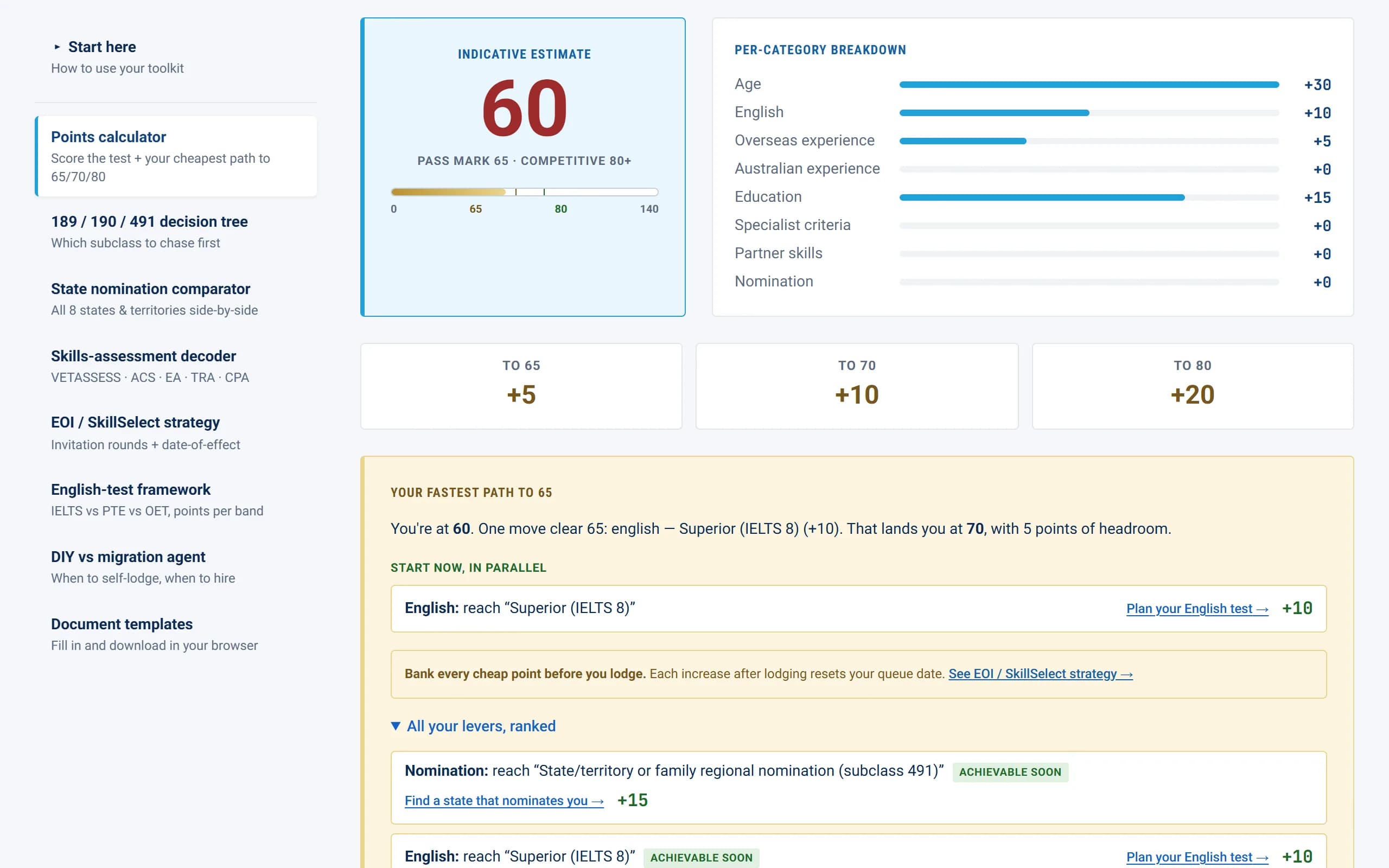
Scenario 1 — Indian operational forecaster, 31 years old, Master's in atmospheric science, five years at the India Meteorological Department, IELTS 7: 30 (age) + 15 (Bachelor) + 10 (English) + 10 (experience) = 65 base. Adds 491 nomination (+15) to land at 80 — competitive on the small meteorologist invitation cycle.
Scenario 2 — UK PhD atmospheric physicist, 29 years old, post-doctoral research role at the UK Met Office Hadley Centre, three years' experience, IELTS 8: 30 (age) + 20 (Doctorate) + 20 (Superior English) + 5 (experience) + 10 (specialist STEM PhD) = 85. Strong 189 candidate.
State Nomination
Victoria
The Bureau's national headquarters and training centre sit in Melbourne. Victoria has nominated 234913 in recent program years on a case-by-case basis. The state's Registration of Interest model lets meteorologists with confirmed Victorian job offers register and be invited.
New South Wales
Sydney hosts the largest private-sector concentration — Weatherzone, energy-trading desks, aviation employers. NSW's 190 program includes the code in most years.
Northern Territory
Darwin's Bureau forecast office plus Defence-related meteorology work make NT a viable regional option. The Territory's program runs separate streams for offshore and onshore applicants — confirm eligibility before lodging.
Tasmania
The Bureau's Antarctic operations are coordinated through Hobart, and Tasmania nominates atmospheric specialists in some program years. Smaller volumes but lower competition.
Other states nominate intermittently — verify against the live published list at EOI lodgement. See the Skilled Occupation List 2026 for the full code roster.
Salary and Employment Outlook
PayScale's 2026 data gives an average meteorologist salary of AU$96,010 in Australia. SEEK's range for similar occupational titles (Research Scientist, Atmospheric Scientist) sits between $90,000 and $125,000. Bureau of Meteorology Glassdoor data shows operational Meteorologists at $98,634 and Senior Meteorologists at $116,000, all under the Australian Public Service classification structure.
| Role | Typical Salary Range (AUD) |
|---|---|
| Graduate Meteorologist (Bureau, APS 3-4) | $64,000-$78,000 + super |
| Operational Meteorologist (Bureau, APS 5-6) | $90,000-$115,000 |
| Senior Meteorologist (Bureau, EL1) | $115,000-$135,000 |
| Principal / Research Meteorologist (Bureau, EL2) | $135,000-$165,000 |
| Private-sector Forecaster (Weatherzone, energy desks) | $100,000-$160,000 |
| Senior Energy/Trading Meteorologist | $150,000-$220,000 |
Bureau salaries follow the Australian Public Service classification — APS 5 through EL2 — and include 15.4% superannuation, which is above the standard 11.5% private-sector rate. Private-sector and trading-desk roles attract performance bonuses but lower super.
Highest-paying sectors:
- Energy and commodity trading — AGL, Origin, EnergyAustralia, Shell, Macquarie. Trading-floor meteorologists who forecast renewables output and gas demand earn well above Bureau base rates.
- Bureau of Meteorology — secure tenure, 15.4% super, EL1/EL2 progression for technical experts
- Aviation — Qantas, Virgin Australia and Airservices Australia (Air Traffic Control's meteorology arm) employ small specialist teams
- Defence and intelligence — Royal Australian Air Force METOC, defence primes
- Private weather services — Weatherzone, MetraWeather, EarthNetworks
Tips for a Successful Application
1. Apply to the Bureau's Graduate Program if you're already a citizen or PR
The Bureau's Graduate Meteorologist Program is the single most reliable on-ramp to meteorology in Australia, but it is restricted to Australian citizens and permanent residents. If you're already on a PR pathway, time your application so you can apply for the next intake — the 2026 program paid $64,169 plus 15.4% super during the 10-month training year, with operational posting on completion. The Bureau opens applications in March-April for the following year's intake.
2. If you're offshore, target the private sector for sponsorship
The Bureau rarely sponsors 482 visas because its workforce-planning model relies on the Graduate Program. Weatherzone, energy-trading desks at AGL/Origin/Shell, and aviation operators are far more open to sponsoring overseas forecasters. Position your CV around model verification, ensemble forecasting, renewables forecasting or extreme-weather analysis — the specialisations that private employers actually buy.
3. Lean on your atmospheric-physics background for points
The points-tested 189 is genuinely competitive for this occupation because the candidate pool is small. A research Master's or PhD in atmospheric physics earns 20 points plus the +10 specialist STEM bonus. Combined with Superior English (IELTS 8 or PTE 79) and age below 33, you can clear 85 points without state nomination.
4. Watch the "highly relevant" experience trap
VETASSESS rejects experience claims where the work was technical-support, observation-network maintenance or IT-systems work for a meteorological agency, rather than forecasting or research. Reference letters must explicitly describe operational forecast duties, numerical-model development, severe-weather analysis or climate research. Have your referees describe outputs (forecasts issued, models validated, papers published) rather than just role titles.
5. Consider the Antarctic and remote-station pathway
The Australian Antarctic Program contracts meteorologists for year-long deployments to Casey, Davis, Mawson and Macquarie Island. These roles often hire at experienced or specialist level, pay well above standard rates with full board, and provide a clear migration story that supports state nomination claims. The Australian Antarctic Division recruits through the Bureau and through specialist Antarctic-program contractors.
Step-by-Step Migration Roadmap
- Confirm 234913 is the right code — review the ANZSCO task list against your actual role via the how to find your ANZSCO code guide
- Audit your degree transcript for atmospheric, fluid-dynamics or numerical-modelling content
- Order verified employment references that emphasise forecasting, modelling or atmospheric research
- Sit IELTS, PTE or OET (aim for IELTS 8 / PTE 79 given the points sensitivity for this code)
- Lodge VETASSESS Full Skills Assessment (or Points Test Advice first if borderline)
- Lodge an Expression of Interest in SkillSelect for 189/190/491
- Lodge state Registration of Interest where the state operates one (Victoria, NSW)
- For employer sponsorship, target Weatherzone, energy-trading desks, aviation and defence primes
- Receive invitation to apply or 482 grant; lodge visa within 60 days
- Complete health and character checks
- Receive grant and relocate; if eligible, apply to the Bureau's next Graduate Program intake post-PR
Frequently Asked Questions
Does the Bureau of Meteorology sponsor 482 visas?
Rarely. The Bureau's primary workforce-planning model is its 10-month Graduate Meteorologist Program, which is open only to Australian citizens and permanent residents. Direct lateral hires of senior meteorologists do happen, but they are infrequent. For most offshore applicants, the pathway is private-sector sponsorship (or 189/190/491), then applying to the Bureau after PR.
Can a Bachelor of Physics qualify me for the meteorologist skills assessment?
Possibly — it depends on the unit mix. VETASSESS looks for atmospheric physics, fluid dynamics, thermodynamics applied to the atmosphere, and numerical-modelling content. A pure-theory or pure-particle-physics degree usually fails the highly-relevant test; an applied-physics degree with atmospheric or oceanographic units typically passes. For a related occupation, see the physicist visa pathway.
Is meteorologist on the MLTSSL?
Yes. ANZSCO 234913 sits on both the Core Skills Occupation List and the MLTSSL, with full access to 189, 190, 491, 482 and 186.
What's the realistic invitation score for 189 in this occupation?
The pool is small, so the invitation threshold is lower than for ICT codes. Recent cycles have invited at 80-85 points for 234913. A candidate with a Master's, Superior English, several years of relevant experience and age under 33 can clear without state nomination — which is the opposite of the ICT picture.
How do I qualify for Bureau employment after PR?
Apply through the Graduate Meteorologist Program (open March-April each year) if you have a Bachelor's or Master's in physics, mathematics, atmospheric science or a closely related field. Direct lateral hiring also happens through Bureau-advertised positions on the APS Jobs website. Bureau hiring requires Australian citizenship or permanent residency at the time of application.
Which private-sector employers actually sponsor meteorologists?
Weatherzone (DTN-owned, with offices in Sydney and Melbourne) hires regularly. Energy-trading desks at AGL, Origin Energy, EnergyAustralia, Shell, Engie and Macquarie's commodity teams hire renewables and demand forecasters. Aviation employers (Qantas, Virgin, Airservices) have smaller specialist teams. Defence primes (Lockheed Martin Australia, Leidos, Northrop Grumman) hire for METOC contracts. See the most in-demand occupations list for context.