Human Resource Adviser Visa Pathway to Australia: Complete 2026 Guide
Updated: 16 August 2026
Australia classifies Human Resource Adviser under ANZSCO 223111. VETASSESS conducts the skills assessment as a Group B professional occupation. The code sits on the Core Skills Occupation List (CSOL) and the Regional Occupation List (ROL), unlocking subclasses 491, 494, 482 and 186, but not the points-tested 189 or 190. Typical 2026 salaries range AUD $90,000 to $110,000. Permanent residency runs almost entirely through employer or regional sponsorship.
Quick Facts: Human Resource Adviser Migration Pathway
| Detail | Information |
|---|---|
| ANZSCO Code | 223111 (Human Resource Adviser) |
| Skill Level | 1 (Bachelor degree or higher, or equivalent experience) |
| Skills Assessment | VETASSESS (Vocational Education and Training Assessment Services) |
| Occupation List | CSOL and ROL (Core Skills and Regional Occupation Lists) |
| Visa Options | 491, 494, 482, 186 |
| Demand Level | Moderate to high — driven by industrial relations reform and workforce restructuring |
| Salary Range | AUD $90,000-$110,000 (SEEK, 2026) |
| Typical 491 Score | 70-85 points after regional nomination |
| Key Challenge | No 189 or 190 route — sponsorship or a regional program is mandatory |
The HR Adviser Role in Australia
Human Resource Advisers provide staffing and human resources administration services that support an organisation's HR policies and programs. The role sits below Human Resource Manager (132311) in the ANZSCO hierarchy. Advisers run recruitment and onboarding, advise line managers on employment conditions and performance, administer remuneration and benefits, interpret enterprise agreements, and keep the business compliant with the Fair Work Act 2009. VETASSESS accepts Human Resource Consultant, Human Resource Officer and Workforce Planning Analyst as roles falling under this code.
Demand has lifted across 2025-26. The Closing Loopholes reforms, the right-to-disconnect rules, and a busy enterprise-bargaining cycle have pushed employers to invest in HR capability. The work concentrates in Sydney, Melbourne, Brisbane and Perth, with Perth and regional centres absorbing demand from mining, healthcare and construction employers. The Australian HR Institute counts a large national HR workforce, but only the professional, degree-qualified tier maps cleanly to 223111.
A point worth being clear about: this code is for advisory professionals, not for the manager who owns the HR function. If you run the function and report near the executive, you map to Human Resource Manager (132311), which is assessed differently. See the Human Resource Manager visa pathway if that describes your role.
ANZSCO Code 223111 — What Counts
The 223111 code covers professionals who advise on and administer HR policy rather than set enterprise workforce strategy. Tasks include advising on staff selection, training and development, employee relations, performance management, occupational health and safety, and equal employment opportunity. The skill level is 1, meaning a Bachelor degree or higher, or five years of relevant experience that VETASSESS accepts in place of formal qualifications in some pathways.
Get the boundary right. Talent acquisition specialists who focus on hiring may fit Recruitment Consultant (223112). Employees who advise on industrial disputes and bargaining map to Workplace Relations Adviser (223113). Senior heads of function map to Human Resource Manager. Read the official descriptions on the ANZSCO code finder and match your real duties, not your job title.
Skills Assessment
VETASSESS (Group B Professional Occupation)
VETASSESS assesses 223111 as a Group B professional occupation, meaning both qualification and employment are assessed and both must pass.
Requirements:
- A qualification assessed as comparable to an AQF Bachelor degree or higher in a field highly relevant to HR.
- At least one year of highly relevant post-qualification employment in the last five years where the degree is highly relevant.
- More relevant employment where the degree is in a less relevant field.
- English evidence as required by the visa subclass and any nominating state.
Assessment cost: AUD $1,096 for non-residents, AUD $1,205.60 for Australia-based applicants including GST (VETASSESS professional occupation fee, October 2025).
Processing time: VETASSESS reports around eight to ten weeks for this occupation from lodgement, with priority processing available for an additional AUD $825 returning an outcome in roughly ten business days.
Common rejection reasons: The most common failure is employment evidence that reads as administrative HR support rather than professional advisory work at skill level 1. The second is a qualification VETASSESS judges to be in a field not highly relevant to human resources, which then demands more years of relevant experience to compensate.
For how VETASSESS compares to other authorities, see the skills assessment bodies complete list.
Visa Pathways
223111 is on the CSOL and ROL but not the MLTSSL, and it is not eligible for the 190 either. That removes both the independent 189 and the state-nominated 190. The realistic routes are employer sponsorship and regional nomination.
Subclass 482 — Skills in Demand Visa
Employer-sponsored temporary work visa, often the fastest route for an adviser with a job offer.
- Visa fee: from AUD $3,210 (primary applicant).
- Eligibility constraint: the Core Skills Income Threshold is AUD $76,515 until 30 June 2026, rising to AUD $79,499 from 1 July 2026. Most professional HR adviser salaries clear this comfortably.
- Processing time: varies by stream and nomination; check current Home Affairs published times.
- Quirk: the 482 leads to permanent residency through the 186 Temporary Residence Transition stream after the qualifying period with the same employer, so it is a genuine PR pathway, not a dead end.
Subclass 186 — Employer Nomination Scheme
Permanent residency through employer sponsorship, available because 223111 is on the CSOL.
- Visa fee: AUD $6,140 (primary applicant, 2026).
- Streams: Direct Entry, or Temporary Residence Transition after holding a 482.
- Quirk: Direct Entry requires at least three years of relevant experience, which most professional HR advisers can show.
Subclass 494 — Skilled Employer Sponsored Regional (Provisional) Visa
Employer-sponsored regional visa with a five-year term and a pathway to permanent residency through the subclass 191.
- Visa fee: AUD $4,910 (primary applicant, 2026).
- Eligibility constraint: the sponsoring employer must operate in a designated regional area and the role must meet skills and salary requirements.
- Quirk: the 494 is the main employer-sponsored route for advisers whose sponsor is outside the major cities, and the ROL listing makes 223111 eligible for it.
Subclass 491 — Skilled Work Regional (Provisional) Visa
Points-tested regional visa, available because 223111 is on the ROL. State or family regional nomination adds 15 points.
- Visa fee: AUD $6,140 (primary applicant, 2026).
- Points boost: +15 from regional nomination.
- Quirk: the 491 needs both a competitive points score and a regional sponsor or eligible family member, so it suits advisers willing to commit to a regional location.
Points Test Strategy
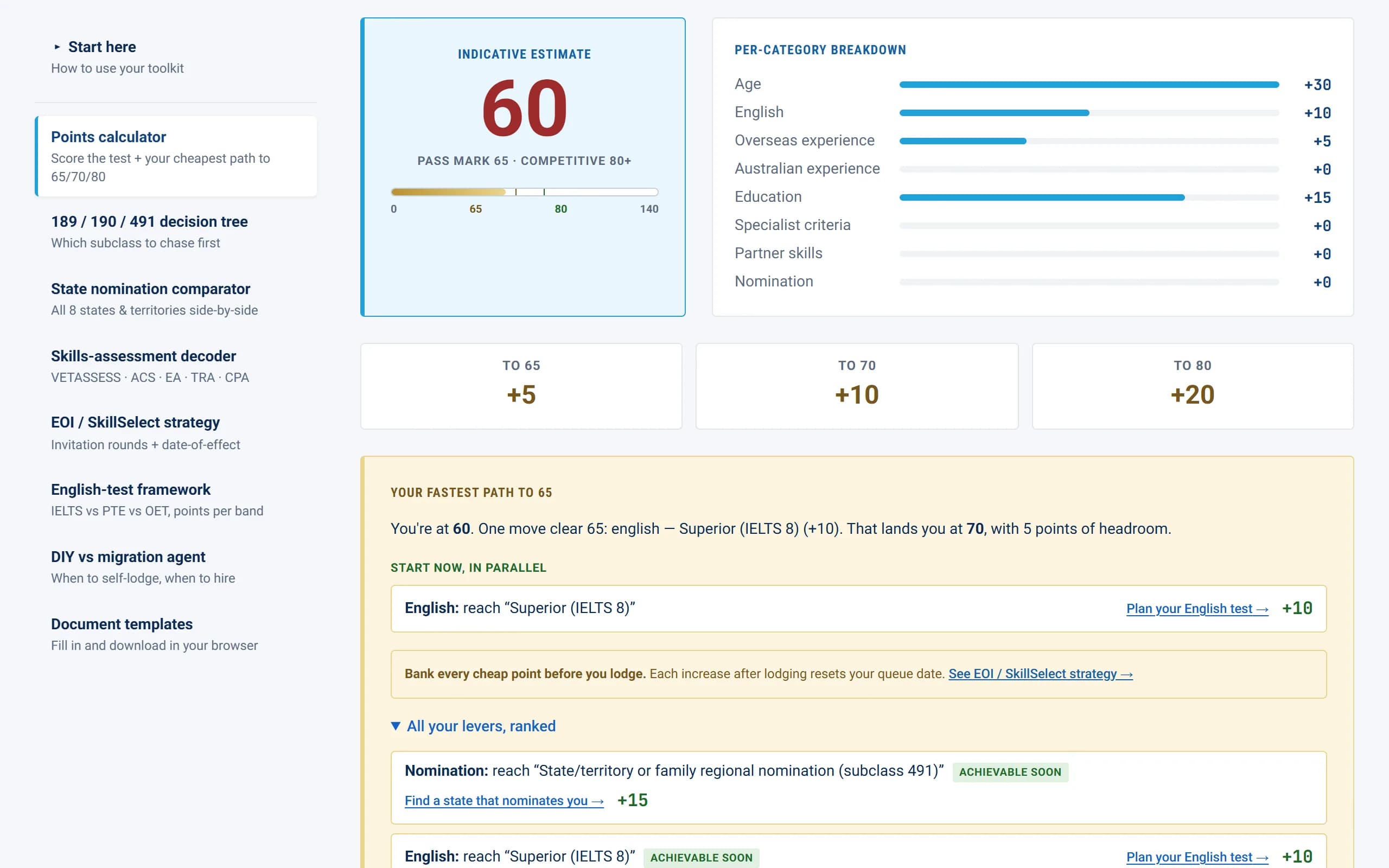
The 491 is the only points-tested route for 223111. Your score determines whether a regional program will consider you.
| Points Factor | Points | Notes |
|---|---|---|
| Age (25-32) | 30 | Maximum bracket |
| Qualification (Bachelor) | 15 | Minimum for Skill Level 1 |
| Qualification (Master/PhD) | 15-20 | Higher band if your degree qualifies |
| English (Proficient — 7.0) | 10 | Realistic target |
| English (Superior — 8.0+) | 20 | Strong lift |
| Skilled employment (overseas) | 5-15 | Depends on assessed years |
| Regional nomination (491) | 15 | The largest single boost for this code |
| Partner skills | 5-10 | If your partner has a skilled occupation |
Scenario 1 — HR adviser, 29, Superior English, 5 assessed years: 30 (age) + 15 (Bachelor) + 20 (English) + 10 (experience) = 75, plus 15 with a 491 regional nomination reaches 90.
Scenario 2 — HR adviser, 33, Proficient English, 3 assessed years: 25 (age) + 15 (Bachelor) + 10 (English) + 5 (experience) = 55, needing the 491 (+15) to reach 70, or an employer to sponsor a 482 or 494. For how invitations are ranked, see the SkillSelect EOI guide.
State and Regional Nomination
Because 223111 is excluded from the 190, state nomination only applies through the regional 491. Several regional programs accept professional occupations under broad business categories, but the specific availability of 223111 changes by program year and by Designated Area Migration Agreement. Always confirm the current status against the relevant state or regional authority's published list before lodging an expression of interest. A code that was open in one program year can close in the next, so do not rely on third-party summaries.
Salary and Employment Outlook
| Role | Typical Salary Range |
|---|---|
| HR Officer / Coordinator | AUD $70,000-$90,000 |
| HR Adviser | AUD $90,000-$110,000 |
| Senior HR Adviser / Business Partner | AUD $110,000-$135,000 |
| HR Consultant (specialist) | AUD $100,000-$140,000 |
Figures draw on SEEK 2026 salary data, which places the typical HR Adviser between AUD $90,000 and $110,000. Total packages add superannuation at 11.5 per cent, and some advisory roles add performance bonuses. The highest pay sits in mining and resources, financial services, large healthcare networks and government, all of which run substantial HR functions. Sydney and Melbourne carry the deepest markets, while Perth pays competitively because of resources-sector demand.
The 2025-26 industrial relations reforms have lifted demand for advisers who can interpret enterprise agreements and the updated Fair Work provisions. Employers value advisers with genuine employee-relations experience over generalist administration, which is also what strengthens a VETASSESS employment assessment.
Tips for a Successful Application
- Confirm 223111 over the alternatives. If you mainly recruit, Recruitment Consultant (223112) fits; if you advise on disputes and bargaining, Workplace Relations Adviser (223113) fits; if you head the function, Human Resource Manager (132311) fits. The wrong code fails at assessment.
- Write references at advisory level. Show that you advised managers, interpreted policy and enterprise agreements, and handled employee relations, not just processed administration. VETASSESS distinguishes professional advisory work from clerical HR support.
- Plan around the absence of a 189 or 190. This code reaches permanent residency through the 186 or the regional 191, so secure an employer or commit to a regional program early.
- Aim for Superior English. HR advisers can usually reach 8.0, and the 20-point lift is decisive for the 491.
- Match your degree to the field. A degree VETASSESS treats as highly relevant to HR cuts the required experience to one year. A less relevant degree demands more years, so document everything.
Step-by-Step Migration Roadmap
- Confirm your ANZSCO code against the ANZSCO code finder, ruling out 223112, 223113 and 132311.
- Check the list status of 223111 on the Core Skills Occupation List and confirm its ROL listing.
- Prepare references describing professional HR advisory duties.
- Sit your English test, aiming for Superior where possible.
- Lodge your VETASSESS assessment as a Group B professional occupation.
- Calculate your points with assessed experience factored in.
- Decide your route — employer sponsorship (482, 186, 494) or regional points (491).
- Secure a sponsor or regional nomination as your route requires.
- Submit an expression of interest in SkillSelect if pursuing the 491.
- Receive your invitation and lodge the visa within the allowed period.
- Complete health and character checks.
- Receive the grant and relocate.
Frequently Asked Questions
Why can't a Human Resource Adviser apply for the 189 or 190?
ANZSCO 223111 sits on the Core Skills Occupation List and the Regional Occupation List, but not on the Medium and Long-term Strategic Skills List used for the independent 189, and it is not eligible for the state-nominated 190. That leaves employer-sponsored routes (482, 186, 494) and the regional points-tested 491 as the available pathways.
What is the difference between a Human Resource Adviser and a Human Resource Manager for migration?
The adviser code (223111) is for professionals who advise on and administer HR policy. The manager code (132311) is for those who own the HR function and set workforce strategy, and it is assessed by a different authority. Choosing 223111 when you genuinely run the function, or the reverse, leads to a failed assessment.
Is employer sponsorship easier than the regional points route for HR advisers?
Often, yes. The 482 does not require a points test, only a skills assessment and a qualifying job offer, and most HR adviser salaries clear the Core Skills Income Threshold. It also transitions to permanent residency through the 186. The 491 requires a competitive points score plus a regional sponsor, so it suits applicants already committed to a regional location.
Can my overseas HR qualification be recognised?
Often, provided VETASSESS assesses it as comparable to an Australian Bachelor degree or higher in a field highly relevant to HR. A degree in human resources, business, psychology or industrial relations is usually treated as highly relevant. A less relevant degree can still work, but VETASSESS will require more years of relevant employment to compensate.
What are the most common reasons these applications fail?
Two reasons dominate. First, employment references that describe administrative HR support rather than professional advisory work at skill level 1. Second, attempting the wrong code, most often using 223111 when the role is genuinely recruitment, workplace relations or HR management. Both are avoidable with careful drafting and honest code selection.