Primary Health Organisation Manager Visa Pathway to Australia: Complete 2026 Guide
Updated: 16 August 2026
Australia classifies Primary Health Organisation Manager under ANZSCO 134213. VETASSESS conducts the skills assessment as a Group A professional occupation. The role sits on the MLTSSL and CSOL, unlocking subclasses 189, 190, 491, 482, and 186. Typical 2026 SEEK Health Manager salaries range AUD $125,000-$140,000, with senior network roles at $160,000+.
Quick Facts: Primary Health Organisation Manager Migration Pathway
| Detail | Information |
|---|---|
| ANZSCO Code | 134213 (Primary Health Organisation Manager) |
| Skill Level | 1 (Bachelor degree or higher in medicine, health administration, or health services management) |
| Skills Assessment | VETASSESS (Group A professional occupation) |
| Occupation List | MLTSSL + CSOL |
| Visa Options | 189, 190, 491, 482, 186 |
| Demand Level | Moderate-to-high — Primary Health Networks, GP super-clinics, and Aboriginal Community Controlled Health Organisations recruit consistently |
| Salary Range | AUD $125,000-$160,000 (SEEK Health Manager band, April 2026); $200,000+ in senior PHN and large-clinic CEO roles |
| Typical 189 Score | 75-85 points |
| Key Challenge | VETASSESS expects substantive primary care management experience — pure hospital or insurance backgrounds frequently miss the duty match |
What a Primary Health Organisation Manager Does in Australia
A Primary Health Organisation Manager plans, organises, directs, controls, and coordinates a primary health organisation that delivers out-of-hospital health services. The Australian primary care system runs through three main organisational types: Primary Health Networks (PHNs — 31 federally funded regional bodies that commission services), general practice corporations and GP super-clinics, and Aboriginal Community Controlled Health Organisations (ACCHOs). The role spans operational leadership, clinical governance, contracted service commissioning, GP and allied-health workforce management, and stakeholder engagement with state Local Health Districts and the federal Department of Health, Disability and Ageing.
Demand is uneven but persistent. PHNs (e.g. Central and Eastern Sydney PHN, North Western Melbourne PHN, Brisbane North PHN) commission rather than deliver services, and their managers focus on procurement, performance, and population health. General practice corporates (IPN/Sonic Clinical Services, ForHealth, Healius, Tristar) run large multi-site clinics and recruit experienced managers at practice manager and regional manager levels. ACCHOs (NACCHO members across all states and territories) increasingly recruit experienced managers familiar with Indigenous health policy and service delivery.
The role differs from a hospital Health Services Manager (134299) because the scope sits outside the acute hospital sector. VETASSESS treats this as a distinct occupation, and the wrong code at lodgement is the single most expensive mistake.
ANZSCO Code Mapping
The code is 134213 Primary Health Organisation Manager. The ABS task list includes determining philosophy, goals, budgets, and standards for primary health services; directing and coordinating organisational activities; advising on health policy; controlling expenditure; representing the organisation in negotiations; and overseeing service performance.
Related codes that share VETASSESS as assessing body but cover different roles:
- 134211 Medical Administrator — for senior medically qualified leaders in hospital and health authority settings
- 134212 Nursing Clinical Director — clinical service direction in nursing-led settings
- 134299 Health and Welfare Services Managers (nec) — catch-all for senior health managers not elsewhere classified, often used for hospital department heads
- 132511 Policy and Planning Manager — for federal/state health policy roles outside frontline delivery
If your current role title is "General Manager" or "CEO" of a private medical centre, day surgery, or community health service, 134213 is usually the correct map provided your scope is genuinely primary (out-of-hospital) care delivery. PHN executives almost always map to 134213.
Skills Assessment with VETASSESS
VETASSESS handles 134213 as a Group A professional occupation. Group A is the highest skill-level classification, requiring a degree-level qualification highly relevant to the nominated occupation.
Qualification requirement: A qualification assessed as comparable to an Australian Qualifications Framework (AQF) bachelor degree or higher, in a field highly relevant to primary health management — Medicine, Health Administration, Health Services Management, Public Health, Nursing (with management postgraduate study), or Business Administration with a substantial health management focus.
Employment requirement: At least one year of post-qualification employment at an appropriate skill level within the last five years, working a minimum 20 hours per week, in duties closely matched to the ANZSCO description.
Assessment cost (2026): AUD $1,076 for the full skills assessment (VETASSESS fee schedule effective from October 2025).
Processing time: Full skills assessment typically 8-10 weeks; full process up to 12-20 weeks depending on documentation. Priority processing available for an additional fee.
Common rejection reasons:
- Wrong sector match — candidates with hospital administration backgrounds frequently lodge for 134213 when their actual scope sits in 134299. VETASSESS scrutinises whether the role genuinely sits in primary (out-of-hospital) care.
- Insufficient management depth — practice managers in single-doctor clinics rarely meet the Group A threshold. The role needs to demonstrate strategic, financial, and governance scope, not just operational supervision.
Visa Pathways for Primary Health Organisation Managers
The MLTSSL listing makes all skilled subclasses available.
Subclass 189 — Skilled Independent
Permanent residency through the points test.
- Visa fee: AUD $6,135
- Minimum points: 65 (realistically 75-85 in 2026)
- Processing time: Approximately 8-9 months for newer applications
- Quirk: Health management occupations receive priority routing in the skilled-visa allocation; healthcare leadership is a federally identified shortage area
Subclass 482 — Skills in Demand
Employer sponsorship is a strong route for this occupation.
- Visa fee: AUD $3,210
- Salary requirement: Most 134213 roles exceed the Specialist Skills Threshold, qualifying for the faster stream
- Processing time: Specialist Skills stream often resolves in around a week for 50% of applications
- Quirk: PHNs, large GP corporates, and ACCHOs sponsor managers under 482 when the role can't be filled domestically. Sponsorship from a federally funded PHN is particularly well-regarded.
Subclass 190 — Skilled Nominated
- Visa fee: AUD $6,140
- Processing time: 6-12 months from invitation
- Points uplift: 5
- Quirk: Several states nominate health managers under 190; demonstrate state employment connection where possible
Subclass 491 — Skilled Work Regional
- Visa fee: AUD $6,140
- Points uplift: 15
- Processing time: 12-14 months
- Quirk: Regional PHNs (Country WA PHN, Western Queensland PHN, Northern Territory PHN, Tasmania PHN) and rural ACCHOs use 491 actively. Salaries are competitive with metro because of remote-area loading.
Subclass 186 — Employer Nomination Scheme
- Visa fee: AUD $6,140
- Processing time: Direct Entry 12-20+ months; TRT shorter
- Quirk: PHNs and large primary care corporates frequently use 186 Direct Entry for senior appointments where the candidate has 3+ years of skilled employment
For deeper detail on employer-sponsored migration see /subclass/482 and the 186 ENS guide.
Points Test Strategy
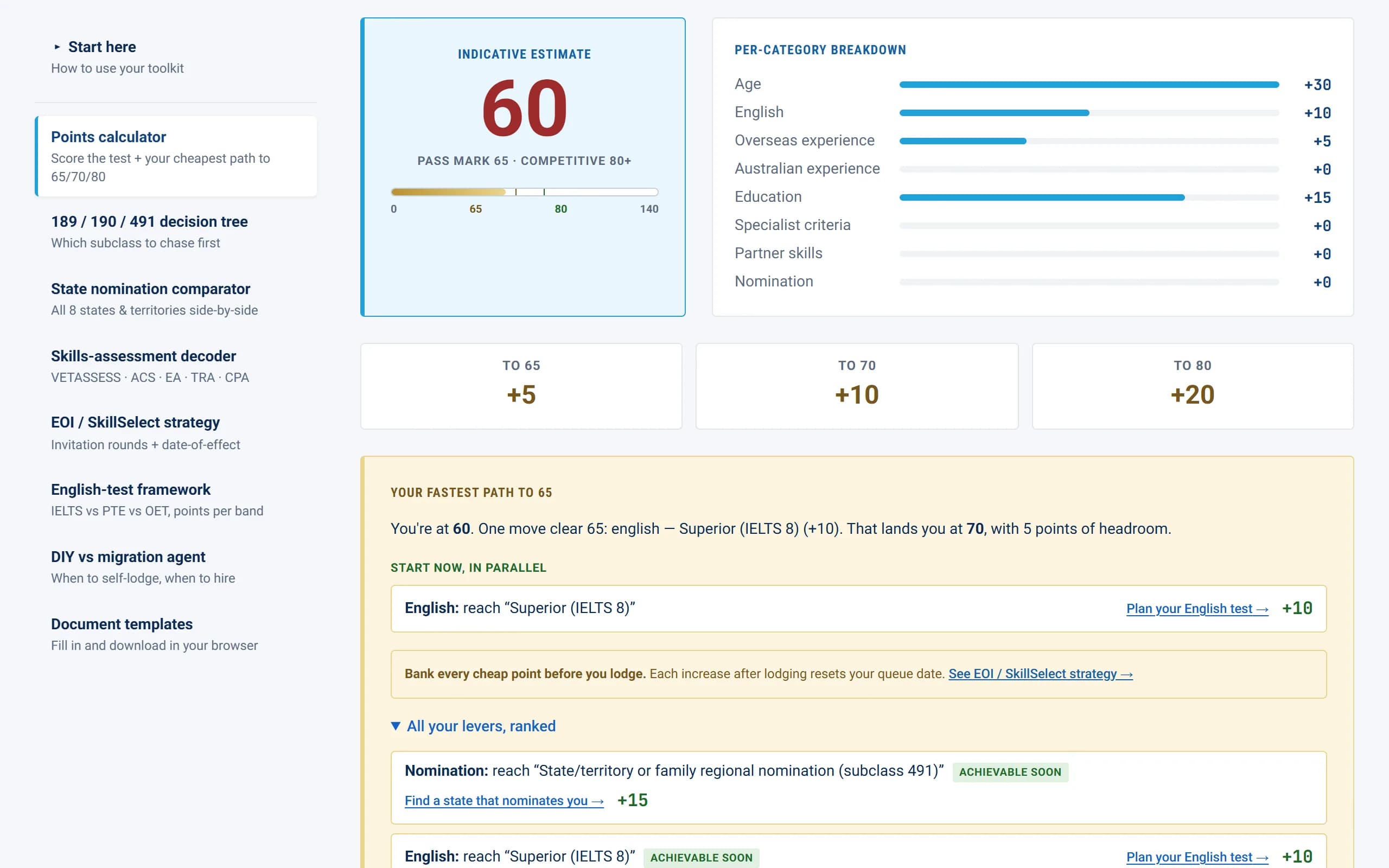
| Points Factor | Points | Notes |
|---|---|---|
| Age 25-32 | 30 | Uncommon for senior managers |
| Age 33-39 | 25 | Realistic for the cadre |
| Age 40-44 | 15 | Still viable with strong English + experience |
| Qualification (Master's / MBA / MPH) | 15 | Common at this level |
| Qualification (PhD) | 20 | Strong claim |
| English (Proficient — IELTS 7) | 10 | |
| English (Superior — IELTS 8) | 20 | Significant differentiator |
| Overseas Skilled Experience (8+ years) | 15 | Most candidates exceed this |
| Australian Skilled Experience (3+ years) | 10-15 | Strong if on existing 482 |
| State Nomination (190) | 5 | |
| Regional Nomination (491) | 15 | |
| Partner Skills | 5-10 |
Realistic Scenarios
Scenario 1 — Offshore senior PHN executive: Age 36 (25) + MPH (15) + Superior English (20) + 8 years overseas experience (15) + 190 nomination (5) = 80 points. Competitive in priority allocation.
Scenario 2 — Onshore practice manager: Age 39 (25) + Bachelor's + Postgrad Diploma (15) + Proficient English (10) + 3 years Australian + 5 years overseas (cap-counted 15) + 491 nomination (15) = 80 points. Strong 491 candidate for a regional PHN role.
State Nomination for Primary Health Organisation Managers
New South Wales
NSW nominates senior health managers under its 190 stream when network demand justifies it. NSW has the highest density of PHNs (10 of the 31 nationally) and the largest GP corporate footprint.
Victoria
Victoria's program prioritises health workers; senior primary care management roles are nominated through 190 and 491. North Western Melbourne PHN, Eastern Melbourne PHN, Gippsland PHN, and Murray PHN are recurring sponsors.
Queensland
Queensland's 190 and 491 streams reliably include senior health managers. Brisbane North PHN, Brisbane South PHN, Western Queensland PHN, and the state's growing ACCHO sector (Apunipima, IUIH) drive demand.
South Australia
SA nominates senior health managers consistently. Country SA PHN and Adelaide PHN sponsor at the senior tier; SA Health's primary care policy team also recruits at executive level.
Western Australia
WA's primary care sector includes WA Primary Health Alliance (covering Perth, Country WA, and Perth South PHNs). The state nominates 190 and 491 for senior health management roles, particularly in regional WA.
Tasmania and ACT
Tasmania nominates the role under 491 for Tasmania PHN, North Western Tasmania PHN, and community health networks. The ACT nominates under 190 for Capital Health Network and federally based health policy roles.
Northern Territory
NT actively nominates health managers under 190 and 491. NT PHN and the strong ACCHO network (AMSANT, Danila Dilba, Miwatj) recruit experienced managers familiar with remote service delivery.
Salary and Employment Outlook
2026 Salary Bands
| Role | Typical Salary Range |
|---|---|
| Practice Manager (mid-sized clinic, 5-10 GPs) | AUD $95,000-$120,000 |
| Regional Manager (GP corporate) | AUD $120,000-$150,000 |
| General Manager (large primary care site) | AUD $135,000-$170,000 |
| PHN Director / Operations | AUD $150,000-$200,000 |
| PHN CEO | AUD $220,000-$320,000 |
| ACCHO CEO (mid-sized) | AUD $180,000-$260,000 |
Sources: SEEK Salary Hub (April 2026 Health Manager average AUD $125,000-$140,000), Yourcareer.gov.au (national 134213 data), Jobs and Skills Australia 134213 occupation profile.
Total package usually includes the 11.5% superannuation guarantee. Many PHNs and ACCHOs are PBI-status not-for-profits offering FBT-exempt salary packaging, which can lift effective take-home by $10,000-$15,000 a year for senior staff.
Highest-paying employers
- Large primary care corporates — Sonic Clinical Services, ForHealth, Tristar Medical Group, Healius pay above-median base salaries for senior regional and national roles
- Primary Health Networks — 31 PHNs Australia-wide; CEO roles are competitive and well-remunerated
- Aboriginal Community Controlled Health Organisations — leading ACCHOs (Apunipima, Mala'la, Wuchopperen, Victorian Aboriginal Health Service, AMS Redfern) pay strongly with FBT-exempt packaging
- National federations — NACCHO, RACGP, ACRRM offer senior policy and program roles
- Federal and state health departments — primary care policy and integration roles at EL/SES bands
Jobs and Skills Australia signal
Jobs and Skills Australia's 134213 occupation profile records steady employment growth and persistent recruitment activity, particularly in regional PHNs and ACCHOs. The occupation is not classified as a critical national shortage but consistently appears in state demand signals across health management categories.
Tips for a Successful Application
1. Distinguish primary from acute care in your evidence
VETASSESS reads 134213 strictly. If your overseas role spanned both hospital and primary care, isolate the primary care scope in your references — outpatient clinics, community programs, GP-equivalent ambulatory services, allied health management. Hospital-only management background routinely fails the duty match for this code.
2. Pursue an Australian-recognised postgraduate qualification
A Master of Public Health, Master of Health Administration, or MBA from a recognised university materially strengthens the VETASSESS qualification weighting and adds 15 points to your skills claim. Several Australian universities offer fully online MPH programs that allow offshore completion.
3. Map your duties to Australian primary care concepts
Australian primary health management uses specific terms: PHN commissioning, MBS/PBS billing, RACGP accreditation, AGPAL/QPA accreditation, My Health Record integration, MyMedicare patient registration. References that demonstrate familiarity with equivalent concepts in your home country (capitation, accreditation, e-health, panel registration) carry more weight than generic management language.
4. Target PHN and ACCHO 482 sponsorship
PHNs are federally funded and have established sponsorship processes. ACCHOs increasingly recruit senior management internationally. Direct outreach to PHN HR teams and the NACCHO members' network identifies sponsorship opportunities not advertised on SEEK.
5. Consider 491 in remote and regional Australia
The Top End, Far West NSW, Cape York, the Goldfields, and regional Tasmania carry severe shortages of experienced primary care managers and remunerate strongly. The 491 visa converts to 191 permanent after three years. Remote-area packages often include subsidised accommodation, relocation, and salary loadings of 10-15%.
Step-by-Step Migration Roadmap
- Confirm the ANZSCO match — verify duties against 134213 using the ANZSCO code finder
- Verify MLTSSL status — confirm 134213 on the current Skilled Occupation List
- Prepare qualification evidence — academic transcripts, course descriptions
- Prepare employment evidence — detailed references emphasising primary care management scope, organisational charts, budget responsibility, governance roles
- Lodge VETASSESS skills assessment — AUD $1,076; allow 8-20 weeks
- Sit English — IELTS or PTE Academic; aim for Superior
- Submit EOI in SkillSelect — claim 189, 190, 491
- Apply for state nomination — if pursuing 190 or 491
- Alternatively, pursue 482 sponsorship — through PHN, GP corporate, or ACCHO
- Receive ITA — 60 days to lodge the visa
- Complete health and character checks
- Receive grant and relocate; build local network through RACGP, AHHA, and NACCHO events
Frequently Asked Questions
How is Primary Health Organisation Manager different from Health and Welfare Services Manager?
134213 sits specifically in primary (out-of-hospital) care. 134299 Health and Welfare Services Managers (nec) is the catch-all code for managers in hospital, aged care, mental health, disability services, and other welfare settings that don't fit elsewhere. The wrong choice is the most common reason VETASSESS issues a non-positive outcome. If your background is hospital department management, file under 134299 and check that code's list status separately.
Do I need an Australian degree to qualify?
No. VETASSESS assesses overseas qualifications against the Australian Qualifications Framework. Most accredited postgraduate health management degrees from the UK, US, Canada, India, the Philippines, South Africa, and South-East Asian universities assess as AQF Master or higher. The decisive factor is whether the qualification is highly relevant to the occupation — a Master of Public Health or Master of Health Administration is the strongest qualification match.
Are GP practice managers eligible for 134213?
Sometimes. A practice manager in a single-doctor clinic with a clerical/operational scope usually does not meet the Group A threshold and is more accurately classified as a Practice Manager (149913 — not on most state lists). A general manager of a multi-site corporate primary care business, with strategic, financial, and governance responsibility, does map to 134213. Scope and seniority decide, not the title.
Which is faster — 189 points-based or 482 employer sponsorship?
In 2026, 482 (Specialist Skills stream) is typically faster from offer to grant — around 1-2 weeks of department processing for most cases — than the 189 invitation cycle, which depends on points-test competition. The trade-off is that 482 is temporary and tied to a sponsor, while 189 is permanent and portable. Most candidates with 80+ points pursue both routes in parallel and accept whichever lands first.
What's the demand outlook for the occupation through 2026 and beyond?
Demand is firm. Federal investment in primary care reform (the Strengthening Medicare package, MyMedicare voluntary patient registration, multidisciplinary care funding), expanded PHN commissioning, and continued ACCHO sector growth all sustain recruitment for senior primary health managers. Regional and remote demand is particularly strong and unlikely to ease in the medium term given the geographic distribution of Australia's primary care workforce.