Recreation Officer Visa Pathway to Australia: Complete 2026 Guide
Updated: 16 August 2026
Australia classifies a Recreation Officer under ANZSCO 272612 (Recreation Officer / Recreation Coordinator), a Skill Level 1 occupation requiring a Bachelor degree or higher. VETASSESS conducts the skills assessment. The occupation sits on the Core Skills Occupation List (CSOL), opening subclasses 190, 491, 482 and 186. Typical 2026 salaries run AUD $70,000 to $97,000. Demand concentrates in local government and community health.
Quick Facts: Recreation Officer Migration Pathway
| Detail | Information |
|---|---|
| ANZSCO Code | 272612 (Recreation Officer / Recreation Coordinator) |
| Skill Level | 1 (Bachelor degree or higher; relevant experience may also be required) |
| Skills Assessment | VETASSESS (Vocational Education and Training Assessment Services) |
| Occupation List | CSOL (also historically on the STSOL) |
| Visa Options | 190, 491, 482, 186 |
| Demand Level | Moderate — steady demand in local councils, community health and aged care |
| Salary Range | AUD $70,000-$97,000 (Talent.com / SEEK, 2026) |
| Typical 189 Score | Not applicable — 272612 is not on the MLTSSL, so no subclass 189 |
| Key Challenge | Matching real duties to the ANZSCO description; the role overlaps with welfare and sport roles |
What a Recreation Officer Does in Australia
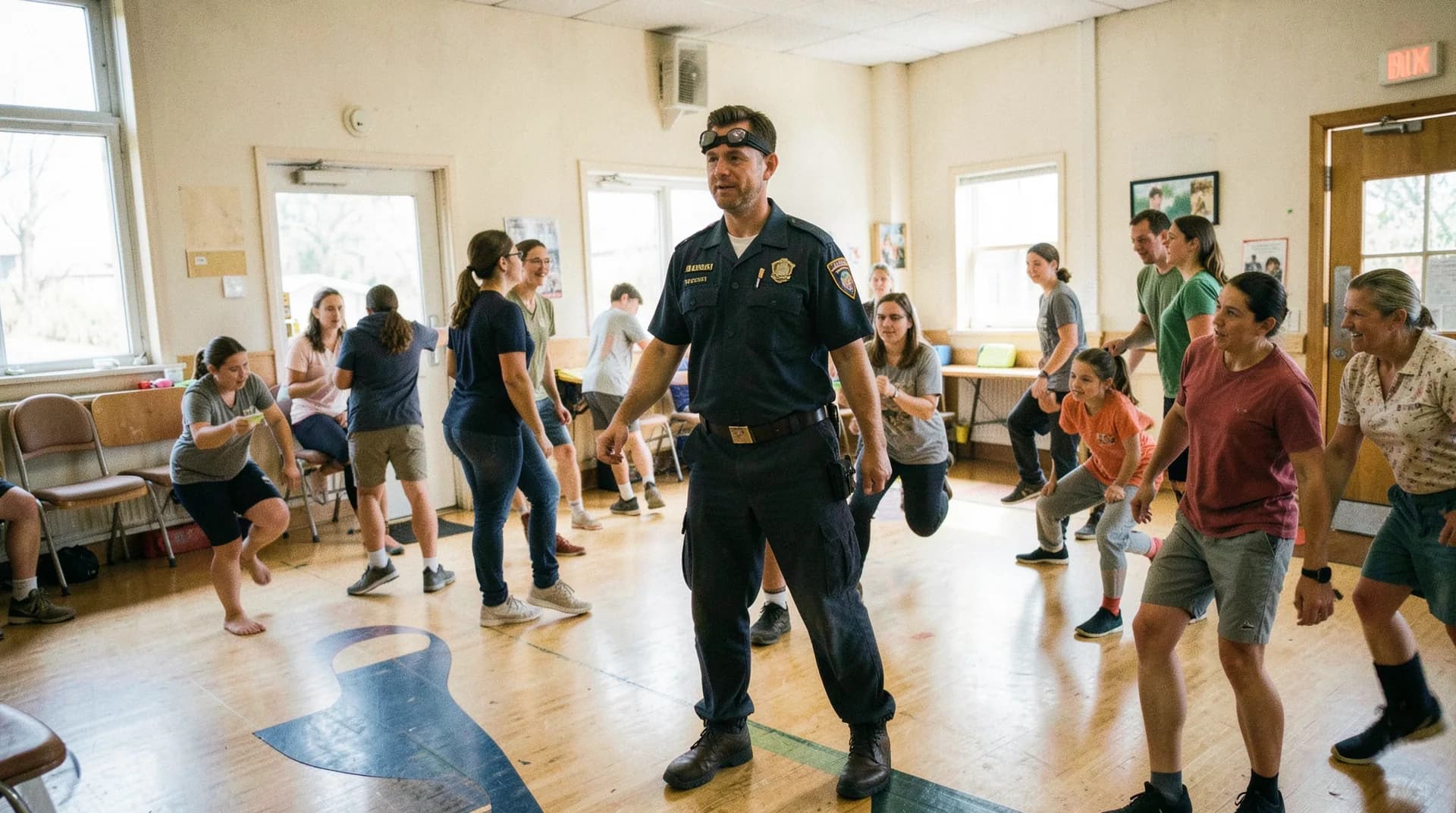
A Recreation Officer plans, organises and coordinates recreation facilities and programs. The work usually sits inside local governments, schools, church bodies, youth organisations, community health services and aged care providers. The day-to-day mix involves researching community needs, designing programs, securing funding through written submissions, running events and measuring whether those programs actually helped.
Most positions in Australia advertise through councils and not-for-profit community organisations. A council might employ a Recreation Officer to run school-holiday sport programs, manage a leisure centre's activity calendar, or coordinate social inclusion programs for older residents. The role is people-facing and administrative in equal measure. You write the funding submission in the morning and run the seniors' aqua class in the afternoon.
Geographically, demand spreads across the country rather than clustering in one capital. Regional councils recruit Recreation Officers to deliver community wellbeing programs, which makes this occupation a reasonable fit for regional visa pathways. Aged care and disability services have widened the demand base as the sector has grown.
ANZSCO Code 272612 Explained
ANZSCO 272612 covers two related titles: Recreation Officer (the Australian term) and Recreation Coordinator (the New Zealand term). The code sits in the Welfare, Recreation and Other Community Service Workers minor group, not in the sport coaching group, which is a common point of confusion.
The official task set includes researching and analysing community issues and needs, developing and maintaining community resources and programs, writing reports and funding submissions, identifying local needs through community consultation, and organising sporting, cultural and recreational events. If your work centres on coaching athletes or managing a fitness facility, a different code may fit better. Read the full description on the ANZSCO code finder before you commit, because the assessing body checks your duties against this exact list.
There is no "nec" fallback inside this code. If your duties do not match, VETASSESS will assess you against the closest alternative occupation rather than force-fit 272612.
Skills Assessment
VETASSESS (Group B Professional Occupation)
VETASSESS assesses Recreation Officer as a Skill Level 1 professional occupation. You can confirm the current requirements on the VETASSESS occupation page.
Requirements:
- A qualification assessed as comparable to an Australian Bachelor degree or higher
- The qualification must be in a highly relevant field (recreation, leisure studies, community development, sport and recreation management, or a closely related discipline)
- At least one year of post-qualification employment at an appropriate skill level within the last five years, where the qualification is highly relevant
- More employment is required where the qualification is in a less related field
Assessment cost: AUD $1,096 for a full skills assessment lodged outside Australia, or AUD $1,205.60 within Australia, including GST (effective 22 October 2025).
Processing time: Around 7 weeks on the standard track. Priority Processing returns an outcome in roughly 10 business days for an additional AUD $825 (offshore) or $907.50 (onshore).
Common rejection reasons: The most frequent failure is a qualification that does not align closely enough with recreation work, for example a generic business or education degree with no recreation specialisation. The second is employment references that describe sport coaching or facility cleaning rather than program development and community consultation.
Visa Pathways for Recreation Officers
Because 272612 is on the CSOL and not the MLTSSL, the subclass 189 independent visa is not available. The realistic routes are state-nominated and employer-sponsored.
Subclass 190 — Skilled Nominated Visa
State nomination adds 5 points and grants permanent residency.
- Visa fee: AUD $6,140 (primary applicant, 2026)
- Constraint: You must hold nomination from a state or territory that currently lists 272612, and you usually need a genuine connection to that state
- Obligation: Live and work in the nominating state for the committed period
- Quirk: State recreation programs are funded locally, so nomination availability shifts year to year. Confirm the current state list before lodging an expression of interest.
Subclass 491 — Skilled Work Regional (Provisional) Visa
Regional nomination adds 15 points. This is a five-year provisional visa with a pathway to permanent residency through subclass 191.
- Visa fee: AUD $6,140 (primary applicant, 2026)
- Constraint: You must commit to a designated regional area, which covers most of Australia outside Sydney, Melbourne and Brisbane
- Quirk: Regional councils are active employers of Recreation Officers, so the occupation aligns well with the regional intent of this visa.
Subclass 482 — Skills in Demand Visa
Employer-sponsored temporary visa. A standing job offer from an approved sponsor is the entry condition.
- Visa fee: AUD $1,895 (primary applicant, Core Skills stream, 2026)
- Constraint: The sponsoring employer must pay at or above the relevant income threshold and demonstrate a genuine position
- Quirk: Larger councils and aged care providers do sponsor, but smaller community organisations rarely have the budget or the accredited-sponsor status.
Subclass 186 — Employer Nomination Scheme
Permanent residency through employer sponsorship, available through the Direct Entry stream or after time on a 482.
- Visa fee: AUD $6,140 (primary applicant, 2026)
- Constraint: Direct Entry requires a positive skills assessment and at least three years of relevant work experience.
Points Test Strategy
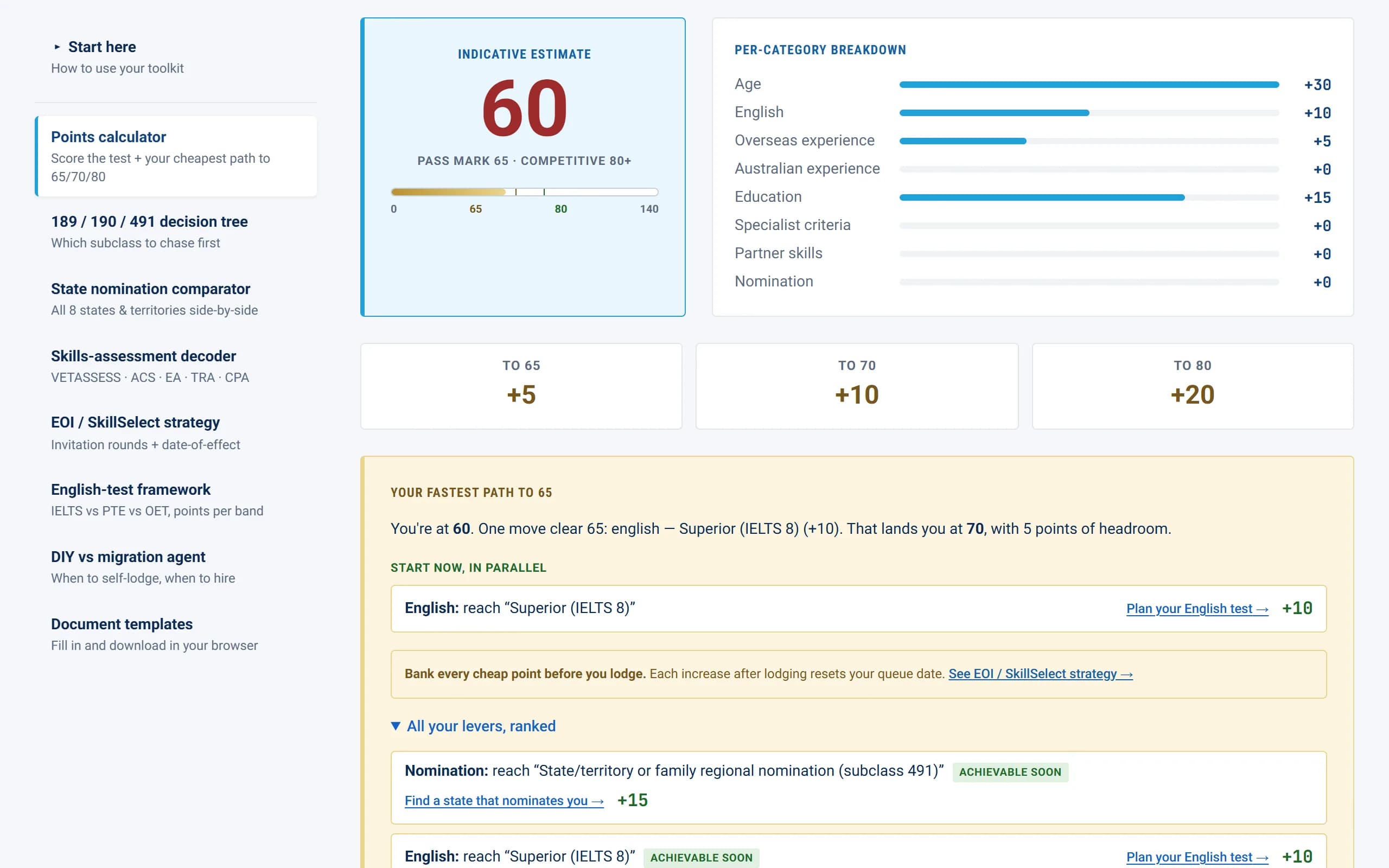
Recreation Officer is a points-tested occupation only through the 190 and 491 routes, since there is no 189 pathway. The standard SkillSelect factors still apply.
| Points Factor | Points | Notes |
|---|---|---|
| Age (25-32) | 30 | Maximum bracket |
| Qualification (Bachelor) | 15 | Minimum for Skill Level 1 |
| Qualification (Master's/PhD) | 15-20 | Higher degrees lift the score |
| English (Proficient — 7.0) | 10 | Realistic target |
| English (Superior — 8.0+) | 20 | Strong advantage |
| Skilled Employment (overseas) | 5-15 | Based on assessed years |
| State Nomination (190) | 5 | If nominated |
| Regional Nomination (491) | 15 | Largest single boost |
| Partner Skills | 5-10 | If partner has a skilled occupation |
Realistic Scenarios
Scenario 1: Regional candidate (Bachelor in recreation, 29 years old, Proficient English, 5 years experience). Age 30 + Bachelor 15 + English 10 + Experience 10 = 65 points, then 491 nomination adds 15 to reach 80. That is a workable score for a regional pathway.
Scenario 2: Onshore candidate (Master's, 34 years old, Superior English, working for a Victorian council). Age 25 + Master's 15 + English 20 + Experience 10 = 70 points, then 190 nomination adds 5 to reach 75. Local employment strengthens the nomination case.
State Nomination
State demand for Recreation Officer is genuine but uneven. Councils, community health services and aged care providers drive it. Because state occupation lists for community service roles are reviewed annually and vary between jurisdictions, you should verify 272612 against the current published list for your target state before lodging an expression of interest. The SkillSelect EOI guide explains how nomination interacts with your expression of interest. As a practical matter, regional pathways through 491 tend to offer the clearest route for this occupation, because regional councils are consistent employers.
Salary and Employment Outlook
| Role | Typical Salary Range |
|---|---|
| Recreation Officer (entry) | AUD $70,000-$78,000 |
| Recreation Officer (experienced) | AUD $80,000-$90,000 |
| Recreation Coordinator / Team Leader | AUD $90,000-$100,000+ |
Talent.com reports an Australian average of around AUD $81,000 per year, with experienced workers reaching about $97,000. SEEK's 2026 data places the typical range between $80,000 and $90,000. Salaries usually include compulsory superannuation at 11.5 per cent. Local government roles often add salary packaging benefits that are common across the not-for-profit and public sectors.
The strongest employers are metropolitan and regional councils, community health organisations, aged care and disability providers, and large not-for-profits. Sydney and Melbourne pay close to the national average, while regional roles can match metro pay once relocation and packaging benefits are counted.
Tips for a Successful Application
- Choose 272612 only if your duties genuinely match. If your work is athlete coaching or gym management, a sport-focused code may assess more cleanly. Compare your duties against the official task list before you spend on assessment.
- Get your employment references right. VETASSESS reads references for program development, community consultation and funding work, not for shift supervision. Ask referees to describe planning and coordination duties in detail.
- Target the regional pathway early. Regional councils are the most reliable employers, and 491 adds 15 points. If your points are tight, regional nomination usually closes the gap faster than waiting for a metro 190 invitation.
- Lift your English score where you can. Moving from Proficient to Superior adds 10 points, which often matters more than an extra year of experience for this occupation.
- Confirm the state list before lodging. Community service occupations move on and off state lists. A quick check against the current published list saves a wasted expression of interest.
Step-by-Step Migration Roadmap
- Confirm your duties match ANZSCO 272612
- Check 272612 on the Core Skills Occupation List
- Review which body assesses you on the skills assessment bodies list
- Gather your qualification documents and detailed employment references
- Sit an English test and aim for Proficient or Superior
- Lodge your VETASSESS skills assessment
- Submit an expression of interest in SkillSelect
- Apply for state or regional nomination (190 or 491), or secure an employer sponsor for 482
- Receive your invitation and lodge the visa within the deadline
- Complete health and character checks
- Receive the grant and relocate
Frequently Asked Questions
Can a Recreation Officer apply for the subclass 189 visa?
No. ANZSCO 272612 is on the Core Skills Occupation List but not the MLTSSL, so the points-only subclass 189 independent visa is closed to this occupation. The realistic permanent routes are the 190 and 491 nominated visas and the employer-sponsored 186. See the Skilled Occupation List 2026 for how the lists differ.
Which states nominate Recreation Officers in 2026?
State demand exists in local government, community health and aged care, but the lists are reviewed each year and differ between jurisdictions. There is no permanent national guarantee for this code, so check the current published occupation list for your target state before lodging. Regional pathways through 491 are often the most consistent.
How long does the VETASSESS assessment take for this occupation?
Standard processing runs about 7 weeks. Priority Processing returns an outcome in roughly 10 business days for an additional fee. Most delays come from incomplete employment references rather than the qualification check.
Is a sport science or fitness degree enough for a positive assessment?
Not always. VETASSESS looks for a qualification in recreation, leisure or community development with employment that shows program planning and community work. A pure fitness or personal training background often assesses better under a different occupation, so review the task list first.
What is the demand outlook for Recreation Officers in Australia?
Moderate and steady rather than critical. Growth in aged care, disability services and community wellbeing programs supports ongoing council and not-for-profit recruitment. For a wider view of where this sits, see the most in-demand occupations list.